Crypto Futures Liquidations Unleash $537 Million Storm as Bitcoin Shorts Dominate 90%
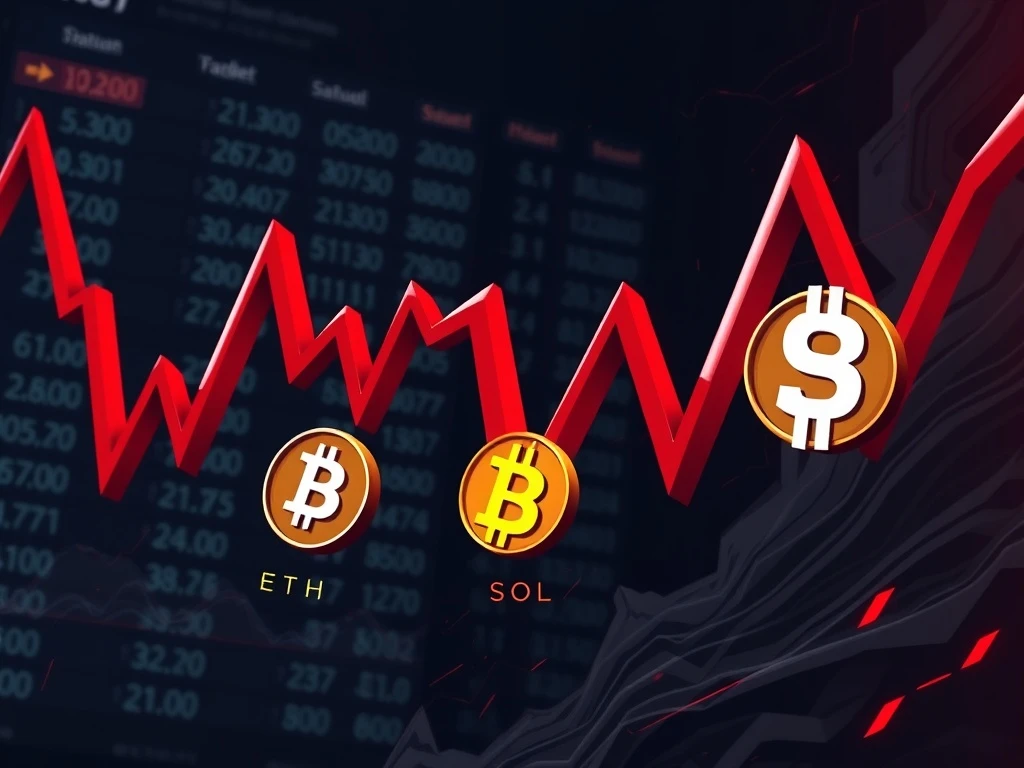
Global cryptocurrency markets witnessed a significant wave of forced position closures on March 21, 2025, with an estimated $537 million liquidated from major perpetual futures contracts within a volatile 24-hour period, highlighting the inherent risks of leveraged derivatives trading.
Analyzing the 24-Hour Crypto Futures Liquidations Data
The recent liquidation event provides a clear snapshot of market stress. Perpetual futures, which lack an expiry date and use funding rate mechanisms to track spot prices, saw substantial forced closures. Specifically, Bitcoin (BTC) futures experienced $377.14 million in liquidations, with a staggering 90.83% of these being short positions. Consequently, traders betting on price declines faced the most severe impact. Meanwhile, Ethereum (ETH) recorded $134.08 million in liquidations, with 68.87% being shorts. Furthermore, Solana (SOL) saw $26.47 million liquidated, where 73.31% were also short positions. This data, aggregated from major exchanges, underscores a market-wide squeeze primarily affecting bearish traders.
To contextualize this event, the following table compares the scale of liquidations across these three major assets:
| Asset | Total Liquidated (24h) | Short Position Ratio |
|---|---|---|
| Bitcoin (BTC) | $377.14 Million | 90.83% |
| Ethereum (ETH) | $134.08 Million | 68.87% |
| Solana (SOL) | $26.47 Million | 73.31% |
Liquidations occur automatically when a trader’s margin balance falls below the maintenance margin requirement. This mechanism protects exchanges from counterparty risk. However, it also creates cascading sell or buy orders that can exacerbate price movements. The high percentage of short liquidations suggests a rapid, unexpected price increase triggered a short squeeze. This event forced bears to cover their positions by buying back the asset, potentially fueling further upward momentum.
The Mechanics and Impact of Perpetual Futures Liquidations
Understanding perpetual futures is crucial for interpreting liquidation data. Unlike traditional futures, these contracts use a funding rate paid between long and short positions to peg the contract price to the underlying asset’s spot price. Traders employ significant leverage, often ranging from 5x to 100x, to amplify potential gains. This leverage also magnifies losses, making positions highly susceptible to market volatility. A relatively small price move against a highly leveraged position can quickly deplete the posted collateral, triggering the liquidation engine.
The impact of such events extends beyond individual traders. Large-scale liquidations can lead to increased market volatility and affect spot prices. For instance, the forced buying from short liquidations can create artificial upward pressure. Conversely, long liquidations can accelerate downward trends. Market analysts often monitor liquidation clusters as indicators of potential local tops or bottoms, as they may signify excessive leverage being flushed from the system. This recent event, with its clear skew toward short liquidations, indicates a powerful counter-trend move that caught a majority of leveraged traders off guard.
Historical Context and Market Structure Insights
Comparing this event to historical data provides deeper insight. For example, the cryptocurrency bear market of 2022 saw single-day liquidation volumes regularly exceeding $1 billion. The $537 million figure, while significant, represents a moderated scale within a maturing market structure. Regulatory developments in 2024, such as enhanced exchange reporting requirements and stricter leverage caps in some jurisdictions, have arguably reduced systemic risk. However, the persistence of high leverage on offshore platforms continues to facilitate these volatility events.
Evidence from on-chain analytics firms and exchange public data feeds confirms the liquidation volumes. The dominance of short liquidations aligns with price action data showing a sharp rally during the period. This pattern is consistent with a market recovering from oversold conditions, where pessimistic sentiment and crowded short positions become fuel for a rebound. The structure of the derivatives market, with its high leverage and automatic liquidation protocols, inherently creates these volatile feedback loops.
Risk Management and the Path Forward for Traders
For participants in the crypto derivatives market, this event serves as a critical case study in risk management. Key lessons include the danger of over-leveraging, especially during periods of apparent trend consensus. Traders can employ several strategies to mitigate liquidation risk:
- Using lower leverage to withstand greater price fluctuations.
- Setting stop-loss orders at strategic levels to manually exit before an automatic liquidation.
- Monitoring funding rates, as extremely negative or positive rates can signal crowded trades.
- Diversifying collateral and avoiding over-concentration in a single position.
Exchanges also play a role by providing robust risk tools, including isolated margin modes and explicit liquidation price calculators. The market’s evolution shows a gradual shift toward more sophisticated risk parameters, though events like this demonstrate that significant leverage-induced volatility remains a defining feature of crypto derivatives trading. The data underscores the importance of understanding the instruments being traded beyond mere price speculation.
Conclusion
The analysis of the 24-hour crypto futures liquidations, totaling over half a billion dollars, reveals a market moment defined by a forceful short squeeze. The extreme skew toward Bitcoin short liquidations highlights the perils of high leverage and crowded trades. These events are integral to the market’s price discovery process, flushing out excessive risk and realigning derivatives positions with spot market momentum. For observers and participants alike, monitoring liquidation data provides valuable, real-time insight into market leverage, sentiment extremes, and potential volatility triggers. As the cryptocurrency derivatives landscape continues to mature, understanding the mechanics and implications of these crypto futures liquidations remains essential for navigating its inherent risks and opportunities.
FAQs
Q1: What causes a liquidation in crypto futures trading?
A liquidation is triggered automatically when a trader’s position loses so much value that their remaining margin (collateral) can no longer cover the potential loss. This happens when the market price moves against the position to a specific point, known as the liquidation price.
Q2: Why were most of the recent liquidations short positions?
The high percentage of short liquidations (e.g., 90.83% for Bitcoin) indicates a rapid price increase occurred. Traders who had borrowed and sold assets, betting on a price drop (shorting), were forced to buy back the assets at higher prices to close their positions, creating a “short squeeze.”
Q3: What is the difference between a perpetual future and a regular future?
A regular futures contract has a fixed expiration date for settlement. A perpetual futures contract has no expiry. Instead, it uses a periodic “funding rate” payment between long and short traders to keep its price anchored to the spot price of the underlying asset.
Q4: Do large liquidations affect the spot price of Bitcoin and Ethereum?
Yes, they can. Large-scale liquidations generate forced market orders. For example, mass short liquidations require buying, which can push the spot price up. Conversely, mass long liquidations require selling, which can push the price down, creating a volatile feedback loop.
Q5: How can traders avoid being liquidated?
Traders can avoid liquidation by using lower leverage, which allows for a larger price move against their position before margin is exhausted. They can also deposit additional collateral (margin), use stop-loss orders to exit manually before liquidation, and carefully monitor market conditions and their liquidation price.