BTC Perpetual Futures Long/Short Ratios Reveal Balanced Market Sentiment Across Top Exchanges
Global cryptocurrency markets maintain equilibrium as March 2025 data reveals remarkably balanced BTC perpetual futures long/short ratios across the world’s three largest derivatives exchanges by open interest. The overall 24-hour figures show 49.9% long positions versus 50.1% short positions, indicating neutral market sentiment with minimal directional bias among sophisticated traders. This balanced positioning emerges during a period of relative price stability for Bitcoin, following several weeks of consolidation within a narrow trading range. Market analysts closely monitor these ratios as leading indicators of potential price movements, especially when significant divergences appear between retail and institutional positioning.
Understanding BTC Perpetual Futures Long/Short Ratios
Perpetual futures represent sophisticated financial instruments that enable traders to speculate on Bitcoin’s price direction without expiration dates. These contracts incorporate funding mechanisms that periodically transfer payments between long and short positions, maintaining contract prices near underlying spot prices. The long/short ratio specifically measures the percentage of open positions betting on price increases versus those anticipating declines. Consequently, this metric serves as a crucial sentiment gauge for professional cryptocurrency traders. Exchange platforms calculate these ratios using real-time position data from their derivatives markets, providing valuable insights into market psychology.
Historically, extreme readings in long/short ratios often precede significant market reversals. For instance, when long positions exceed 70%, markets frequently become overextended and vulnerable to corrections. Conversely, excessive short positioning below 30% sometimes signals capitulation before rallies. The current balanced ratios suggest neither excessive optimism nor pessimism dominates current market sentiment. This equilibrium typically indicates consolidation phases where traders await clearer directional signals from macroeconomic factors or Bitcoin-specific developments. Market participants particularly watch for divergences between exchange ratios, which can reveal institutional versus retail sentiment splits.
Exchange-Specific Analysis of BTC Positioning
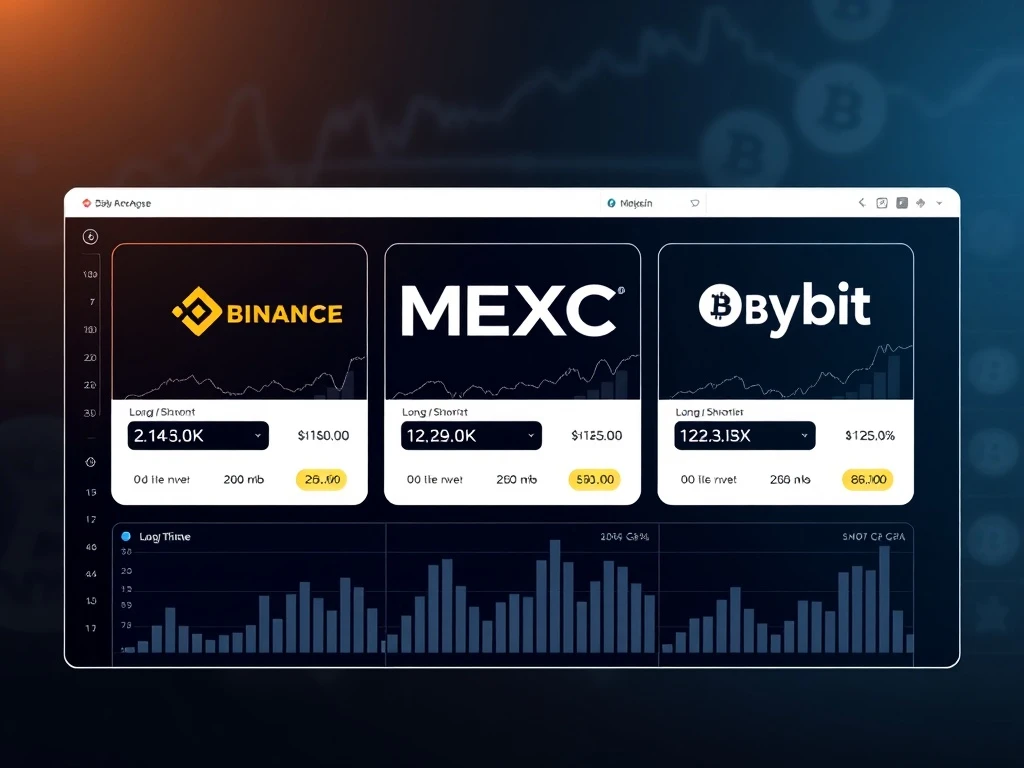
Detailed examination reveals subtle variations in trader positioning across major platforms. Binance, the world’s largest cryptocurrency exchange by volume, shows 51.2% long positions against 48.8% short positions. This slight bullish bias reflects the platform’s diverse user base, which includes both retail traders and institutional participants. Meanwhile, MEXC demonstrates near-perfect equilibrium with 50.07% long versus 49.93% short positions. This precision balance suggests sophisticated algorithmic trading dominates activity on this platform. Bybit maintains a moderate bullish tilt at 50.77% long positions compared to 49.23% short positions, consistent with its reputation as a preferred platform for experienced derivatives traders.
| Exchange | Long Positions | Short Positions | Net Bias |
|---|---|---|---|
| Overall | 49.9% | 50.1% | -0.2% (Neutral) |
| Binance | 51.2% | 48.8% | +2.4% (Slightly Bullish) |
| MEXC | 50.07% | 49.93% | +0.14% (Neutral) |
| Bybit | 50.77% | 49.23% | +1.54% (Slightly Bullish) |
These variations, while statistically small, provide meaningful insights into different trading communities. Binance’s slight bullishness potentially reflects broader retail optimism, while MEXC’s precision suggests high-frequency trading dominance. Bybit’s consistent positioning aligns with its user base of dedicated derivatives specialists. Importantly, all three exchanges show ratios within 2.5 percentage points of equilibrium, indicating remarkable consensus across global trading venues. This convergence suggests market participants share similar assessments of current risk-reward dynamics, despite operating on different platforms with varying fee structures and interface designs.
Historical Context and Market Implications
Current long/short ratios represent significant normalization compared to historical extremes observed during previous market cycles. During Bitcoin’s 2021 bull market peak, long ratios frequently exceeded 65% across major exchanges, signaling excessive optimism preceding substantial corrections. Conversely, the 2022 bear market bottom saw short ratios approach 60% before the subsequent recovery began. The present equilibrium suggests markets have matured considerably, with professional risk management tempering emotional trading decisions. This development aligns with broader cryptocurrency market evolution toward institutional participation and sophisticated trading strategies.
Several factors contribute to current balanced positioning. First, macroeconomic uncertainty surrounding interest rate policies creates hesitation among directional traders. Second, Bitcoin’s established trading range between $60,000 and $70,000 throughout early 2025 provides limited short-term directional conviction. Third, increasing options market activity allows sophisticated traders to express views through volatility strategies rather than directional futures positions. Fourth, regulatory developments in major jurisdictions prompt caution until clearer frameworks emerge. Finally, the approaching Bitcoin halving event in 2024 created anticipation that has gradually normalized as the event recedes into history.
Expert Analysis of Derivatives Market Dynamics
Derivatives specialists emphasize that balanced long/short ratios typically precede significant volatility expansions. When positioning becomes excessively one-sided, markets often move contrary to consensus expectations as crowded trades unwind. Conversely, equilibrium positioning suggests latent energy awaiting catalyst release. Market makers and liquidity providers particularly monitor funding rates alongside long/short ratios. Currently neutral funding rates across exchanges confirm balanced positioning rather than hidden imbalances. This synchronization between positioning data and funding mechanisms indicates healthy market functioning without manipulation concerns.
Institutional analysts note several technical factors supporting current equilibrium. Open interest levels remain stable without dramatic increases that might signal leverage buildup. Liquidations data shows minimal forced position closures, indicating sustainable leverage usage. Volume patterns demonstrate consistent participation without panic buying or selling episodes. These technical confirmations strengthen the reliability of long/short ratio signals. Furthermore, cross-exchange arbitrage opportunities remain minimal, suggesting efficient price discovery across venues. This efficiency reflects cryptocurrency market maturation since earlier periods of frequent dislocations between exchange prices.
Comparative Analysis with Traditional Markets
Bitcoin derivatives markets increasingly demonstrate correlations with traditional financial instruments, particularly during periods of macroeconomic significance. The current balanced positioning coincides with similar neutrality in S&P 500 futures positioning and Treasury bond market sentiment. This synchronization suggests cryptocurrency traders now incorporate similar macroeconomic variables as traditional asset managers. However, important distinctions remain. Bitcoin’s 24-hour trading cycle creates continuous position adjustments unavailable in traditional markets with limited hours. Additionally, cryptocurrency derivatives incorporate perpetual funding mechanisms without direct traditional equivalents.
Key differences between cryptocurrency and traditional derivatives include:
- Leverage availability: Crypto platforms typically offer higher maximum leverage than regulated traditional exchanges
- Market hours: Continuous 24/7 trading affects position management and risk calculations
- Regulatory frameworks: Varying global regulations create jurisdictional arbitrage opportunities
- Volatility profiles: Bitcoin maintains higher historical volatility than most traditional assets
- Correlation patterns: Evolving relationships with traditional markets during different economic regimes
These structural differences explain why cryptocurrency long/short ratios sometimes diverge from traditional market sentiment indicators. Currently, however, alignment prevails as both markets process similar macroeconomic information. This convergence suggests growing integration between cryptocurrency and traditional finance, particularly among institutional participants operating across both domains. Market observers monitor whether this correlation persists during future stress periods or whether cryptocurrencies reassert their historical independence during market dislocations.
Risk Management Considerations for Traders
Balanced long/short ratios present both opportunities and challenges for active market participants. Neutral positioning reduces immediate directional bias but increases importance of volatility strategies and timing precision. Experienced traders often implement specific approaches during equilibrium periods. First, range-bound strategies capitalize on predictable support and resistance levels. Second, volatility expansion preparations position for eventual breakout movements. Third, cross-exchange arbitrage exploits minimal pricing discrepancies. Fourth, options strategies generate income from time decay during consolidation. Fifth, careful leverage management prevents overexposure before clear trends emerge.
Several risk factors warrant particular attention during balanced market conditions. Liquidity sometimes decreases as participants await directional clarity, potentially exacerbating slippage during large orders. Funding rate stability may suddenly reverse if positioning becomes unbalanced. Unexpected news events can trigger disproportionate reactions from complacent markets. Cross-market correlations might break down, creating unhedged exposures. Regulatory announcements could disproportionately affect derivatives versus spot markets. Sophisticated traders therefore maintain flexible strategies adaptable to changing conditions rather than rigid directional bets based solely on long/short ratios.
Conclusion
Current BTC perpetual futures long/short ratios reveal remarkably balanced market sentiment across Binance, MEXC, and Bybit exchanges. The overall 49.9% long versus 50.1% short positioning indicates neutral expectations among derivatives traders during March 2025. Minor variations between exchanges reflect platform-specific user demographics and trading behaviors without altering the broader equilibrium conclusion. This balanced positioning follows Bitcoin’s extended consolidation period and coincides with similar neutrality in traditional financial markets. Market participants interpret these ratios as indicative of latent energy awaiting catalyst release rather than complacency. As cryptocurrency derivatives markets continue maturing, long/short ratios provide increasingly reliable sentiment indicators alongside other metrics like funding rates, open interest, and liquidation patterns. The current equilibrium suggests neither excessive optimism nor pessimism dominates professional trader positioning, potentially setting the stage for significant volatility expansion once clearer directional signals emerge from macroeconomic developments or Bitcoin-specific catalysts.
FAQs
Q1: What do BTC perpetual futures long/short ratios measure?
These ratios measure the percentage of open positions betting on Bitcoin price increases (long) versus decreases (short) in perpetual futures contracts, serving as key sentiment indicators for derivatives traders.
Q2: Why are Binance, MEXC, and Bybit specifically analyzed?
These three exchanges represent the world’s largest cryptocurrency futures platforms by open interest, providing comprehensive market coverage and reliable data from diverse trading communities.
Q3: How do current ratios compare to historical extremes?
Current near-50% ratios represent significant normalization compared to historical extremes above 65% long or 60% short observed during previous market cycle peaks and troughs.
Q4: What typically happens after extended periods of balanced positioning?
Equilibrium periods often precede volatility expansions and significant price movements once catalysts emerge, as balanced positioning indicates latent energy rather than market complacency.
Q5: How should traders use long/short ratio data in decision-making?
Sophisticated traders incorporate ratio data alongside funding rates, open interest, volume patterns, and technical analysis rather than relying solely on any single metric for directional decisions.