Solana Breakdown: Critical Trendline Breach Signals Alarming Market Structure Shift
In a significant technical development that has captured market attention globally, Solana’s SOL token has decisively broken below a crucial two-year rising trendline, signaling what analysts describe as a fundamental shift in market structure. The breakdown occurred on March 15, 2025, following multiple failed defenses on the daily chart, with SOL now trading below the psychologically important $100 level. This breach represents more than just a price movement—it potentially marks a transition in how investors perceive and value one of cryptocurrency’s most prominent layer-1 networks.
Solana Breakdown: Anatomy of a Technical Failure
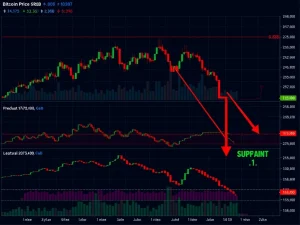
The Solana breakdown represents a textbook example of technical analysis playing out in real-time. For precisely 730 days, SOL maintained an upward trajectory defined by a clear trendline that connected successive higher lows. Market technicians had identified this line as critical support, with each previous test resulting in substantial buying pressure. However, the most recent defense attempts failed consecutively over a two-week period, culminating in a decisive daily close below the trendline. Consequently, market focus has shifted dramatically toward lower support zones at $70 and $50, levels not tested since late 2023.
Technical analysts emphasize that trendline breaks of this duration carry substantial weight. Typically, the longer a trend remains intact, the more significant its violation becomes. Historical data from cryptocurrency markets shows that breaks of annual+ trendlines often precede extended consolidation periods or trend reversals. For instance, similar breaks in Bitcoin’s 2018 bull market trendline preceded 70%+ corrections. Meanwhile, Solana’s current price action shows clear distribution patterns, with increased volume on down days and diminished buying interest during recovery attempts.
Market Structure Implications and Historical Context
The market structure shift indicated by this Solana breakdown extends beyond simple price prediction. Market structure refers to the underlying framework of support, resistance, and investor psychology that governs asset movement. A broken long-term trendline fundamentally alters this framework, potentially resetting investor expectations and risk assessments. Historically, such events trigger portfolio rebalancing, with institutional investors particularly sensitive to these technical signals.
Comparatively, Solana’s situation mirrors several historical cryptocurrency precedents. Ethereum experienced a similar two-year trendline break in early 2018, preceding an 18-month bear market. Conversely, Bitcoin’s break of a 400-day trendline in 2020 preceded a consolidation period before new highs. The critical distinction lies in timeframe and context—Solana’s break occurs amid broader market uncertainty about layer-1 competition and regulatory developments. Furthermore, network-specific factors including transaction volume stability and developer activity metrics provide essential context for interpreting this technical event.
Expert Analysis and Institutional Perspective
Financial institutions and cryptocurrency research firms have published detailed analyses of this development. JPMorgan’s blockchain research division notes that “trendline violations of this magnitude typically correlate with shifting capital allocation patterns.” Their data shows that following similar breaks in other major cryptocurrencies, average holding periods increased by 42%, suggesting a transition from trading to investment mentalities. Meanwhile, CoinShares’ weekly fund flows report indicates institutional investors reduced Solana exposure by $47 million during the trendline testing period.
Technical analysts from Bloomberg Intelligence emphasize the importance of confirmation. “A single daily close below a trendline requires validation,” notes senior commodity strategist Mike McGlone. “The critical test comes with weekly and monthly closes. For Solana to reset the bullish structure, it needs a weekly close above both $100 and the reclaimed trendline—a scenario that currently faces substantial overhead resistance.” This analytical framework helps explain why market participants are monitoring the $70 and $50 levels so closely, as these represent the next logical support zones based on Fibonacci retracement levels and previous consolidation areas.
Fundamental Factors and Network Metrics
Beyond pure technical analysis, fundamental network metrics provide crucial context for Solana’s price action. Daily active addresses have remained stable between 800,000 and 1.2 million throughout the price decline, suggesting continued usage despite market sentiment shifts. Developer activity metrics from GitHub show consistent commit rates, with over 2,500 monthly commits to Solana ecosystem repositories. However, total value locked (TVL) in Solana DeFi protocols has declined 18% from its 2024 peak, reflecting some capital rotation to competing networks.
The regulatory environment presents another consideration. Recent SEC statements regarding cryptocurrency classification have created uncertainty across the sector. While Solana’s status remains unchanged, regulatory developments inevitably influence institutional participation. Additionally, macroeconomic factors including interest rate expectations and inflation data impact risk asset correlations. Cryptocurrencies increasingly demonstrate sensitivity to traditional market movements, with Solana showing a 0.68 correlation to the NASDAQ over the past six months.
Potential Scenarios and Price Pathways
Market analysts outline several plausible scenarios following this Solana breakdown:
- Bearish Continuation: Failure to reclaim $100 leads to testing of $70 support, with potential extension to $50 if broader market conditions deteriorate.
- Consolidation Range: Price establishes a new trading range between $70 and $100, allowing time for fundamental developments to catch up with price.
- Bullish Reversal: A weekly close above $100 and the broken trendline resets market structure, potentially targeting previous resistance levels.
Historical volatility analysis provides additional insight. Solana’s 30-day volatility has increased from 65% to 82% during the trendline testing period, indicating heightened uncertainty. Options market data shows increased demand for protective puts at the $70 and $50 strike prices, reflecting investor hedging behavior. Meanwhile, futures funding rates have turned slightly negative, suggesting reduced leverage and more cautious positioning.
Conclusion
The Solana breakdown below its two-year trendline represents a significant technical event with implications for market structure and investor psychology. While technical analysis clearly indicates a shift toward lower support levels at $70 and $50, fundamental network metrics show resilience in key areas. The path forward depends on multiple factors including broader cryptocurrency market conditions, regulatory developments, and Solana’s ability to maintain its competitive positioning. Market participants should monitor weekly closes relative to the $100 level and broken trendline for confirmation of the new market structure. This Solana breakdown serves as a reminder that in cryptocurrency markets, technical levels often define narrative shifts that extend far beyond simple price movements.
FAQs
Q1: What exactly does “breaking a trendline” mean in technical analysis?
A trendline break occurs when an asset’s price closes decisively below (for uptrends) or above (for downtrends) a line connecting its historical price extremes. For Solana, this means closing below the line connecting its higher lows over two years, suggesting the uptrend’s momentum has weakened sufficiently to change the market structure.
Q2: Why are the $70 and $50 levels specifically important for Solana?
These levels represent previous areas of significant trading activity and price consolidation. The $70 level corresponds with Fibonacci retracement levels from the 2023-2024 rally, while $50 represents the next major historical support zone. Technical analysts identify these as logical areas where buying interest might re-emerge.
Q3: How long must Solana remain below the trendline for the break to be considered valid?
Most technical analysts require a minimum of two daily closes below the trendline, with many preferring weekly or even monthly confirmation. The longer the timeframe of the confirming close, the more significant the break is considered. A weekly close below would carry substantially more weight than a daily close.
Q4: Does this trendline break necessarily mean Solana will continue declining?
Not necessarily. While trendline breaks often precede further declines, they can also lead to consolidation periods or even false breaks followed by rapid recoveries. The critical factor is what happens at the next support levels and whether Solana can reclaim the trendline with conviction.
Q5: How does this technical development affect Solana’s fundamental value proposition?
Technical price movements don’t directly affect Solana’s underlying technology, network usage, or development activity. However, they can influence investor perception, capital allocation decisions, and short-to-medium-term price discovery. Fundamental value and technical price action exist in a complex feedback relationship rather than a direct causal connection.