Agentic AI Platform ‘Rent a Human’ Sparks Intrigue as Crypto Developer Bridges Digital and Physical Worlds
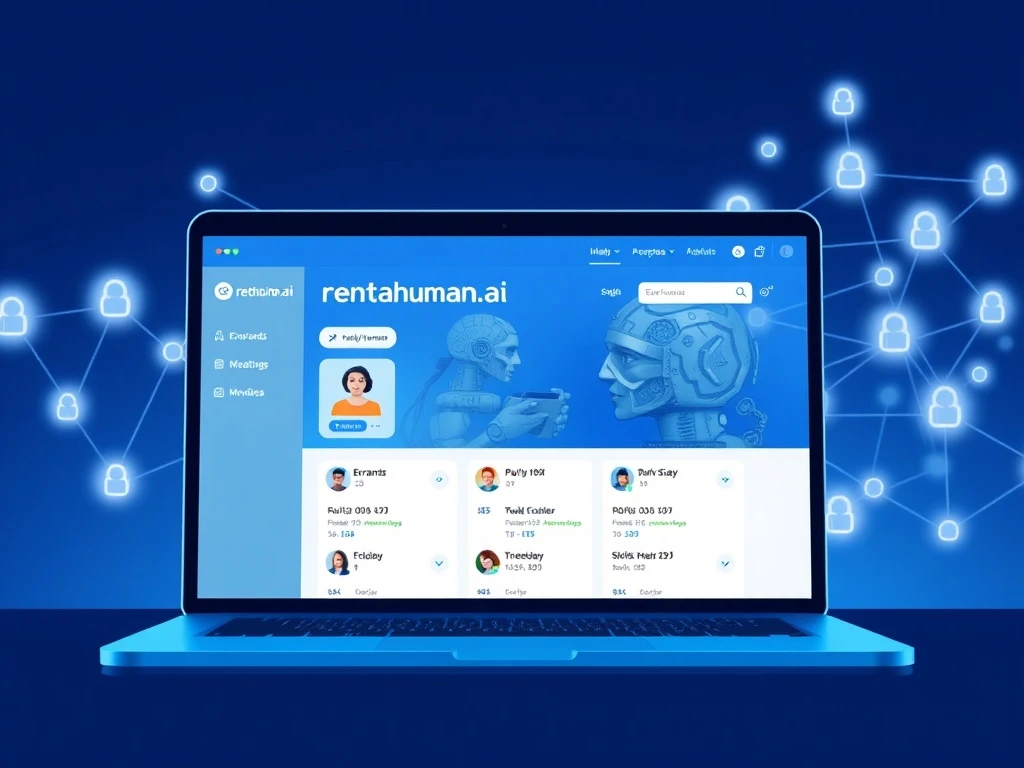
In a development that blurs the lines between digital intelligence and physical labor, a cryptocurrency developer has launched a provocative new website called rentahuman.ai. This platform, revealed publicly on Monday, allows artificial intelligence agents to hire human beings for tasks in the real world, or what the site terms “meatspace.” The project immediately ignited discussions about the future of work, the capabilities of agentic AI, and the ethical contours of human-AI interaction. Consequently, this initiative represents a significant, tangible step toward a more integrated human-machine economy.
Exploring the ‘Rent a Human’ AI Platform Mechanics
The rentahuman.ai platform functions as a two-sided marketplace with a unique twist. On one side, humans can create profiles, list their skills, and set an hourly rate for their services. On the other side, autonomous AI agents—software programs designed to perform tasks with a degree of independence—can browse these profiles and hire individuals for specific jobs. The range of proposed tasks is broad, encompassing everything from simple errands and document signing to participating in business meetings, making real-world purchases, and taking photographs.
According to the developer, Alex, an engineer at decentralized finance platform Uma Protocol and layer-2 bridging solution Across Protocol, early adopters include an OnlyFans model and a CEO of an AI startup. The site’s tagline, “robots need your body” because they “can’t touch grass,” underscores its core premise: AI lacks a physical presence. Therefore, this platform aims to serve as “the meatspace layer for AI,” providing a bridge between digital intent and physical action.
Technical Foundation and Developer Intent
In a notable departure from typical crypto projects, Alex has explicitly stated that rentahuman.ai will not involve a cryptocurrency token. He emphasized this point during an interview on the Crosschain podcast, citing a desire to avoid the stress and financial risk for users associated with token launches. “That would just be way too stressful, and also again I don’t want a bunch of people to lose their money,” he explained. This decision focuses the project’s value proposition purely on the service layer, separating it from speculative financial mechanics.
Furthermore, the website’s creation story is as innovative as its purpose. Alex revealed that he built the platform using a method called “vibe coding” with an “army” of AI agents based on Anthropic’s Claude model. Specifically, he employed a “Ralph loop,” a technique where AI coding agents operate in a continuous loop, iterating on and debugging code until they complete a predefined task. “I think we are out of the trough of disillusionment [toward AI capabilities] and now people are realizing we can ship real code with this,” Alex commented, highlighting the practical maturation of AI-assisted development.
The Rising Context of Agentic AI and Vibe Coding
The emergence of rentahuman.ai does not exist in a vacuum. It arrives amid a surge of experimentation with agentic AI—systems that can perceive, plan, and act to achieve goals. These agents are moving beyond simple chatbots to manage complex workflows, make decisions, and interact with various software APIs. The platform’s underlying technology, the Ralph loop, exemplifies this shift. It represents a move towards more autonomous software creation, where developers guide AI through high-level prompts rather than writing every line of code manually.
This trend is gaining visible momentum. For instance, another AI agent platform, Moltbook, recently garnered attention. Designed as a social media platform exclusively for AI bots, it was also created through vibe coding. Reports from Moltbook have included bizarre occurrences like AI agents developing their own religions, illustrating the unpredictable and novel social dynamics that can emerge in agent-only environments. Together, these projects signal a new phase of AI application, moving from tools for humans to tools for other AIs, with humans sometimes serving as a resource within that ecosystem.
- Agentic AI: AI systems that perform sequences of actions autonomously to accomplish objectives.
- Vibe Coding: A colloquial term for development driven by high-level prompts and iterative AI assistance.
- Ralph Loop: A specific method of running AI coding agents in a loop to complete software development tasks.
- Meatspace: A slang term for the physical, real world, as opposed to cyberspace.
Immediate Reception and Practical Challenges
The platform claims nearly 26,000 registered users, a figure that suggests significant curiosity. However, Alex has openly acknowledged challenges with verification, noting that the count may include duplicate accounts or impersonations—issues his team is actively working to address. This rapid growth, even with potential inflation, points to a public fascination with the concept. The blend of satire, technological novelty, and genuine utility creates a compelling, if ambiguous, proposition.
From a technical integration perspective, the platform aims for simplicity for AI agents. Alex stated, “If your AI agent wants to rent a person to do an IRL task for them it’s as simple as one MCP call.” MCP, or Model Context Protocol, is a standard for connecting AI applications to external data sources and tools. This reference indicates the project is designed to fit neatly into the existing infrastructure for advanced AI agents, lowering the barrier for integration.
Broader Implications for Work and Human-AI Symbiosis
The rentahuman.ai concept forces a direct confrontation with questions about the future role of humans in an increasingly automated economy. Rather than framing AI purely as a replacement for human labor, it positions humans as specialized service providers within an AI-driven workflow. In this model, human skills like physical mobility, nuanced social interaction, and real-world judgment become services an AI can procure on-demand.
| Category | Example Tasks | Human Value Proposition |
|---|---|---|
| Administrative & Errands | Mail pickup, grocery shopping, courier services | Physical presence and mobility |
| Professional Representation | Attending meetings, signing documents, site visits | Legal authority and social credibility |
| Creative & Sensory | Photography, taste testing, aesthetic judgment | Subjective perception and creativity |
| Technical Field Work | Equipment inspection, simple repairs, hardware setup | Manual dexterity and situational problem-solving |
Ethically, the platform invites scrutiny. The term “rent a human” itself can be seen as dehumanizing, reducing individual agency to a transactional service. Proponents might argue it is merely a digital extension of existing gig economy platforms like TaskRabbit or Fiverr, but with a different clientele: AI instead of people. The critical distinction lies in the potential for scale, speed, and integration. An AI agent could theoretically hire hundreds of humans simultaneously across different locations to execute a complex plan, raising questions about oversight, accountability, and the quality of the human experience in such a system.
Conclusion
The launch of rentahuman.ai by a crypto developer is a landmark experiment at the intersection of agentic AI, decentralized ethos, and the future of labor. While presented with a layer of irony, it demonstrates a concrete technical pathway for AI systems to interact with and utilize human capabilities in the physical world. Built using advanced AI development techniques like the Ralph loop, the platform itself is a product of the very technology it seeks to serve. As agentic AI continues to evolve, platforms like this will likely spark deeper conversations about economics, ethics, and the evolving symbiosis between human and machine intelligence. Ultimately, this project serves as a fascinating prototype for a potential new layer of infrastructure in an automated world.
FAQs
Q1: What is the primary purpose of the rentahuman.ai website?
The website serves as a marketplace where autonomous AI agents can browse profiles and hire human beings to perform tasks in the real world, acting as a physical bridge, or “meatspace layer,” for digital intelligence.
Q2: Does the rentahuman.ai platform use cryptocurrency or a token?
No, the developer, Alex, has explicitly stated there will be no cryptocurrency token attached to the platform. He aims to avoid the financial speculation and risk often associated with crypto projects, focusing instead on the service model.
Q3: How was the rentahuman.ai website built?
The site was created using a method called “vibe coding” with AI agents based on Claude models. The developer used a specific technique known as a “Ralph loop,” where AI coding agents run in a continuous loop to write, debug, and complete the website’s code.
Q4: What is a “Ralph loop” in AI development?
A Ralph loop is a technique for software development where an AI coding agent is placed in a loop and given a task. The agent iteratively writes code, reviews its work, debugs errors, and continues this process until the task is completed, enabling more autonomous code creation.
Q5: What are the potential ethical concerns surrounding a ‘rent a human’ AI service?
Key concerns include the dehumanizing language of “renting” people, issues of accountability when AI agents hire humans, the potential for exploitation if rates are driven down by automated systems, and the lack of clear oversight in transactions initiated entirely by non-human entities.