Ethereum Liquidation Price: The Critical $1,830 Threshold for Trend Research’s $1.43B Stash
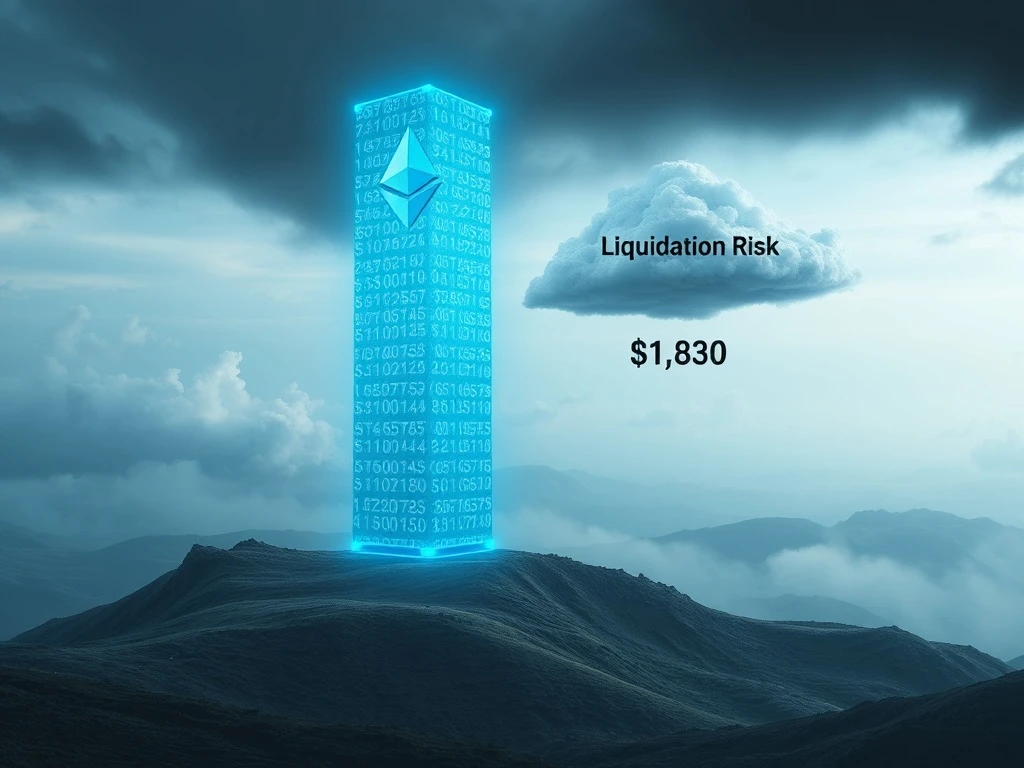
In a revealing disclosure that underscores the intricate risks within institutional crypto investing, Trend Research, a subsidiary of the prominent LD Capital, now manages a massive Ethereum position with a perilously close liquidation price. According to a detailed report from analytics firm AmberCN, the firm’s substantial holding of approximately 618,000 ETH, valued at $1.43 billion, could face automatic sell-offs if the market price approaches $1,830. This critical threshold emerges from a complex strategy involving significant borrowing against the digital asset. Consequently, this situation provides a stark case study in decentralized finance (DeFi) leverage and risk management for the broader market.
Decoding Trend Research’s Ethereum Liquidation Price and Strategy
Trend Research initiated its aggressive accumulation of Ethereum in November of last year, a period marked by cautious optimism following the bear market lows. The firm established an average purchase price of $3,180 per ETH, committing substantial capital to its bullish thesis on the leading smart contract platform. However, to amplify its position and potentially fund other ventures, Trend Research engaged in collateralized borrowing. Specifically, the firm deposited its purchased ETH into crypto lending protocols like Aave to secure loans. This common DeFi practice, known as “leveraging up,” allows investors to gain greater exposure without additional upfront capital. Nevertheless, it introduces the non-negotiable mechanism of liquidation.
A liquidation price represents the market level at which the value of the collateral (ETH) falls too close to the value of the loan it secures. When this happens, the lending protocol automatically sells the collateral to repay the loan, protecting the protocol’s solvency. For Trend Research, AmberCN’s analysis pinpoints this automatic trigger at approximately $1,830. At this price, the firm’s $941 million in outstanding loans from protocols would threaten to exceed the safe collateral ratio, prompting an enforced sale. This potential event could unleash hundreds of thousands of ETH onto the market, creating significant selling pressure.
The Mechanics of DeFi Leverage and Risk
The architecture of DeFi lending is built on transparent, code-governed rules. Users deposit crypto assets into a liquidity pool to earn interest or, more pertinently, to use them as collateral for borrowing other assets. Protocols maintain strict loan-to-value (LTV) ratios. If market volatility erodes the collateral value and the LTV ratio exceeds a maximum threshold, the position becomes eligible for liquidation. Third-party “liquidators” are incentivized to repay a portion of the debt in exchange for the collateral at a discount, a process that happens in seconds. Therefore, Trend Research’s reported liquidation price is not a subjective estimate but a mathematical outcome of their borrowed amount, collateral amount, and the specific protocol’s parameters.
Recent Moves: Realized Losses and Strategic Repayments
Facing market pressures, Trend Research recently executed a strategic maneuver to bolster its financial standing. The firm sold 33,589 ETH, worth approximately $79.12 million at the time of transaction. This move served a dual purpose: generating capital to repay a portion of its loans and, more importantly, actively lowering its overall liquidation threshold. By reducing the debt burden, the distance between the current Ethereum price and the liquidation price increases, providing a larger safety buffer against market downturns. This is a standard defensive action in leveraged finance, yet it came at a significant cost.
The sale resulted in a realized loss of $27.71 million, a clear indicator that the ETH was sold below its average acquisition cost. Furthermore, the firm continues to carry substantial unrealized losses totaling $534 million, reflecting the difference between the current market price and their $3,180 average cost basis. These figures highlight the severe financial pressure even large, sophisticated firms can face during prolonged market corrections. The decision to realize a loss demonstrates a prioritization of survival and risk mitigation over holding for a potential future recovery.
- Collateralized Debt Position (CDP): The core financial structure where ETH is locked to borrow other assets.
- Liquidation Margin: The buffer zone between the market price and the liquidation price.
- Health Factor: A numerical metric in protocols like Aave that determines liquidation proximity.
Market Context and Systemic Implications
The situation with Trend Research does not exist in a vacuum. It reflects broader conditions in the cryptocurrency lending and institutional investment landscape. Following the collapses of centralized lenders like Celsius and Voyager in 2022, the industry witnessed a mass migration of institutional activity towards transparent, on-chain DeFi protocols. While these protocols offer transparency and eliminate counterparty risk with a central entity, they do not eliminate market risk or the harsh mechanics of liquidation. A single large position, like Trend Research’s, becoming vulnerable can have ripple effects.
Market analysts often monitor large liquidation clusters—price levels where many leveraged positions face risk. A cascade of liquidations can create a self-reinforcing downward spiral: forced selling drives the price lower, triggering more liquidations. The reported $1,830 level for a $1.43 billion position therefore becomes a notable technical and psychological level for the entire Ethereum market. Other traders and algorithms will watch this zone closely, as a breach could accelerate selling activity. This interplay between individual firm strategy and overall market dynamics is a hallmark of modern digital asset markets.
Historical Precedents and Risk Management Lessons
History offers clear lessons on the dangers of excessive leverage in crypto. The May 2021 market crash saw over $8 billion in liquidations within 24 hours, dramatically amplifying the price drop. Similarly, the failure of the Terra ecosystem in May 2022 triggered a liquidation cascade that erased hundreds of billions in market value. These events forced a industry-wide reevaluation of risk management. Sophisticated firms now employ more hedging strategies, use multiple protocols to diversify liquidation risks, and maintain higher collateral ratios. Trend Research’s recent loan repayment activity suggests it is applying these hard-learned lessons, actively de-risking its book to avoid becoming a catalyst for broader instability.
Conclusion
The analysis of Trend Research’s Ethereum liquidation price at $1,830 reveals the high-stakes reality of institutional cryptocurrency investing. The firm’s strategy of leveraging a $1.43 billion ETH holding through DeFi protocols exemplifies both the opportunities and existential risks present in this asset class. Its recent defensive sales, despite realizing millions in losses, underscore a primary focus on survival and risk mitigation. For the wider market, this single position highlights how the financial engineering of one entity can create a significant technical level that influences overall price action. As the cryptocurrency market continues to mature, the management of leverage and liquidation risk remains a paramount concern for all participants, from large funds to individual investors.
FAQs
Q1: What is a liquidation price in cryptocurrency trading?
A1: A liquidation price is the specific market price at which a leveraged position (where assets are borrowed against collateral) is automatically closed or sold by the lending protocol. This occurs to ensure the loan is repaid before the collateral’s value falls below the debt value.
Q2: Why did Trend Research sell ETH at a loss?
A2: Trend Research sold a portion of its ETH holdings to generate cash to repay its loans. This action directly lowers its debt ratio, increases the buffer between the current ETH price and its liquidation price, and reduces the immediate risk of an enforced, larger-scale liquidation.
Q3: What is the difference between a realized loss and an unrealized loss?
A3: A realized loss is a concrete financial loss that occurs when an asset is sold for less than its purchase price. An unrealized loss is a paper loss that exists on paper when an asset’s current market price is below its purchase price, but the asset has not yet been sold.
Q4: How does a large liquidation like this affect the overall Ethereum market?
A4: A large, forced liquidation can create substantial selling pressure, potentially driving the market price down rapidly. This can trigger a cascade if other leveraged positions hit their liquidation prices at similar levels, leading to a self-reinforcing downward spiral.
Q5: What are crypto lending protocols like Aave?
A5: Crypto lending protocols are decentralized finance (DeFi) applications that allow users to lend and borrow cryptocurrencies without a traditional bank. They use smart contracts to automate the process, set interest rates algorithmically, and manage collateral and liquidations transparently on the blockchain.