SEC Crypto ETF Pause Sparks Market Turmoil as Government Shutdown Cripples Regulatory Progress
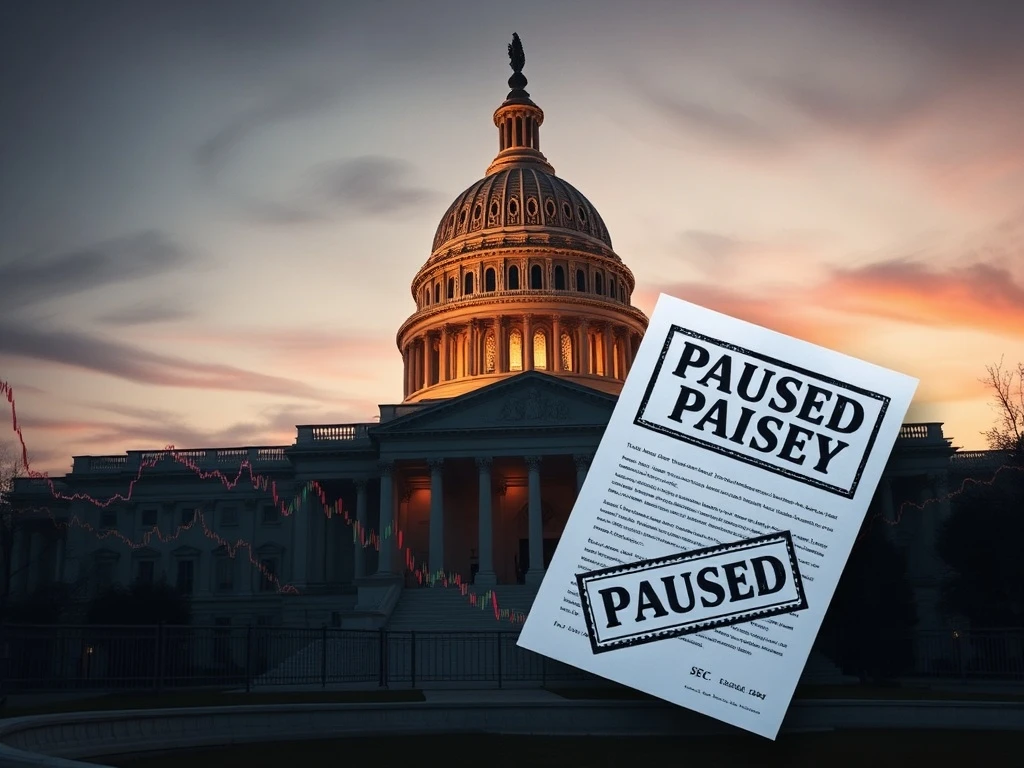
WASHINGTON, D.C. — February 1, 2026: The U.S. Securities and Exchange Commission has effectively halted all non-essential cryptocurrency regulatory activities, including critical ETF approvals, as a federal government shutdown forces the agency into emergency operations. This regulatory paralysis arrives at a pivotal moment for digital asset markets, immediately impacting prices and stalling months of anticipated regulatory clarity that industry participants desperately sought.
SEC Crypto ETF Pause: Understanding the Shutdown Protocol
The SEC initiated its contingency plan on January 31, 2026, following Congress’s failure to pass a federal budget. Consequently, the agency now operates with minimal staff under legally mandated shutdown procedures. While the EDGAR filing system remains technically functional, allowing companies to submit documents, virtually no personnel exist to review, process, or approve those submissions.
Only a skeleton crew remains active, authorized to address genuine emergencies that threaten immediate market integrity or investor protection. Routine regulatory work, including the review of spot Bitcoin ETF applications, registration statements for new crypto products, and interpretive guidance, has ceased entirely. This operational freeze follows established precedent from previous government shutdowns but arrives amid unprecedented cryptocurrency market maturation.
The Mechanics of Regulatory Paralysis
During shutdowns, the SEC categorizes activities as either “excepted” or “non-excepted.” Excepted activities continue because they protect life and property. Non-excepted activities stop. The approval of new financial products, including cryptocurrency ETFs, falls squarely into the non-excepted category. This procedural reality creates a backlog that will only clear once Congress restores funding and full staff return.
Immediate Market Consequences and Price Volatility
The regulatory pause coincides with significant cryptocurrency market declines. The total digital asset market capitalization dropped over 6% to approximately $2.64 trillion in the days surrounding the shutdown announcement. Bitcoin (BTC) declined to around $78,000, while Ethereum (ETH) fell toward $2,400. Market analysts directly attribute part of this sell-off to the sudden injection of regulatory uncertainty.
Investors anticipated several key decisions in early 2026, particularly regarding Ethereum-based ETF products and updated rules for cryptocurrency custody. The shutdown delays these timelines indefinitely, creating a holding pattern that exacerbates negative sentiment. Furthermore, the ETF market itself shows strain, with data indicating outflows from existing products as confidence wanes.
| Asset | Price | 7-Day Change | Market Context |
|---|---|---|---|
| Bitcoin (BTC) | ~$78,000 | -8.2% | Testing key support level |
| Ethereum (ETH) | ~$2,400 | -9.5% | Awaiting ETF clarity |
| Total Crypto Market Cap | ~$2.64T | -6.3% | Broad-based decline |
Broader Regulatory Momentum Grinds to a Halt
Beyond ETF approvals, the shutdown stalls wider inter-agency collaboration. Senior officials from the SEC and the Commodity Futures Trading Commission (CFTC) recently met to formalize a cooperative framework aimed at ending jurisdictional disputes. Their stated goals included:
- Creating clearer regulatory boundaries
- Reducing compliance duplication for crypto firms
- Providing consistent guidance to the market
These plans, representing significant progress after years of industry complaints, are now suspended. The timing is particularly damaging because many in Congress viewed 2026 as a potential breakthrough year for comprehensive digital asset legislation. The shutdown environment severely hampers the bipartisan negotiations necessary for such legislative progress.
Historical Context and Precedent
This is not the SEC’s first shutdown operation. The agency followed similar protocols during budget impasses in 2013, 2018, and 2019. Each event caused delays in corporate filings, IPO processing, and enforcement actions. However, the current situation carries greater weight for the cryptocurrency sector, which exists in a more defined yet unsettled regulatory space compared to traditional finance during prior shutdowns.
Operational Realities for Crypto Firms and Investors
For cryptocurrency companies awaiting SEC action, the shutdown creates immediate operational challenges. Firms with pending registration statements or exemptive applications cannot receive feedback or approval. Those engaged in ongoing discussions with SEC staff about novel products face radio silence. This limbo forces businesses to pause launch plans and reconsider funding timelines.
Investors, meanwhile, confront renewed uncertainty. The promised regulatory clarity that many viewed as a prerequisite for further institutional investment is postponed. This delay could temporarily suppress capital inflows into the digital asset ecosystem. Market participants must now monitor political developments in Washington as closely as blockchain analytics.
Path Forward and Resolution Timeline
The duration of the regulatory pause depends entirely on political resolution. Once Congress passes a funding bill and the President signs it, the SEC will recall furloughed employees. However, a return to normal operations is not instantaneous. The agency will need to triage its backlog, potentially pushing cryptocurrency matters behind more time-sensitive traditional finance filings.
Industry advocates have long argued that cryptocurrency regulation requires dedicated, consistent attention rather than fits and starts. This shutdown exemplifies the systemic risk that political dysfunction poses to emerging financial technologies seeking legitimacy within the U.S. framework.
Conclusion
The SEC crypto ETF pause, triggered by the federal government shutdown, demonstrates the fragile intersection of digital asset innovation and traditional governmental processes. This regulatory stall halts critical decision-making, injects volatility into markets, and delays the legal clarity essential for the industry’s next growth phase. The episode underscores how political gridlock in Washington can directly and swiftly impact technological and financial developments, leaving both builders and investors in a state of suspended animation awaiting political resolution.
FAQs
Q1: What exactly has the SEC paused during the government shutdown?
The SEC has paused all non-essential activities, including the review and approval of new cryptocurrency ETF applications, the processing of registration statements for crypto firms, and the issuance of new interpretive guidance or rules for digital assets.
Q2: Can companies still file documents with the SEC during the shutdown?
Yes, the EDGAR electronic filing system remains operational, so companies can submit documents. However, with most staff furloughed, no one will review or act upon those filings until after the shutdown ends.
Q3: How does this shutdown affect existing, already-approved cryptocurrency ETFs?
Existing ETFs continue to trade on secondary markets like any other security. The shutdown primarily affects the approval pipeline for new products. However, market sentiment toward existing products may suffer due to broader regulatory uncertainty.
Q4: What constitutes an “emergency” that would trigger SEC action during the shutdown?
The SEC’s skeleton crew can only act if there is an immediate threat to market integrity or investor protection, such as a major fraud unfolding in real-time or a critical market infrastructure failure. Routine regulatory matters do not qualify.
Q5: What happens to the regulatory timeline once the government reopens?
All delayed matters will enter a backlog. The SEC will need to prioritize its workload, potentially causing further delays. Matters deemed less urgent, which could include some cryptocurrency applications, might wait longer for resolution as the agency addresses more time-sensitive traditional finance filings first.