BlockDAG Presale Finale: Analyzing Chainlink’s 2026 Ambitions and MYX’s Volatility in a Critical Market Moment
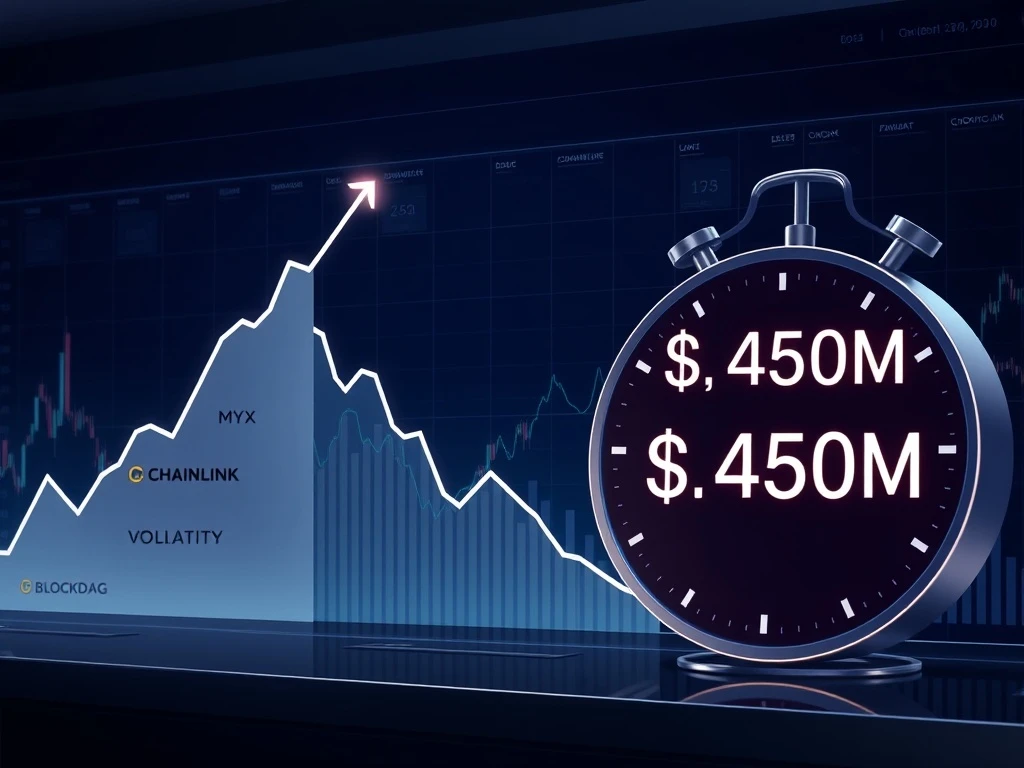
Global cryptocurrency markets are witnessing a pivotal convergence of events this week, as analysts scrutinize Chainlink’s long-term roadmap, assess the factors behind MYX Finance’s sharp correction, and monitor the final hours of BlockDAG Network’s record-breaking $450 million presale, currently priced at $0.0005 per BDAG token. This trifecta of developments offers a microcosm of the broader blockchain sector’s dynamics, encompassing long-term infrastructure bets, short-term DeFi volatility, and the intense capital formation driving layer-1 innovation. Market participants from Singapore to San Francisco are weighing these narratives against macroeconomic indicators and evolving regulatory frameworks.
BlockDAG’s Monumental $450M Presale Nears Its Climax
The cryptocurrency fundraising landscape is poised for a significant milestone as the BlockDAG Network presale enters its final phase. According to official project communications and blockchain analytics platforms, the presale has successfully secured approximately $450 million in committed capital. This event will conclude with the final batch of BDAG tokens selling at a price of $0.0005 each. Consequently, the project’s community growth and development treasury now ranks among the largest ever accumulated in a crypto presale event.
BlockDAG promotes itself as a novel, high-throughput layer-1 blockchain utilizing a directed acyclic graph (DAG) structure integrated with a proof-of-work (PoW) consensus mechanism. This architectural choice, the team claims, aims to solve the classic blockchain trilemma of achieving scalability, security, and decentralization simultaneously. The substantial capital raise underscores intense investor interest in alternative base-layer protocols, especially those promising compatibility with the Ethereum Virtual Machine (EVM).
- Presale Status: Final batch (Batch 45) is active, ending imminently.
- Final Batch Price: $0.0005 per BDAG token.
- Total Raised: ~$450 million, as per project announcements.
- Core Proposition: A hybrid DAG and PoW structure for scalable smart contracts.
Industry observers note that the success of such presales places immense execution pressure on development teams. The allocated funds are earmarked for ecosystem grants, liquidity provisioning, and further protocol development, with the mainnet launch representing the next critical test for investor confidence.
Chainlink’s Strategic Path Toward 2026 Price Objectives
Simultaneously, market analysts are conducting deep dives into Chainlink’s (LINK) potential trajectory leading into 2026. As the leading decentralized oracle network, Chainlink’s value is intrinsically tied to the adoption of its services across decentralized finance (DeFi), traditional finance (TradFi), and other smart contract ecosystems. Price goals discussed in analyst circles are not mere speculation but are based on fundamental metrics like network usage, partnership announcements, and total value secured (TVS).
Chainlink’s recent technological expansions provide concrete context for these projections. The network has moved beyond simple price feeds to offer a full-stack platform of services, including Cross-Chain Interoperability Protocol (CCIP), Verifiable Random Function (VRF) for gaming and NFTs, and Automation for smart contract execution. Each new service adoption represents a potential revenue stream and utility driver for the LINK token. Major financial institutions exploring tokenization projects have repeatedly named Chainlink as a critical infrastructure provider, lending credence to its long-term utility thesis.
Expert Analysis on Oracle Network Valuation
Financial modeling from several independent research firms incorporates a discounted cash flow (DCF) analysis based on projected fee generation from oracle services. These models factor in the growth rate of the overall smart contract economy, Chainlink’s market share among oracle providers, and the token’s staking mechanics, which introduce a deflationary yield component. While specific price targets vary, the consensus highlights that LINK’s valuation by 2026 will be less dependent on general crypto market sentiment and more directly correlated with measurable, on-chain economic activity. The successful implementation and adoption of its staking mechanism, which ties network security to token ownership, is frequently cited as a key variable in these assessments.
Deciphering MYX Finance’s Recent Market Correction
In contrast to the long-term narratives surrounding Chainlink and BlockDAG, the MYX Finance (MYX) token has experienced a notable price decline in recent trading sessions. MYX is the native token of a decentralized perpetual exchange operating on a novel mechanism called Matching Pool Liquidity (MPL). This downturn presents a case study in the volatility inherent to newer DeFi protocols and the factors that can trigger rapid repricing.
Several plausible, evidence-based explanations for the drop are circulating among traders and analysts. First, a broader market correction often disproportionately affects higher-beta, newer assets like MYX. Second, specific on-chain data may reveal profit-taking by early presale participants or liquidity providers after a period of appreciation. Third, changes in trading volume on the MYX protocol itself or competitive pressures from other perpetual DEXs could influence token demand. It is crucial to distinguish this from fundamental failure; many successful protocols undergo significant volatility during their early growth phases as the market seeks a sustainable valuation.
| Asset | Current Narrative | Key Driver | Time Horizon |
|---|---|---|---|
| BlockDAG (BDAG) | Presale culmination | Capital formation & mainnet anticipation | Imminent (Hours) |
| Chainlink (LINK) | 2026 price analysis | Adoption of CCIP, Automation, VRF | Long-term (2+ years) |
| MYX Finance (MYX) | Recent price correction | DeFi volatility, profit-taking, sector rotation | Short-term (Days/Weeks) |
This table illustrates the distinct temporal and thematic drivers affecting each project. Investors typically categorize assets based on such profiles, aligning them with specific portfolio strategies ranging from high-risk, high-reward speculation to steady, infrastructure-based accumulation.
The Interconnected Nature of Modern Crypto Markets
The simultaneous occurrence of these three events is not coincidental but reflective of a maturing, yet complex, digital asset ecosystem. Capital flows are highly dynamic. For instance, some analysts hypothesize that profits realized from earlier investments in established projects like Chainlink may have been recycled into high-profile presales like BlockDAG, seeking asymmetric returns. Conversely, volatility in tokens like MYX can lead to capital flight toward perceived safer harbors or more liquid, large-cap assets.
Furthermore, all these projects exist within a broader macroeconomic context defined by interest rate expectations, regulatory developments from bodies like the U.S. Securities and Exchange Commission (SEC) and the European Markets in Crypto-Assets (MiCA) authority, and institutional adoption trends. A major announcement from a TradFi institution using Chainlink’s CCIP, for example, could positively influence sentiment across the entire oracle and interoperability sector, demonstrating the interconnectedness of market narratives.
Conclusion
The current cryptocurrency market landscape is defined by the climactic end of the BlockDAG presale, the forward-looking analysis of Chainlink’s fundamental growth path to 2026, and the real-time volatility exhibited by the MYX token. Each story represents a different facet of the industry: monumental fundraising for novel base layers, the steady expansion of critical financial infrastructure, and the inherent price discovery turbulence in nascent DeFi sectors. For market participants, these developments underscore the importance of differentiated analysis, separating long-term utility value from short-term trading momentum and speculative capital cycles. The coming weeks will be critical, as the closure of the BlockDAG presale transitions the project into its delivery phase, while Chainlink and MYX continue to execute their respective roadmaps under the watchful eyes of investors and analysts alike.
FAQs
Q1: What is the current status of the BlockDAG presale?
The BlockDAG presale is in its final batch (Batch 45), selling BDAG tokens at $0.0005 each. Project announcements indicate it has raised approximately $450 million and will conclude within hours.
Q2: What are analysts basing Chainlink’s 2026 price goals on?
Analysts are using fundamental metrics, not speculation. These include the adoption rate of new services like CCIP and Automation, Total Value Secured (TVS) by the oracle network, partnership growth with financial institutions, and projected fee generation from its expanding suite of products.
Q3: What caused the recent price drop for MYX Finance?
While no single official cause is confirmed, common factors analyzed include general market corrections affecting riskier assets, profit-taking by early participants, changes in protocol trading volume, and normal volatility during a new DeFi project’s early price discovery phase.
Q4: How does BlockDAG’s technology differ from a traditional blockchain?
BlockDAG proposes a hybrid architecture combining a Directed Acyclic Graph (DAG) for structuring transactions with a Proof-of-Work (PoW) consensus mechanism. The DAG aims to allow for higher transaction throughput compared to a linear blockchain, while PoW provides security.
Q5: Are the funds from the BlockDAG presale secure?
Presale funds are typically held in multi-signature wallets or via vesting contracts, with allocations publicly outlined for development, marketing, liquidity, and ecosystem grants. Security depends on the project team’s adherence to these stated plans and robust treasury management practices post-launch.
Q6: Is MYX Finance’s drop a sign of protocol failure?
Not necessarily. Many successful crypto assets experience severe corrections. The key differentiator is whether the drop correlates with a decline in core protocol metrics (like active users or trading volume) or is part of broader market sentiment and profit-taking cycles.