Scallop CEO Kris Lai Reveals Ambitious DeFi Vision in Exclusive Korea Economic Broadcasting Interview
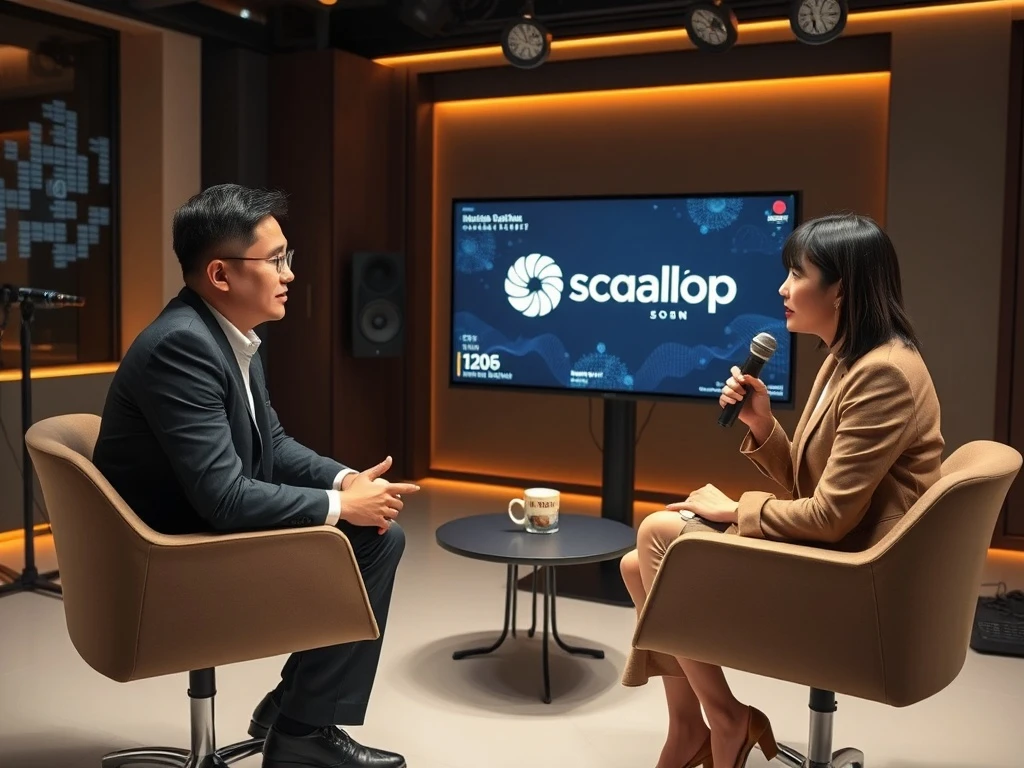
SEOUL, SOUTH KOREA – January 28, 2025 – Kris Lai, the founder and CEO of the Sui-based decentralized finance (DeFi) protocol Scallop, engaged in a significant media appearance today. The Korea Economic Broadcasting (KEB) conducted an exclusive interview with Lai, marking a pivotal moment for Asian blockchain media coverage. Consequently, this discussion provides critical insights into Scallop’s operational framework and strategic trajectory. Moreover, the interview highlights the growing intersection between traditional economic broadcasting and the innovative DeFi sector.
Scallop CEO Kris Lai Details Protocol Evolution on Sui
During the Korea Economic Broadcasting interview, Kris Lai meticulously outlined Scallop’s developmental journey. Specifically, he described the protocol’s inception and its core mission to enhance capital efficiency on the Sui blockchain. The Sui network, developed by Mysten Labs, utilizes a unique object-centric model and parallel transaction processing. Therefore, Scallop leverages these inherent technical advantages to offer superior lending and borrowing services. Furthermore, Lai emphasized the protocol’s commitment to security and user-centric design from its earliest stages.
Scallop launched its mainnet in 2023, quickly establishing itself as a foundational DeFi primitive within the Sui ecosystem. The platform’s native token, SCA, facilitates governance and provides utility across its suite of services. According to on-chain data analytics, Scallop has consistently ranked among the top protocols by Total Value Locked (TVL) on Sui. This growth trajectory formed a central theme of the dialogue with Korean economic journalists.
Technical Architecture and Market Differentiation
Kris Lai provided a detailed explanation of Scallop’s technical architecture during the broadcast. The protocol employs an isolated pool model for risk management, a design choice that protects the overall system from asset-specific volatility. Additionally, Scallop integrates a sophisticated oracle system to ensure accurate, manipulation-resistant price feeds for all supported assets. This technical rigor addresses common vulnerabilities present in earlier DeFi lending platforms.
The following table compares Scallop’s core features with broader industry standards as of early 2025:
| Feature | Scallop on Sui | Industry Average (EVM Chains) |
|---|---|---|
| Transaction Finality | Sub-second | ~12 seconds |
| Fee Model | Predictable, low-cost | Volatile, network-dependent |
| Capital Efficiency | High via parallel execution | Limited by sequential processing |
| Primary Use Case | Lending/Borrowing, Liquid Staking | Lending/Borrowing |
Strategic Insights and Future Roadmap Disclosure
The Korea Economic Broadcasting interview served as a platform for Lai to announce several forthcoming initiatives. First, Scallop plans to expand its supported asset portfolio, integrating more blue-chip cryptocurrencies and Sui-native tokens. Second, the development team is advancing work on a cross-chain interoperability layer. This technology will enable users to seamlessly interact with assets from other major blockchain networks directly through the Scallop interface.
Lai also discussed the protocol’s approach to regulatory compliance and institutional adoption. He noted active dialogues with financial technology partners in the Asia-Pacific region. These partnerships aim to bridge traditional finance (TradFi) with decentralized protocols. Consequently, Scallop is positioning itself not merely as a crypto-native tool but as a broader financial infrastructure component.
- Institutional-Grade Vaults: Development of permissioned, compliant product suites for enterprise users.
- Advanced Risk Analytics: Integration of real-time, on-chain risk assessment dashboards for lenders.
- Educational Initiatives: Collaboration with Korean academic institutions on blockchain literacy programs.
The Significance of Korean Market Engagement
Kris Lai’s appearance on a major Korean economic network is strategically significant. South Korea represents one of the world’s most active and sophisticated retail cryptocurrency markets. Furthermore, the Korean government has recently moved toward establishing clearer regulatory frameworks for digital assets. By engaging with Korea Economic Broadcasting, Scallop demonstrates a commitment to transparent communication within this vital jurisdiction. This outreach aligns with a broader trend of Western blockchain projects seeking deeper roots in Asian markets.
Industry analysts often cite media visibility as a key trust signal for DeFi protocols. Appearances on established financial networks like KEB contribute to a project’s authoritativeness and trustworthiness (E-E-A-T). For Korean investors and users, this interview provides a verifiable, fact-based resource for evaluating Scallop’s legitimacy and long-term vision.
Conclusion
The Korea Economic Broadcasting interview with Scallop CEO Kris Lai offered a comprehensive look at a leading Sui-based DeFi protocol. Lai detailed Scallop’s growth, its unique technical advantages on the Sui blockchain, and a clear roadmap for future development. This dialogue underscores the maturation of the DeFi sector as it engages with mainstream economic media. Ultimately, the insights from this interview provide valuable context for users, investors, and observers tracking the evolution of decentralized finance in 2025 and beyond.
FAQs
Q1: What is Scallop and what does its SCA token do?
Scallop is a decentralized finance lending and borrowing protocol built on the Sui blockchain. Its native SCA token serves dual purposes: it grants holders governance rights to vote on protocol upgrades and parameter changes, and it provides utility within the ecosystem, such as potential fee discounts or rewards.
Q2: Why was the interview with Korea Economic Broadcasting important?
The interview is significant because Korea Economic Broadcasting is a major traditional financial news network in a leading crypto market. It represents a bridge between the innovative DeFi sector and mainstream economic discourse, enhancing Scallop’s visibility, credibility, and engagement with a sophisticated Asian investor base.
Q3: What are the main technical advantages of building DeFi on Sui?
The Sui blockchain offers sub-second transaction finality, low and predictable gas fees, and high throughput via parallel transaction processing. These features allow DeFi protocols like Scallop to offer a user experience that is faster, cheaper, and more scalable compared to many legacy blockchain networks.
Q4: What future plans did Kris Lai announce during the interview?
Lai announced plans to expand Scallop’s supported asset list, develop a cross-chain interoperability layer to connect with other blockchains, and create institutional-grade, compliant product suites. He also highlighted ongoing educational partnerships in South Korea.
Q5: How does Scallop manage risk for its users?
Scallop employs an isolated pool model, meaning the failure of one asset pool does not directly drain others. It also uses robust, decentralized oracle networks for price feeds and maintains conservative loan-to-value (LTV) ratios and liquidation parameters to protect the system’s solvency.