Strategic Shift: World Liberty Financial Executes $8.1M WBTC to Ethereum Swap
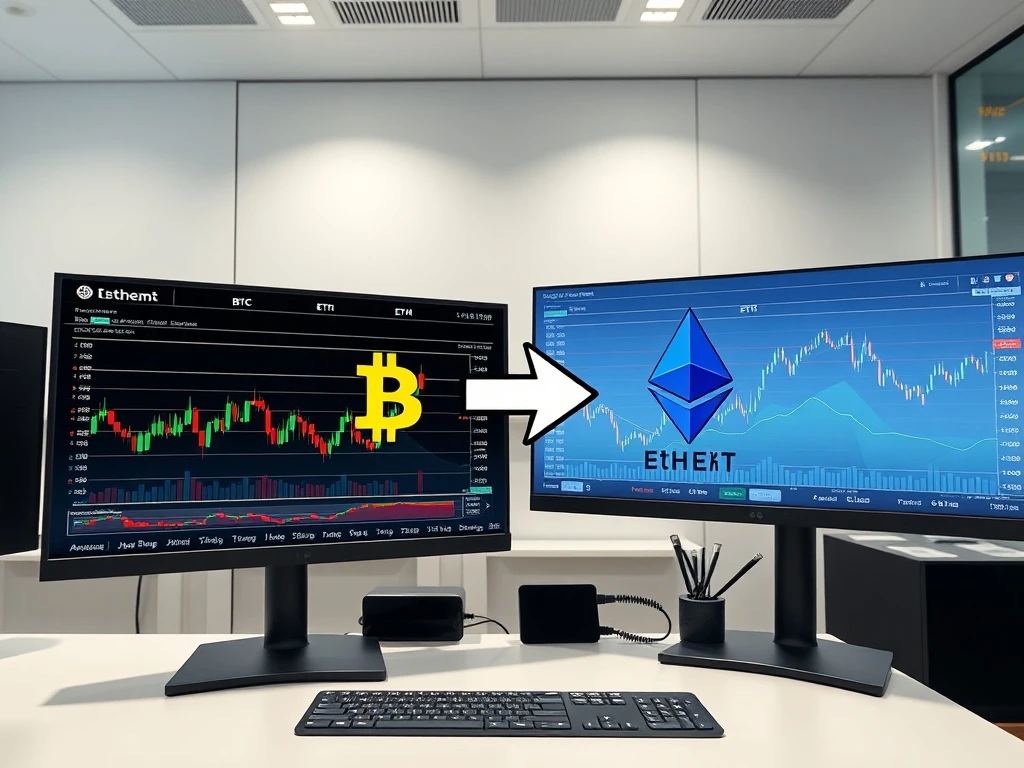
Global, March 2025: In a notable transaction capturing the attention of institutional crypto watchers, World Liberty Financial (WLFI) has executed a significant portfolio reallocation. The firm sold 93.77 Wrapped Bitcoin (WBTC), valued at approximately $8.07 million, and purchased 2,868.4 Ethereum (ETH) at an average price of $2,813 per token. This move, first reported by blockchain analytics platform Onchain Lens, represents a multi-million dollar vote of confidence in Ethereum’s ecosystem and provides a concrete data point in the ongoing narrative of institutional asset rotation within digital assets.
Analyzing the World Liberty Financial WBTC to ETH Transaction
The mechanics of the trade are straightforward yet significant. World Liberty Financial converted a substantial Bitcoin-denominated position into Ethereum. Using the reported figures, the transaction highlights a precise exchange: 93.77 WBTC for 2,868.4 ETH. WBTC, or Wrapped Bitcoin, is a tokenized version of Bitcoin that exists on the Ethereum blockchain. It allows Bitcoin holders to participate in Ethereum’s decentralized finance (DeFi) ecosystem without selling their Bitcoin exposure. The decision to unwind a WBTC position for native ETH, therefore, suggests a strategic pivot rather than a simple exit from crypto markets.
Blockchain transparency allows analysts to verify such moves. Platforms like Onchain Lens track large wallet movements, providing real-time insight into the actions of known entities like investment funds and corporations. This transaction was not a slow accumulation over time but a defined swap, indicating a deliberate portfolio decision. The average purchase price of $2,813 per ETH places the trade within a specific market context, offering a benchmark for the firm’s valuation assessment at the time of execution.
Institutional Crypto Strategy and Portfolio Diversification
Major financial entities like World Liberty Financial do not make multi-million dollar asset swaps on a whim. Such moves are typically the result of rigorous internal analysis and reflect a broader investment thesis. For years, Bitcoin has been viewed by many institutions as “digital gold”—a primary store of value and hedge against inflation. Ethereum, while also a store of value, is increasingly framed as a “digital economy” due to its smart contract functionality, which underpins thousands of applications.
- Yield Generation: Ethereum’s staking mechanism, following its transition to Proof-of-Stake, allows holders to earn rewards. This provides a potential yield that Bitcoin, in its native form, does not.
- Ecosystem Exposure: Holding ETH offers indirect exposure to the entire Ethereum application layer, including DeFi, non-fungible tokens (NFTs), and decentralized autonomous organizations (DAOs).
- Risk Management: Diversifying a crypto portfolio across the two largest assets by market cap is a standard risk-management practice, reducing overexposure to any single network’s performance.
A shift from WBTC to ETH could signal a desire to increase exposure to these utility and yield-generating aspects of the crypto market.
The Broader Context of Bitcoin and Ethereum Performance
To understand the potential rationale, one must consider the market landscape. Historically, Bitcoin and Ethereum have exhibited different performance cycles. While often correlated, Ethereum has periodically outperformed Bitcoin during periods of high activity in its DeFi and NFT sectors. Institutional investors closely monitor metrics like network activity, developer growth, and protocol upgrade roadmaps.
Ethereum’s ongoing development, including previous upgrades like “The Merge” to Proof-of-Stake and forthcoming enhancements aimed at scaling and reducing fees, may present a compelling growth narrative for long-term holders. A move from a pure store-of-value asset (Bitcoin/WBTC) to a platform asset (ETH) could reflect a strategic bet on the expansion of the Web3 economy built on Ethereum. This trade occurred against a backdrop where institutional adoption of both assets continues to grow, with new spot ETF products in various global markets increasing accessibility.
Implications for the Cryptocurrency Market
Transactions of this scale from identifiable institutions serve as important market signals. They are studied by other funds, retail investors, and analysts for clues about sentiment and strategy. While a single trade does not define a trend, it contributes to the mosaic of on-chain data.
First, it demonstrates sustained institutional engagement with crypto assets beyond simple buy-and-hold strategies. Active portfolio management, including rebalancing between major assets, indicates a maturation of the space. Second, it validates the utility of blockchain analytics. The fact that this transaction was publicly reported and analyzed within hours underscores the transparent yet complex nature of crypto markets. Finally, it may influence perception. Seeing a firm with “Financial” in its name execute a large ETH purchase can bolster confidence in Ethereum’s legitimacy as an institutional-grade asset.
It is crucial to maintain perspective. This is one transaction by one entity. It does not necessarily predict market direction, nor does it diminish Bitcoin’s standing. Rather, it exemplifies the dynamic and evolving strategies employed by sophisticated market participants navigating a dual-asset ecosystem.
Conclusion
The $8.1 million WBTC to Ethereum swap by World Liberty Financial is a significant data point in the institutional cryptocurrency narrative. It moves beyond speculation to provide a verified, on-chain example of a major financial player actively reallocating capital within the digital asset class. The trade highlights a potential strategic shift towards seeking yield and utility-based exposure through Ethereum, while also underscoring the mature, analytical approach institutions are applying to crypto portfolios. As blockchain transparency continues to illuminate the actions of large holders, moves like this will remain critical for understanding the evolving strategies shaping the future of finance.
FAQs
Q1: What is WBTC?
WBTC stands for Wrapped Bitcoin. It is an ERC-20 token on the Ethereum blockchain that represents Bitcoin. Each WBTC is backed 1:1 by a real Bitcoin held in custody, allowing Bitcoin to be used in Ethereum’s DeFi applications.
Q2: Why would an institution swap WBTC for ETH instead of just selling Bitcoin?
Swapping WBTC for ETH is likely a portfolio reallocation within the crypto asset class. It suggests the institution wanted to reduce its Bitcoin exposure and increase its Ethereum exposure while remaining invested in cryptocurrency, rather than exiting to traditional currency (fiat).
Q3: How was this transaction discovered?
It was reported by Onchain Lens, a blockchain analytics platform. These platforms monitor the public ledgers of blockchains like Ethereum, tracking movements from wallets associated with known institutions like World Liberty Financial.
Q4: Does this mean World Liberty Financial is bearish on Bitcoin?
Not necessarily. Portfolio rebalancing is a normal practice. The firm may still hold other Bitcoin positions. This move could simply reflect a desire to diversify its crypto holdings or capitalize on specific opportunities within the Ethereum ecosystem.
Q5: What is the significance of the average purchase price of $2,813?
It provides context for the trade’s timing and the institution’s valuation perspective. It shows the price level at which World Liberty Financial found Ethereum an attractive buy relative to the Bitcoin it sold, serving as a benchmark for that moment in the market.