Trump’s Shocking Threat: 100% Tariff on Canada Over China Trade Deal
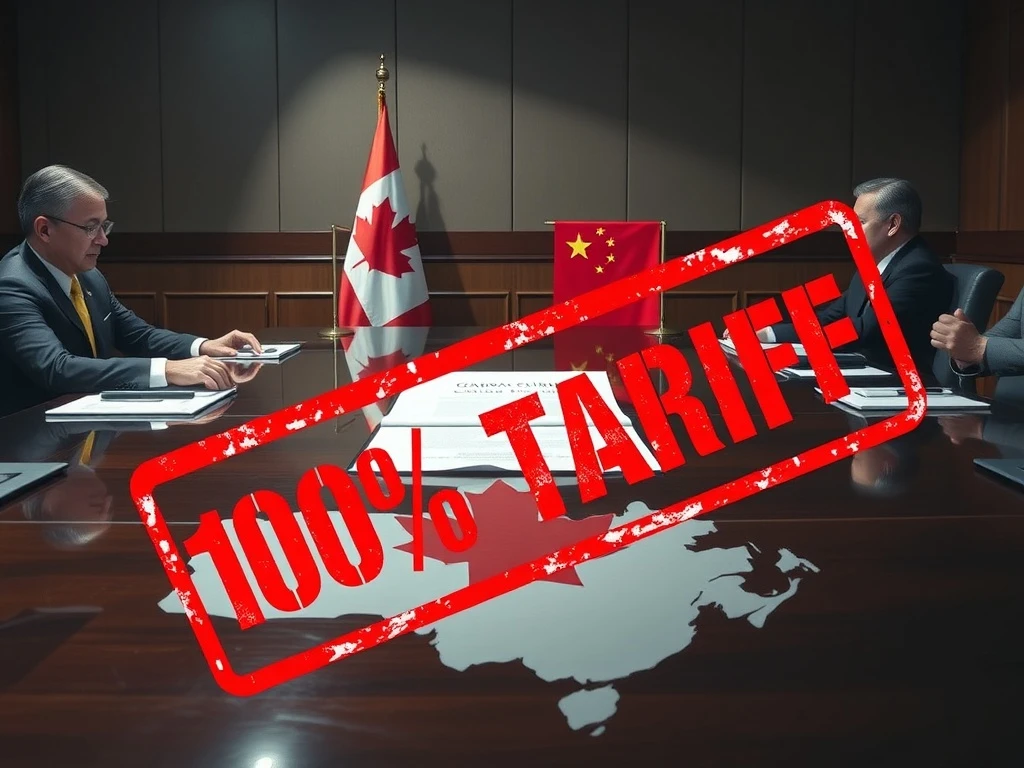
Washington, D.C., April 2025: In a move that has sent shockwaves through diplomatic and trade circles, former President Donald Trump has issued a stark warning to Canada, threatening to impose a 100% tariff on Canadian products if the country proceeds with a potential trade agreement with China. The threat, delivered via his Truth Social platform, represents a significant escalation in rhetoric and poses a direct challenge to the stability of North American trade relations. This development places Canada in a precarious position between its largest trading partner and a growing economic power, with potentially severe consequences for all parties involved.
Trump’s 100% Tariff Threat and Its Immediate Context
The core of the controversy stems from a post by former President Trump on Truth Social. In it, he stated unequivocally that he would levy a 100% tariff on goods from Canada should the Canadian government finalize a trade deal with China. He framed the potential agreement as “one of the worst in history” and claimed that “China is successfully and completely taking over Canada.” This language echoes protectionist themes central to his previous and potential future administrations. The threat is not an isolated comment but fits into a broader pattern of using tariffs as a primary tool of economic statecraft. Analysts note that while Trump is currently a private citizen, his statement carries weight as the presumptive Republican nominee for the 2024 presidential election, signaling a potential policy direction.
Historical Background of US-Canada-China Trade Relations
To understand the gravity of this threat, one must examine the complex trade triangle between the United States, Canada, and China. The United States-Mexico-Canada Agreement (USMCA), which replaced NAFTA in 2020, governs North American trade. A key provision, Article 32.10, requires a member country to notify the others if it intends to begin free trade negotiations with a “non-market country,” a clause widely understood to target China. Canada has been cautiously exploring deeper economic ties with China for years, seeking to diversify its export markets beyond the overwhelming reliance on the United States, which takes in approximately 75% of Canadian exports. However, previous attempts have been slow-moving, hampered by diplomatic tensions between Beijing and Ottawa and consistent pressure from Washington to align on China policy.
The Economic Stakes for Canada
The potential impact of a 100% tariff on Canadian exports to the United States would be catastrophic for the Canadian economy. Consider the following key export sectors and their vulnerability:
- Automotive Industry: Integrated supply chains mean vehicles and parts flow freely across the border. A 100% tariff would cripple this sector instantly.
- Energy: Canada is the largest supplier of foreign oil, natural gas, and electricity to the U.S. Tariffs here would disrupt U.S. energy security and devastate Canadian producers.
- Agriculture: From beef and pork to grains and maple syrup, Canadian farmers are deeply dependent on the U.S. market.
- Forestry & Minerals: Lumber, aluminum, and potash are major exports that would face immediate, insurmountable barriers.
Economists estimate such a tariff could trigger an immediate recession in Canada and cause significant price increases and supply chain disruptions within the United States.
Analyzing China’s Trade Strategy and Canada’s Dilemma
China’s pursuit of a trade deal with Canada is part of its long-term strategy to secure resources, technology, and influence while navigating its own tensions with the United States. For China, Canada represents a stable, resource-rich economy with advanced technology sectors. A deal could offer China improved access to critical minerals, agricultural products, and a foothold in a G7 nation. For Canada, the calculus is fraught. The benefits of diversifying trade are clear, but the risks of provoking its neighbor are immense. The Canadian government must now weigh the theoretical gains from a China deal against the very real and immediate threat of economic devastation from the south. This puts Prime Minister Justin Trudeau’s government in an exceptionally difficult diplomatic bind, forced to balance national economic interests with continental security and partnership.
Legal and Diplomatic Pathways Forward
The situation presents several complex legal and diplomatic questions. First, could a future U.S. president legally impose such a blanket tariff? Under U.S. trade law, specifically Section 232 of the Trade Expansion Act of 1962 and Section 301 of the Trade Act of 1974, a president has broad authority to impose tariffs on national security or unfair trade practice grounds. However, a 100% tariff on all goods from a treaty ally like Canada would be unprecedented and would almost certainly face legal challenges in U.S. courts and at the World Trade Organization (WTO). Diplomatically, it would represent a fundamental rupture in the US-Canada relationship, potentially undermining the USMCA itself and forcing Canada to seek retaliatory measures, however damaging they might be.
Potential Global Consequences and Market Reactions
The ramifications of this threat extend far beyond North America. Global markets react to trade uncertainty, and this development introduces a new layer of risk. Key consequences could include:
- Commodity Market Volatility: Prices for oil, natural gas, lumber, and grains would likely spike due to anticipated supply disruptions.
- Supply Chain Re-evaluation: Multinational corporations with integrated North American operations would be forced to urgently reconsider their manufacturing and logistics networks.
- Alliance Strain: Other U.S. allies, particularly in Europe and Asia, would watch closely, concerned about the precedent of using extreme tariff threats against a close partner.
- Empowerment of China: The discord could provide China with an opportunity to position itself as a more stable trading partner, potentially driving a wedge in Western economic cohesion.
Conclusion
Former President Donald Trump’s threat of a 100% tariff on Canada over a potential China trade deal is more than a political statement; it is a stark warning of the fragile state of international trade norms. It highlights Canada’s vulnerable position in the great power competition between the United States and China and underscores the continued potency of tariffs as a tool of economic confrontation. While the immediate implementation of such a drastic measure remains uncertain, the threat alone forces a severe recalculation in Ottawa, Beijing, and boardrooms worldwide. The ultimate impact will depend on Canada’s next move, China’s response, and the trajectory of American trade policy, making this a critical issue for global economic stability. The Trump 100% tariff Canada China trade deal threat has fundamentally altered the diplomatic landscape, proving that North American economic integration is not immune to profound political disruption.
FAQs
Q1: What exactly did Donald Trump say about Canada and China?
In a post on Truth Social, former President Trump stated he would impose a 100% tariff on Canadian products if Canada proceeds with a trade agreement with China, which he called “one of the worst in history” and accused China of “completely taking over Canada.”
Q2: Can a U.S. president legally impose a 100% tariff on an ally like Canada?
U.S. trade law grants the president broad authority to impose tariffs on national security (Section 232) or unfair trade practice (Section 301) grounds. While legally possible, a blanket 100% tariff on a treaty ally would be unprecedented and would face immediate legal challenges domestically and internationally.
Q3: How would a 100% tariff impact the average American consumer?
American consumers would face immediate price increases on a wide range of goods, including cars, energy, food (like beef and pork), and lumber for housing. It would also disrupt integrated supply chains, potentially causing shortages and job losses in U.S. industries reliant on Canadian components.
Q4: Why is Canada considering a trade deal with China in the first place?
Canada has long sought to diversify its export markets to reduce its overwhelming economic dependence on the United States, which buys about 75% of Canadian exports. A deal with China is seen as a strategic move to access a massive market for Canadian resources and goods.
Q5: What are the main exports from Canada to the U.S. that would be affected?
The most significant exports include vehicles and auto parts, crude oil and natural gas, agricultural products (meat, grains), forestry products (lumber), and minerals like aluminum and potash. All would become prohibitively expensive with a 100% tariff.