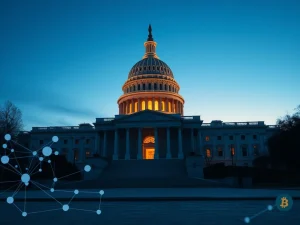
Presidential Crypto Ban Sparks Controversy as Democrats Target Trump’s $1.4 Billion Digital Fortune

WASHINGTON, D.C. – July 2025 – A dramatic legislative proposal now threatens to reshape the intersection of political power and digital finance. Senate Democrats have ignited a fierce debate by pushing to include an unprecedented presidential crypto ban within a major market structure bill. This move directly targets potential conflicts of interest, specifically citing former President Donald Trump’s reported $1.4 billion earnings from cryptocurrency ventures. The proposed amendment to the Crypto-Asset Market Structure Act, known as CLARITY, seeks to impose strict financial prohibitions on the nation’s highest elected officials.
Understanding the Proposed Presidential Crypto Ban
The core of the amendment is strikingly simple yet profound. It aims to prohibit the President, Vice President, and all members of Congress from conducting personal financial transactions using digital assets. Lawmakers drafted this provision ahead of crucial discussions in the Senate Agriculture Committee, which holds jurisdiction over the Commodity Futures Trading Commission (CFTC). The CFTC is a key regulator for many digital asset markets. Consequently, this committee’s decisions carry significant weight for the future of crypto regulation.
Proponents argue the rule is a necessary guardrail. They believe it prevents elected officials from using non-public information for personal gain in a highly volatile market. Furthermore, they contend it eliminates any appearance of impropriety when politicians make regulatory decisions affecting the same assets they might own. The legislative text specifically addresses “covered transactions,” which include buying, selling, or trading any cryptocurrency, token, or digital asset. This broad definition leaves little room for loopholes.
The Political Catalyst: Trump’s Crypto Windfall
The amendment did not emerge in a vacuum. It follows a detailed Bloomberg report that estimated former President Donald Trump’s crypto-related business earnings at approximately $1.4 billion. This staggering figure includes revenue from licensing deals, promotional partnerships, and his involvement with the stablecoin project World Liberty Financial. The report highlighted how political figures can leverage their fame and influence to build substantial wealth in the nascent digital asset sector.
This financial revelation provides critical context for the Democrats’ legislative strategy. It transforms an abstract ethical concern into a tangible, headline-grabbing issue. The proposed ban directly responds to a scenario where a sitting or former president could potentially influence regulatory policy while holding a massive, personally beneficial stake in the industry’s success. This situation creates a clear conflict of interest, according to government ethics experts cited in committee briefings.
Historical Precedents and Existing Ethics Laws
While novel for cryptocurrency, the concept of restricting officials’ financial activities has deep roots. The Stop Trading on Congressional Knowledge (STOCK) Act of 2012 already bans members of Congress and their staff from using non-public information for stock market trades. Additionally, federal officials must disclose their financial holdings. However, crypto assets have presented unique challenges for these existing frameworks. Their classification—as property, commodities, or securities—remains contested, creating enforcement gaps.
The following table compares traditional and digital asset rules for federal officials:
| Asset Type | Current Disclosure Rule | Current Trading Restriction | Proposed Change |
|---|---|---|---|
| Public Stocks | Required (STOCK Act) | No trading on non-public info | None |
| Cryptocurrencies | Varies by agency interpretation | No specific federal ban | Complete prohibition for top officials |
| Bonds & Commodities | Required | Subject to ethics review | None |
This legislative gap is what the CLARITY Act amendment seeks to close. It represents a definitive move to treat digital assets with stricter scrutiny than traditional securities for those in power.
Market Structure and the Broader CLARITY Act
The presidential ban is just one part of the larger Crypto-Asset Market Structure Act. The CLARITY Act itself is a landmark piece of legislation designed to finally establish clear regulatory boundaries for the digital asset ecosystem in the United States. Its primary objectives include:
- Defining Regulatory Jurisdiction: Clarifying whether the Securities and Exchange Commission (SEC) or the CFTC has primary authority over different crypto assets.
- Creating a Registration Pathway: Establishing a process for crypto exchanges and trading platforms to register with federal regulators.
- Protecting Consumer Assets: Implementing rules for custody, disclosure, and conflict-of-interest management at trading firms.
Inserting an ethics provision into this technical market structure bill is a strategic maneuver. It ties the politically charged issue of officials’ conduct directly to the must-pass framework needed to legitimize the crypto industry. Supporters hope this increases the amendment’s chances of survival during negotiations. However, critics call it a “poison pill” designed to derail the broader regulatory effort.
Expert Analysis on Potential Impacts
Financial law professors and former regulators have weighed in on the proposal’s potential ripple effects. Dr. Sarah Chen, a professor of financial regulation at Georgetown University, notes, “This amendment highlights a fundamental tension. We are attempting to regulate a borderless, innovative technology with laws written for a physical, centralized world. A blanket ban is administratively simple but may be overly broad. It could discourage tech-savvy individuals from public service.”
Conversely, Mark Johnson, a former SEC enforcement attorney, argues for the provision’s necessity. “The speed and opacity of crypto transactions make them uniquely susceptible to abuse,” Johnson states. “Unlike stock trades which settle in days, a crypto trade is near-instantaneous and can be conducted pseudonymously. Existing compliance tools for monitoring officials’ finances are not equipped for this.” This expert debate underscores the complex balance between ethical safeguards and practical governance.
Legislative Pathway and Political Hurdles
The amendment’s journey through Congress will be arduous. After review by the Senate Agriculture Committee, the full CLARITY Act would need to pass the Senate. It would then move to the House of Representatives, where different committees hold jurisdiction. Finally, both chambers would need to reconcile their versions into a single bill for the President’s signature. Given the partisan nature of the ethics provision, its survival at each stage is uncertain.
Key political hurdles include:
- Republican Opposition: Many GOP lawmakers view the amendment as a politically motivated attack on Donald Trump rather than a genuine ethics reform.
- Industry Pushback: Major crypto advocacy groups, while supporting clear regulation, may lobby against provisions they see as stigmatizing digital assets.
- Constitutional Questions: Some legal scholars have raised concerns about whether a legislative branch can restrict the personal financial activities of a separate executive branch head without a constitutional amendment.
Despite these challenges, the proposal has shifted the Overton window. It has forced a public conversation about the appropriate financial boundaries for leaders in the digital age, a discussion that will continue regardless of the amendment’s ultimate fate.
Conclusion
The push for a presidential crypto ban within the CLARITY Act marks a pivotal moment in American financial regulation. It directly confronts the novel ethical dilemmas posed by digital assets and political power. By targeting the potential conflicts of interest highlighted by former President Trump’s substantial crypto earnings, Senate Democrats have framed the debate in stark, politically resonant terms. The outcome will not only influence the future of crypto market structure but also set a precedent for how the nation governs the personal finances of its highest leaders in an increasingly digital economy. The proposed presidential crypto ban, therefore, is more than a legislative clause; it is a test of how traditional institutions adapt to disruptive technology.
FAQs
Q1: What exactly would the proposed presidential crypto ban prohibit?
The amendment would ban the President, Vice President, and all members of Congress from personally buying, selling, or trading any cryptocurrency or digital asset for the duration of their term in office.
Q2: Why are lawmakers focusing on cryptocurrency and not other investments?
Proponents cite the unique combination of market volatility, regulatory uncertainty, and potential for anonymous or rapid transactions in crypto, which they argue creates a higher risk for conflicts of interest and insider trading compared to more traditional, transparent markets.
Q3: Does this mean politicians would have to sell any crypto they already own?
The legislative text is still being finalized, but most interpretations suggest officials would be required to divest existing holdings upon taking office or place them in a qualified blind trust, similar to rules for other significant financial assets.
Q4: How does this relate to Donald Trump’s reported $1.4 billion in crypto earnings?
The Bloomberg report on Trump’s earnings provided a concrete, high-profile example of the massive financial stakes a political figure can have in the crypto industry, which supporters of the ban cite as a prime justification for needing strict conflict-of-interest rules.
Q5: What are the chances this amendment becomes law?
The path is politically difficult. While it may pass the Democratic-controlled Senate, it faces strong opposition in the Republican-led House and would likely be vetoed by a President Trump if he were in office. Its greatest impact may be in shaping the public debate around crypto and ethics.