Bitcoin Price Plummets Below $90,000: Market Reacts to Sudden Downturn
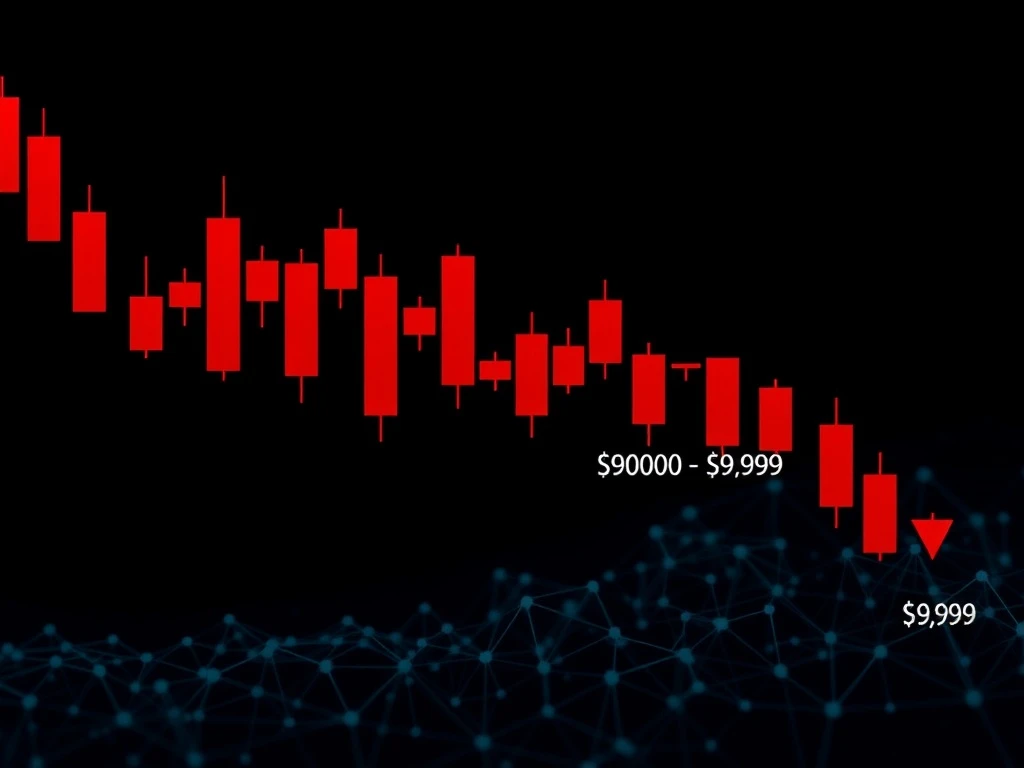
Global cryptocurrency markets experienced significant volatility on Thursday, March 13, 2025, as Bitcoin’s price dropped below the critical $90,000 psychological threshold. According to real-time data from Crypto News Insights market monitoring, BTC currently trades at $89,995.35 on the Binance USDT market. This development represents a notable shift in market sentiment following weeks of relative stability above the $92,000 level. Market analysts immediately began examining multiple potential catalysts for this movement, including macroeconomic factors, regulatory developments, and technical indicators. The Bitcoin price decline has triggered widespread discussion among traders and institutional investors about near-term market direction.
Bitcoin Price Analysis and Market Context
Bitcoin’s descent below $90,000 marks its first breach of this support level in approximately three weeks. Consequently, traders are closely monitoring several key technical indicators. The 24-hour trading volume has increased by approximately 42% compared to yesterday’s average. Furthermore, the Relative Strength Index (RSI) currently sits at 38, indicating neither oversold nor overbought conditions. Market depth data from major exchanges shows significant buy orders accumulating between $88,500 and $89,000. However, resistance appears strong at the $90,500 level. Historical data reveals that Bitcoin has tested the $90,000 support level seven times in the past six months. Each previous test resulted in either a rapid rebound or further decline averaging 8.2%.
Several parallel developments in traditional markets provide important context. The U.S. Dollar Index (DXY) strengthened by 0.6% today. Additionally, Treasury yields rose following the latest Federal Reserve commentary. These movements typically create headwinds for risk assets including cryptocurrencies. Meanwhile, Bitcoin’s dominance rate remains steady at 52.3%. This stability suggests the current movement affects the broader crypto market proportionally. On-chain analytics firm Glassnode reports that exchange inflows increased moderately today. Approximately 12,000 BTC moved to exchanges in the past 24 hours. This represents a 15% increase from the weekly average.
Cryptocurrency Market Reactions and Correlations
The broader cryptocurrency market reacted predictably to Bitcoin’s decline. Ethereum (ETH) dropped 3.2% to $4,850. Similarly, other major altcoins followed the downward trend. Solana (SOL) decreased by 4.1% while Cardano (ADA) fell 3.8%. However, some decentralized finance tokens showed relative resilience. Uniswap (UNI) declined only 1.9% during the same period. The overall cryptocurrency market capitalization decreased by approximately 2.4% in 24 hours. This reduction translates to nearly $120 billion leaving the digital asset space. Market correlation matrices indicate that altcoin movements remain strongly tied to Bitcoin’s performance. The 30-day correlation coefficient between BTC and major altcoins averages 0.78 currently.
Institutional activity provides additional insights. Grayscale’s Bitcoin Trust (GBTC) trading volume increased by 35% today. Meanwhile, Bitcoin futures open interest declined by $1.2 billion across major exchanges. This reduction suggests some leverage unwinding occurred. The futures funding rate turned slightly negative on several platforms. This shift indicates changing sentiment among derivatives traders. Spot Bitcoin ETF flows showed mixed results during early trading hours. The BlackRock iShares Bitcoin Trust (IBIT) recorded $85 million in inflows. Conversely, the Fidelity Wise Origin Bitcoin Fund (FBTC) experienced $42 million in outflows. These divergent flows reflect institutional uncertainty about short-term direction.
Technical Analysis and Support Levels
Technical analysts identify several crucial support and resistance zones. The immediate support cluster exists between $88,200 and $88,800. This area represents the 50-day moving average convergence. Additionally, the 200-day moving average provides stronger support near $86,500. On the resistance side, the $90,500 level presents the first significant hurdle. Beyond that, the $92,000 area contains substantial historical volume. Chart patterns suggest Bitcoin has entered a consolidation phase after its recent rally. The Bollinger Bands have widened significantly today. This expansion indicates increased volatility expectations. Meanwhile, the Moving Average Convergence Divergence (MACD) histogram shows bearish momentum increasing.
Historical precedent offers valuable perspective. Bitcoin has experienced 17 similar 3-5% single-day declines this year alone. The average recovery time from such movements has been 4.2 trading days. However, the current macroeconomic environment differs substantially from earlier periods. Inflation data released yesterday exceeded expectations slightly. This development may influence Federal Reserve policy decisions. Consequently, cryptocurrency markets face additional uncertainty from traditional finance sectors. The VIX volatility index, often called the “fear gauge,” increased 8% today. This rise suggests broader market anxiety extending beyond digital assets.
Fundamental Factors and Regulatory Landscape
Several fundamental developments potentially contributed to today’s price movement. The European Central Bank announced stricter cryptocurrency reporting requirements yesterday. These regulations will affect exchanges operating within EU jurisdictions. Additionally, the U.S. Securities and Exchange Commission delayed decisions on three Ethereum ETF applications. This postponement disappointed some market participants expecting quicker approvals. Meanwhile, Bitcoin network fundamentals remain robust. The hash rate reached a new all-time high of 650 exahashes per second this week. This metric indicates strong miner commitment despite price volatility. The network difficulty adjustment scheduled for next week will likely increase by approximately 3.5%.
Institutional adoption continues progressing despite short-term price movements. Goldman Sachs announced expanded cryptocurrency custody services yesterday. Similarly, Bank of America launched new blockchain research initiatives. These developments suggest long-term institutional interest remains intact. On-chain metrics provide additional fundamental context. The percentage of Bitcoin supply inactive for over one year remains near 68%. This statistic indicates strong holder conviction among long-term investors. The MVRV ratio, measuring profit/loss conditions, currently sits at 1.85. Historically, values below 2.0 suggest Bitcoin is not in a bubble territory. Exchange reserves continue their multi-year downward trend. Only 11.2% of Bitcoin supply remains on exchanges today compared to 17% two years ago.
Market Psychology and Trader Sentiment
Trader sentiment indices show notable shifts following today’s price action. The Crypto Fear & Greed Index dropped from 72 (Greed) to 58 (Neutral). This represents the largest single-day decline in three weeks. Social media analysis reveals increased discussion of “buying the dip” strategies. However, derivatives data suggests caution prevails among experienced traders. Put option volume increased 65% relative to call options today. This skew indicates heightened demand for downside protection. Liquidations data from Coinglass shows $240 million in long positions liquidated today. Conversely, only $85 million in short positions faced liquidation. This asymmetry suggests the market was positioned for upward movement before today’s decline.
Seasonal patterns offer additional context. Historically, March has produced mixed results for Bitcoin. Over the past decade, Bitcoin has averaged a 4.2% gain during March. However, volatility typically increases during this period. The upcoming Bitcoin halving, scheduled for April 2024, continues influencing long-term investor behavior. Historical analysis of previous halving cycles suggests accumulation often increases 6-9 months before the event. Current on-chain data supports this pattern. Entities holding 100-1,000 BTC have increased their holdings by 4.3% since January. This accumulation suggests sophisticated investors view current prices as attractive for long-term positioning.
Global Economic Context and Macro Influences
Traditional financial markets provide important backdrop for cryptocurrency movements. The S&P 500 declined 0.8% today amid inflation concerns. Similarly, technology stocks underperformed with the NASDAQ dropping 1.2%. These parallel movements highlight ongoing correlation between risk assets. The U.S. 10-year Treasury yield increased to 4.35% today. This rise creates opportunity cost considerations for Bitcoin investors. Gold, often considered an alternative store of value, gained 0.4% during the same period. This divergence suggests some capital may be rotating between asset classes. Central bank balance sheet data shows the Federal Reserve continuing its quantitative tightening program. This reduction in liquidity historically creates challenges for speculative assets.
Geopolitical developments also warrant consideration. Tensions in several regions have increased recently. Historically, Bitcoin has demonstrated mixed reactions to geopolitical uncertainty. During some periods, it has served as a potential hedge. During others, it has correlated with risk-off sentiment. The current situation appears to reflect the latter pattern. Currency markets show the Japanese Yen strengthening against the U.S. Dollar today. This movement often indicates risk aversion among global investors. Oil prices declined 1.8% despite Middle East tensions. This seemingly contradictory movement suggests complex cross-asset relationships currently influence markets.
Conclusion
Bitcoin’s decline below $90,000 represents a significant technical and psychological development in cryptocurrency markets. The Bitcoin price movement reflects complex interactions between technical factors, macroeconomic conditions, and shifting investor sentiment. While short-term volatility may continue, fundamental network metrics remain strong. Institutional adoption continues progressing despite price fluctuations. Historical patterns suggest such corrections often create accumulation opportunities for long-term investors. Market participants should monitor key support levels between $88,200 and $88,800. Additionally, broader economic indicators will likely influence Bitcoin’s trajectory in coming weeks. The cryptocurrency market’s maturation means single-day movements increasingly reflect multifaceted global factors rather than isolated events.
FAQs
Q1: What caused Bitcoin to fall below $90,000?
A1: Multiple factors likely contributed including technical selling at key levels, broader risk asset weakness, moderate exchange inflows, and reactions to regulatory developments. No single catalyst explains the movement completely.
Q2: How significant is the $90,000 level for Bitcoin?
A2: The $90,000 level represents both a psychological round number and a technical support area that has been tested multiple times in recent months, making its breach noteworthy for market sentiment.
Q3: What are the key support levels below $90,000?
A3: Immediate support clusters exist between $88,200-$88,800 (50-day moving average area) with stronger support near $86,500 (200-day moving average). These levels will likely attract buyer interest if tested.
Q4: Has institutional interest in Bitcoin changed following this decline?
A4: Available data shows mixed institutional flows with some ETFs experiencing inflows and others outflows, suggesting divided short-term views but continued long-term institutional engagement.
Q5: How does this decline compare to previous Bitcoin corrections?
A5: At approximately 3-4% from recent highs, this movement falls within normal volatility parameters for Bitcoin, which has experienced 17 similar single-day declines this year alone with average recovery within several trading days.