Chainlink’s Critical $11.90 Support: How Long Can Bulls Defend This Pivotal Level?

As global markets digest significant geopolitical shifts, Chainlink’s LINK token faces a crucial technical test at the $11.90 support level that could determine its near-term trajectory. The cryptocurrency market, always sensitive to macroeconomic developments, now watches closely as this key DeFi asset approaches what analysts describe as a “make-or-break” technical zone. This analysis examines the multiple factors influencing LINK’s price action, from derivatives positioning to fundamental development metrics, providing a comprehensive view of the asset’s current standing within the evolving digital asset landscape.
Chainlink’s Technical Crucible: The $11.90 Support Zone
Chainlink’s LINK token currently trades within a critical technical framework that has defined its price action since November 2025. The $11.90 level represents more than just a number on a chart—it embodies a psychological and technical barrier that has triggered multiple reversals over recent months. Technical analysts note that this support zone has demonstrated remarkable resilience, with price bouncing from this area on at least four separate occasions during the current market cycle.
Market data from January 22, 2026, shows LINK trading at $12.40, representing a modest 1.05% gain over the previous 24 hours. However, the more significant story unfolds beneath these surface numbers. Trading volume surged 26% to $522.29 million during this period, indicating heightened institutional and retail interest despite the relatively small price movement. This volume spike suggests market participants are actively positioning themselves around the crucial support level.
The technical picture presents a nuanced narrative. While LINK remains below its 50-day Exponential Moving Average (EMA)—traditionally a bearish signal—historical patterns reveal that the asset has previously rallied from similar positions. This creates what analysts describe as a “confluence zone” where technical indicators conflict, requiring deeper analysis of on-chain data and market structure to determine probable outcomes.
Historical Context and Pattern Recognition
Examining LINK’s price history reveals consistent behavior around key support levels. The $11.90 zone first emerged as significant support in late 2025, following a broader market correction that affected most digital assets. Since establishing this level, LINK has demonstrated what technical analysts call “memory at price,” where the market consistently recognizes and respects certain price points.
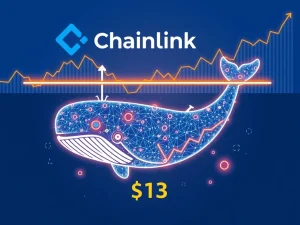
This pattern recognition becomes particularly relevant when considering potential price targets. Technical analysis suggests that a successful defense of the $11.90 support could trigger a 15% upward move, potentially propelling LINK toward the $14 resistance level. This projection aligns with Fibonacci extension levels and previous consolidation patterns observed throughout 2025.
Fundamental Strengths: Development Activity and Network Growth
Beyond technical indicators, Chainlink’s fundamental metrics provide crucial context for understanding the asset’s resilience. Recent data from on-chain analytics firm Santiment reveals that Chainlink leads all DeFi projects in development activity—a metric that tracks code commits, repository updates, and protocol improvements. This development dominance suggests several important advantages for the network.
Firstly, active development indicates ongoing protocol enhancement and security improvements. Secondly, consistent developer activity typically correlates with long-term project viability and innovation. Thirdly, this metric often precedes network effect expansion as new features and integrations attract additional users and applications. Chainlink’s position as the leading decentralized oracle network remains unchallenged, with integrations spanning hundreds of protocols across multiple blockchain ecosystems.
The development activity metric becomes particularly significant when contrasted with broader market conditions. While many projects reduce development during market downturns, Chainlink’s consistent commitment to building suggests strong institutional backing and long-term vision. This fundamental strength provides context for understanding why the $11.90 support level has held through multiple market tests.
Macroeconomic Catalysts and Market Sentiment
External factors increasingly influence cryptocurrency markets, and Chainlink proves no exception. The recent removal of tariffs on European countries by U.S. President Donald Trump has created ripple effects across global financial markets. While the direct impact on decentralized oracle networks may seem attenuated, the broader implications for risk assets cannot be ignored.
Improved trade relations typically correlate with increased capital flows into growth-oriented assets, including technological innovations like blockchain infrastructure. Furthermore, reduced trade barriers often stimulate economic activity that eventually filters into digital asset markets through various transmission mechanisms. Market analysts note that such geopolitical developments create what they term “sentiment windows” where traditional and crypto markets exhibit heightened correlation.
Derivatives Data Reveals Trader Conviction
Exchange liquidation maps from CoinGlass provide compelling evidence of market positioning around the critical support level. Data reveals concentrated leverage at two key price points: $11.88 on the support side and $12.72 on the resistance side. The asymmetry in positioning tells a revealing story about market expectations.
Traders have established $7.81 million in long-leveraged positions at the support level, compared to just $2.08 million in short positions at resistance. This 3.75:1 ratio demonstrates strong conviction among derivatives traders that the support will hold. The concentration of long positions at $11.88 creates what derivatives analysts describe as a “liquidity magnet”—a price level that attracts market movement due to the potential for cascading liquidations if breached.
This derivatives positioning interacts with spot market dynamics in complex ways. The substantial long leverage at support suggests that a break below $11.90 could trigger significant selling pressure as positions unwind. Conversely, successful defense of this level could create upward momentum as short positions face pressure and new capital enters the market.
Comparative Analysis with Broader DeFi Sector
Chainlink’s position within the broader decentralized finance ecosystem provides additional context for evaluating its price action. While many DeFi tokens experienced significant volatility throughout 2025, LINK demonstrated relative stability—a characteristic that appeals to institutional participants seeking blockchain exposure with reduced volatility.
The oracle network’s utility extends beyond speculative trading, with actual usage metrics showing consistent growth. The number of active data feeds, integration partnerships, and cross-chain implementations continues expanding despite market conditions. This real-world utility creates what economists call “intrinsic demand pressure” that supports price during market downturns.
Risk Factors and Alternative Scenarios
While the bullish case for LINK appears compelling, prudent analysis requires examination of potential downside scenarios. Several risk factors could challenge the $11.90 support level’s integrity. First, broader market conditions remain uncertain, with traditional financial markets exhibiting volatility that often spills into cryptocurrency markets. Second, regulatory developments continue evolving, creating potential headwinds for all digital assets.
Technical indicators present mixed signals that warrant consideration. The position below the 50-day EMA suggests lingering bearish momentum that could reassert itself. Additionally, trading volume, while increased, remains below peaks observed during previous market cycles. These factors create what risk managers describe as “asymmetric uncertainty” where downside risks may outweigh potential rewards for certain investor profiles.
Alternative scenarios include extended consolidation within a narrowing price range or a breakdown that tests lower support levels near $10.50. Each scenario carries different implications for market structure and requires distinct trading approaches. Successful navigation of these possibilities demands continuous monitoring of both technical and fundamental developments.
Conclusion
Chainlink’s LINK token stands at a critical technical juncture, with the $11.90 support level representing a pivotal battleground between bullish and bearish forces. Multiple factors suggest this support may hold, including strong derivatives positioning, leading development activity, and improving macroeconomic conditions. However, market participants must remain vigilant to changing conditions and emerging risks. The coming days will likely determine whether LINK can capitalize on its technical setup to achieve the projected 15% upside move toward $14, or whether bears will successfully challenge this crucial support zone. Regardless of immediate outcomes, Chainlink’s fundamental strengths position it favorably within the evolving blockchain infrastructure landscape.
FAQs
Q1: Why is the $11.90 level so important for Chainlink’s LINK?
The $11.90 level represents a key technical support zone that has triggered multiple price reversals since November 2025. This level has demonstrated historical significance as both a psychological and technical barrier, with the market consistently recognizing its importance through repeated tests and bounces.
Q2: What does development activity indicate about Chainlink’s future prospects?
Leading development activity, as measured by code commits and protocol improvements, suggests strong ongoing commitment to network enhancement. This metric typically correlates with long-term project viability, security improvements, and eventual network effect expansion as new features attract additional users and integrations.
Q3: How do derivatives positions influence LINK’s price action?
Derivatives data reveals concentrated long leverage at the $11.88 support level, creating what analysts call a “liquidity magnet.” This positioning suggests strong trader conviction in the support holding but also creates potential for cascading liquidations if the level breaks, amplifying price movements in either direction.
Q4: What macroeconomic factors currently affect Chainlink’s price?
The recent removal of tariffs on European countries has improved risk sentiment across financial markets. While the direct connection to decentralized oracle networks may seem indirect, such geopolitical developments typically influence capital flows into growth-oriented technological assets, including blockchain infrastructure projects.
Q5: What are the key risk factors for LINK’s price in the near term?
Primary risks include broader market volatility spillover from traditional finance, evolving regulatory developments, and technical indicators showing mixed signals. The position below the 50-day EMA suggests lingering bearish momentum that could reassert itself despite otherwise favorable conditions.