Bitcoin ETF Outflows Deepen: The Resilient Market’s Surprising Altcoin Pivot
On January 22, 2026, the cryptocurrency market demonstrated a fascinating paradox: despite deepening outflows from flagship Spot Bitcoin and Ethereum ETFs, prices refused to collapse, hinting at a complex underlying strength and a significant capital rotation. This development unfolds against a backdrop of shifting U.S. geopolitical signals, challenging the narrative that institutional flows solely dictate market direction. Consequently, the market’s refusal to break suggests a maturation beyond simple ETF-driven momentum.
Analyzing the Scale of Bitcoin ETF Outflows
Data from January 21, 2026, revealed a substantial institutional retreat from Bitcoin investment vehicles. The total net outflows reached a staggering $708.7 million, indicating a clear pause in institutional accumulation. Leading the sell-off was BlackRock’s iShares Bitcoin Trust (IBIT), which experienced $356.6 million in outflows. Similarly, Fidelity’s Wise Origin Bitcoin Fund (FBTC) saw $287.7 million leave. This selling pressure was nearly universal across major funds.
For instance, Ark Invest’s ARKB and Bitwise’s BITB recorded outflows of $29.8 million and $25.9 million, respectively. Even Grayscale’s GBTC, a long-standing bellwether, recorded an $11.3 million reduction. Valkyrie’s BRRR saw a smaller $3.8 million drain. The sole exception in the Bitcoin ETF space was VanEck’s HODL, which attracted a modest $6.4 million inflow. Remarkably, Bitcoin’s price held relatively steady at $89,864.17 during this period, showcasing notable price resilience despite the heavy fund selling.
The Institutional Sentiment Shift
This coordinated outflow pattern strongly suggests institutions are exercising caution, likely in response to macroeconomic or regulatory signals. Analysts often interpret such moves as de-risking or profit-taking rather than a loss of long-term conviction. The market’s ability to absorb this volume of potential selling without a major price breakdown points to robust underlying demand from other market participants, including retail investors and high-net-worth individuals outside the ETF structure.
Ethereum ETFs Mirror the Bitcoin Trend
A nearly identical story played out in the Ethereum ETF market on the same day, with combined net outflows totaling $287.0 million. BlackRock’s iShares Ethereum Trust (ETHA) accounted for the lion’s share, bleeding $250.3 million. Fidelity’s Ethereum Fund (FETH) and Grayscale’s Ethereum Trust (ETHE) followed with outflows of $30.9 million and $11.4 million, respectively. VanEck’s Ethereum Strategy ETF (ETHV) also saw a $4.4 million reduction.
In a notable deviation, Grayscale’s Mini Ethereum Trust (MINI) was the only Ethereum-focused fund to record positive movement, attracting a $10 million inflow. This occurred while Ethereum traded at $3,006.78, having posted a 1.29% gain in the prior 24 hours. The parallel outflows from both major crypto ETFs underscore a broad, asset-class-wide institutional pause rather than a chain-specific issue.
The Altcoin Exception and Capital Rotation
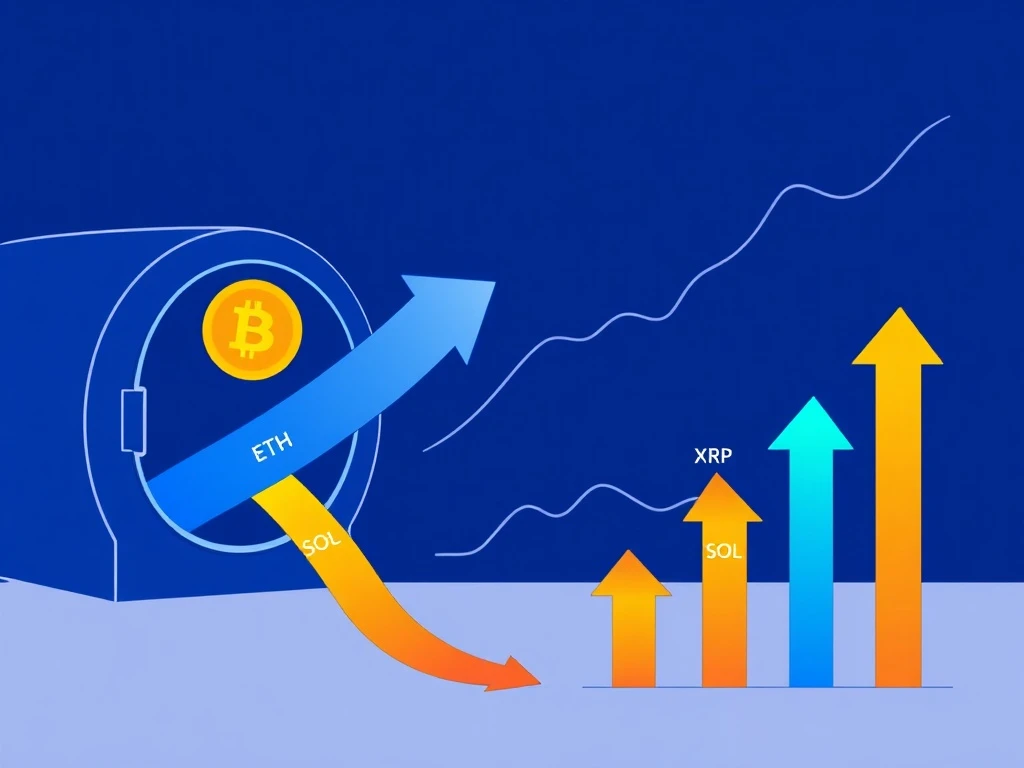
While Bitcoin and Ethereum ETFs faced headwinds, select altcoin investment products displayed surprising resilience, signaling a clear capital rotation. Ripple (XRP) ETFs recorded a healthy $7.18 million in net inflows. Simultaneously, Solana (SOL) ETFs attracted $3.0 million. This divergence is critical; it indicates that capital exiting the two largest cryptocurrencies is not leaving the digital asset space entirely. Instead, it is rotating into perceived high-growth or strategically positioned alternative assets.
Market analysts suggest this rotation could be driven by several factors. First, investors may seek higher potential returns (alpha) in established altcoins with strong fundamentals. Second, specific regulatory clarity or positive developments for XRP and SOL could be attracting targeted investment. Finally, this trend may reflect a portfolio diversification strategy as the crypto market matures, moving beyond a purely Bitcoin-dominated correlation.
Grayscale’s Strategic Move into NEAR
Adding further credence to the altcoin narrative, Grayscale Investments filed a Form S-1 with the U.S. Securities and Exchange Commission (SEC) on January 20, 2026. The filing seeks to convert its existing Grayscale Near Trust into a spot ETF (GSNR). This move is significant for several reasons. It represents a major institutional asset manager identifying value beyond the top two cryptocurrencies. Furthermore, if approved, GSNR would provide a regulated bridge for institutional capital to access the NEAR protocol’s ecosystem, potentially validating a new wave of altcoin investment vehicles.
Market Context and Geopolitical Influences
The current market activity occurs within a specific geopolitical context. Recent policy shifts from the U.S. administration under President Donald Trump have introduced uncertainty into global markets, including digital assets. Institutional investors, known for their risk sensitivity, often reduce exposure during periods of geopolitical flux. However, the crypto market’s tempered response—a relief rally without ETF support—suggests other forces are at play.
These forces include sustained retail interest, developments in decentralized finance (DeFi) and non-fungible token (NFT) ecosystems, and growing global adoption as a hedge against currency volatility. The data implies that the crypto market’s driver set is diversifying, reducing its dependency on any single inflow source, including U.S.-based spot ETFs.
Conclusion
The deepening outflows from Spot Bitcoin and Ethereum ETFs in January 2026 reveal a moment of institutional caution, not panic. The market’s refusal to break under this pressure, coupled with concurrent inflows into altcoin ETFs, paints a picture of a resilient and dynamically rotating ecosystem. Capital is not exiting; it is migrating within the digital asset space, seeking new opportunities. This behavior indicates a maturing market that is developing multiple pillars of support, moving beyond simplistic narratives tied solely to the fortunes of its two largest assets. The approval of new altcoin ETFs, like the potential Grayscale NEAR Trust, could further accelerate this diversification trend.
FAQs
Q1: What caused the massive outflows from Bitcoin and Ethereum ETFs?
The outflows are primarily attributed to institutional caution driven by shifting U.S. geopolitical signals and potential regulatory uncertainty. Institutions appear to be pausing or taking profits rather than abandoning long-term crypto exposure.
Q2: Why didn’t Bitcoin’s price crash despite the large ETF outflows?
The price remained resilient due to robust demand from other market participants, including global retail investors and entities outside the ETF structure. This demonstrates the market’s growing depth and reduced reliance on a single inflow channel.
Q3: What does capital rotation into XRP and SOL ETFs signify?
It signifies that investors moving capital out of Bitcoin and Ethereum are still confident in the crypto asset class. They are rotating into altcoins perceived to have strong fundamentals or higher growth potential, indicating a strategic diversification within the sector.
Q4: How significant is Grayscale’s filing for a NEAR spot ETF?
It is highly significant as it shows a major institutional player seeking to expand the ETF landscape beyond Bitcoin and Ethereum. Approval could pave the way for more altcoin ETFs, bringing institutional liquidity to a wider range of blockchain projects.
Q5: Does this mean the era of Bitcoin and Ethereum dominance is over?
Not at all. The outflows represent a short-term tactical shift. Bitcoin and Ethereum remain the foundational assets with the largest market capitalization, liquidity, and institutional adoption. However, the trend highlights the growing importance and legitimacy of select altcoins within a diversified crypto portfolio.