1INCH Price Plunge Exposes Alarming Altcoin Liquidity Crisis: A $2M Sell Order Triggers 13% Collapse
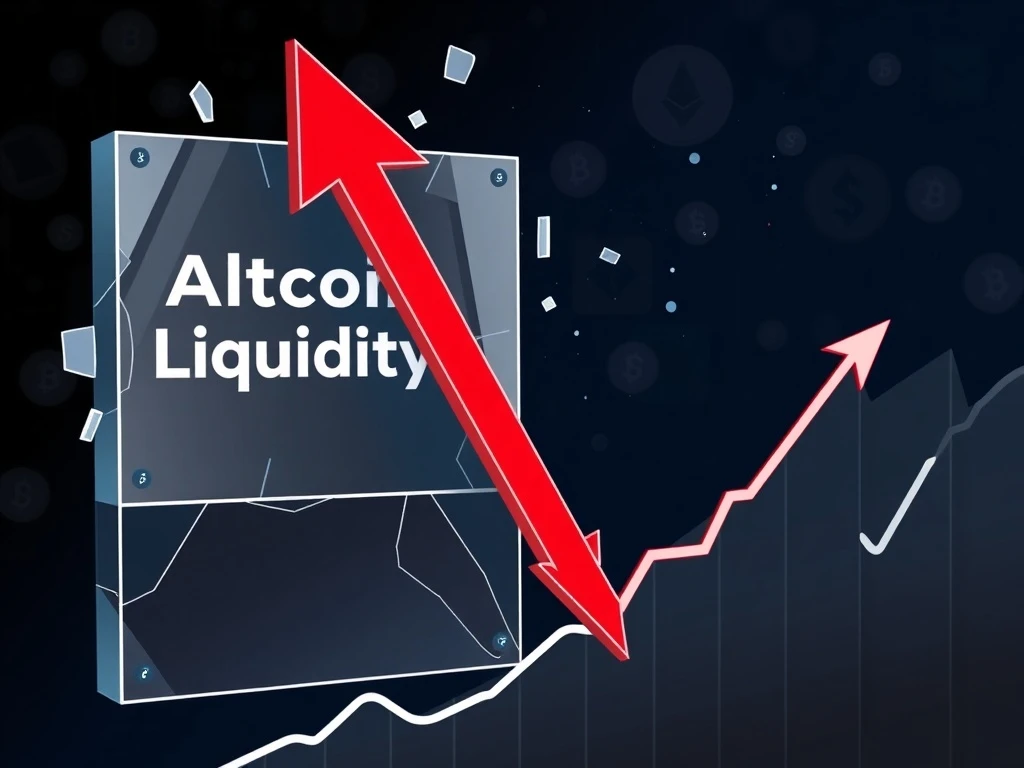
A single sell order worth less than $2 million triggered a dramatic 7% price collapse for the 1INCH token this week, subsequently exposing a severe and alarming altcoin liquidity crisis across cryptocurrency markets. According to a detailed analysis from blockchain intelligence firm AmberCN, this event starkly illustrates how fragile trading conditions have become for digital assets outside the top tier, even for a token with a market capitalization of approximately $180 million. The initial sell-off quickly snowballed, with the token’s total decline widening to 13%, raising urgent questions about market depth and stability for investors and protocols alike.
1INCH Price Drop Reveals Market Fragility
The incident involving the 1INCH token serves as a critical case study in current market microstructure. Initially, a sell order of sub-$2 million executed on a major exchange. Consequently, the token’s price immediately fell by 7%. This disproportionate reaction highlights a fundamental lack of buy-side depth in the order book. Market analysts consistently monitor such liquidity metrics because they directly impact price stability and execution costs for all traders. Furthermore, the 24-hour trading volume for the 1INCH/USDT pair on Binance, one of the world’s largest crypto exchanges, reportedly stood at only $1.5 million at the time of the analysis. This figure itself is remarkably low for a token of its size.
Also read: Bitcoin Spot ETFs Shatter Positive Streak With $296 Million Outflow
AmberCN’s investigation delved deeper into this volume data. The firm identified that a significant portion, approximately $1.16 million, was attributable to activity from arbitrage bots. These automated systems exploit tiny price differences across exchanges and do not represent genuine, directional trading interest. Therefore, the firm estimated the actual available liquidity—the capital readily available to absorb buys and sells without major price impact—was a mere $340,000. This revelation contextualizes why a sub-$2 million order could cause such significant price dislocation. For comparison, a similar order against a major asset like Bitcoin or Ethereum would typically cause a price movement measured in basis points, not percentage points.
Understanding Liquidity in Crypto Markets
Liquidity refers to the ease with which an asset can be bought or sold without causing a drastic change in its price. High liquidity markets have many participants and deep order books. Conversely, low liquidity markets are characterized by thin order books where large trades can move prices significantly. Key components of liquidity include:
Also read: Bitcoin Strategy Divide: GameStop's 4,710 BTC Hold Contrasts With Nation's Massive Sell-Off
- Market Depth: The volume of orders on the buy and sell side of the order book at different price levels.
- Trading Volume: The total value of assets traded over a specific period, often used as a superficial liquidity proxy.
- Bid-Ask Spread: The difference between the highest price a buyer is willing to pay and the lowest price a seller is willing to accept; tighter spreads usually indicate better liquidity.
The 1INCH event demonstrates that reported trading volume alone can be a misleading indicator. The dominance of arbitrage bot activity inflates volume figures without contributing to genuine market depth, creating a facade of health over a fragile reality.
Broader Altcoin Liquidity Deterioration
AmberCN’s report explicitly states that liquidity in the altcoin market has “severely deteriorated.” This trend is not isolated to 1INCH. Numerous mid-cap and small-cap tokens have experienced similar conditions throughout 2024 and into 2025. Several interconnected factors drive this environment. First, macroeconomic uncertainty and shifting regulatory landscapes have prompted a flight to quality, with capital concentrating in Bitcoin and a handful of large-cap cryptocurrencies. Second, the aftermath of the 2022 market downturn led to the closure or reduced activity of many market-making firms and crypto-native funds that previously provided liquidity across a wider asset universe.
Third, the evolving regulatory environment, particularly in the United States with ongoing SEC actions, has made exchanges and institutional players more cautious about supporting a broad range of altcoins. This caution reduces market-making services and listing opportunities. Finally, the crypto market’s cyclical nature often sees liquidity dry up during bearish or consolidating phases, as retail interest wanes and trading activity declines. The current data suggests this cycle’s liquidity crunch is particularly acute for altcoins, potentially lengthening recovery timelines and increasing volatility.
Implications for Investors and Protocols
The practical implications of this liquidity crisis are profound. For traders and investors, it means higher slippage—the difference between the expected price of a trade and the price at which it actually executes. Large orders become expensive and risky to fill. For the blockchain protocols behind these tokens, like the 1INCH decentralized exchange aggregator, low liquidity for their native token can hinder ecosystem growth. It complicates treasury management, makes partnerships less attractive, and can affect token utility within the protocol’s own mechanics. Furthermore, it exposes the protocol’s community and holders to heightened volatility from relatively small market actions, potentially undermining long-term confidence.
Historical Context and Market Comparisons
To fully grasp the significance of the 1INCH liquidity event, historical context is essential. During the bull market peak in late 2021, altcoins regularly saw daily volumes in the hundreds of millions, even for mid-cap projects. Market depth was sufficient to absorb multi-million dollar orders with minimal price impact. The current environment represents a stark contrast. A comparison table illustrates the shift:
| Metric | Bull Market Peak (Late 2021) | Current Environment (2025 Analysis) |
|---|---|---|
| Typical Altcoin Order Book Depth | Deep, with layered orders | Shallow, concentrated near price |
| Impact of a $2M Sell Order | Minor (often < 2%) | Major (7%+ as seen with 1INCH) |
| Arbitrage Bot Share of Volume | Present, but lower percentage | Dominant, inflating true volume |
| Institutional Participation | High across many assets | Concentrated in top assets |
This deterioration did not happen overnight. It resulted from a prolonged period of market stress, regulatory pressure, and a reallocation of risk capital. Analysts from firms like AmberCN and others in the space have tracked this trend through on-chain data, exchange metrics, and derivatives market activity, consistently noting the widening gap between large-cap and small-cap asset liquidity.
Expert Analysis and Forward Outlook
Industry experts emphasize that liquidity is the lifeblood of any financial market. The events surrounding the 1INCH token are a clear warning signal. While the immediate cause was a specific sell order, the root cause is a systemic withdrawal of liquidity providers from the altcoin space. Recovery will likely require a combination of factors: a sustained bullish turn in overall crypto market sentiment, clearer regulatory frameworks that encourage market-making activity, and potentially new decentralized finance (DeFi) solutions designed to bootstrap liquidity in a trust-minimized way.
In the meantime, participants are advised to exercise heightened caution. Due diligence for any altcoin investment must now include a rigorous assessment of liquidity metrics—looking beyond simple trading volume to examine order book depth, the bid-ask spread, and the composition of volume. Protocols may need to incentivize liquidity provision more directly through their treasuries or tokenomics to ensure functional markets for their native assets. The 1INCH price plunge is more than an isolated dip; it is a symptom of a broader market condition that demands attention from all market participants.
Conclusion
The 7% plunge in the 1INCH price following a sub-$2 million sell order acts as a powerful lens focusing on a critical issue: the severe deterioration of altcoin liquidity. Analysis from AmberCN reveals a market where reported volumes mask a fragile reality, with actual usable liquidity far lower than surface data suggests. This environment increases volatility, raises trading costs, and poses significant challenges for both investors and the blockchain projects reliant on healthy token markets. As the cryptocurrency ecosystem evolves, restoring reliable and genuine liquidity across a broader range of assets will be essential for sustainable growth and maturity. The 1INCH event serves as a stark reminder that in thin markets, even modest trades can have outsized consequences.
FAQs
Q1: What caused the 1INCH price to drop 7%?
The immediate cause was a single sell order valued at less than $2 million. However, the primary reason for such a large price move was critically low market liquidity, meaning there were not enough buy orders in the order book to absorb the sale without a significant price decline.
Q2: What does “altcoin liquidity” mean?
Altcoin liquidity refers to how easily cryptocurrencies other than Bitcoin (altcoins) can be bought or sold in the market without causing a major price change. High liquidity means easy trading with minimal price impact; low liquidity means trades can drastically move the price, as seen with 1INCH.
Q3: Why did AmberCN say the actual liquidity was only $340,000?
AmberCN analyzed the 24-hour trading volume of $1.5 million for 1INCH/USDT on Binance. They found that about $1.16 million of that volume came from arbitrage bots, which trade to capture tiny price differences and do not provide genuine market depth. Subtracting this leaves approximately $340,000 in liquidity from real traders.
Q4: Is low liquidity a problem only for 1INCH?
No. While the 1INCH price drop is a prominent example, AmberCN’s report indicates that poor liquidity is a widespread issue affecting many mid-cap and small-cap altcoins in the current market environment, representing a broader market trend.
Q5: How does low liquidity affect a regular cryptocurrency investor?
For investors, low liquidity leads to higher “slippage,” meaning you may pay more than expected when buying or receive less when selling. It also increases volatility and risk, as prices can swing dramatically on relatively small trades, making portfolio management more challenging.

This article was produced with AI assistance and reviewed by our editorial team for accuracy and quality.