KOSPI Shatters Historic 5,000 Barrier, Signaling a New Era for South Korea’s Economy
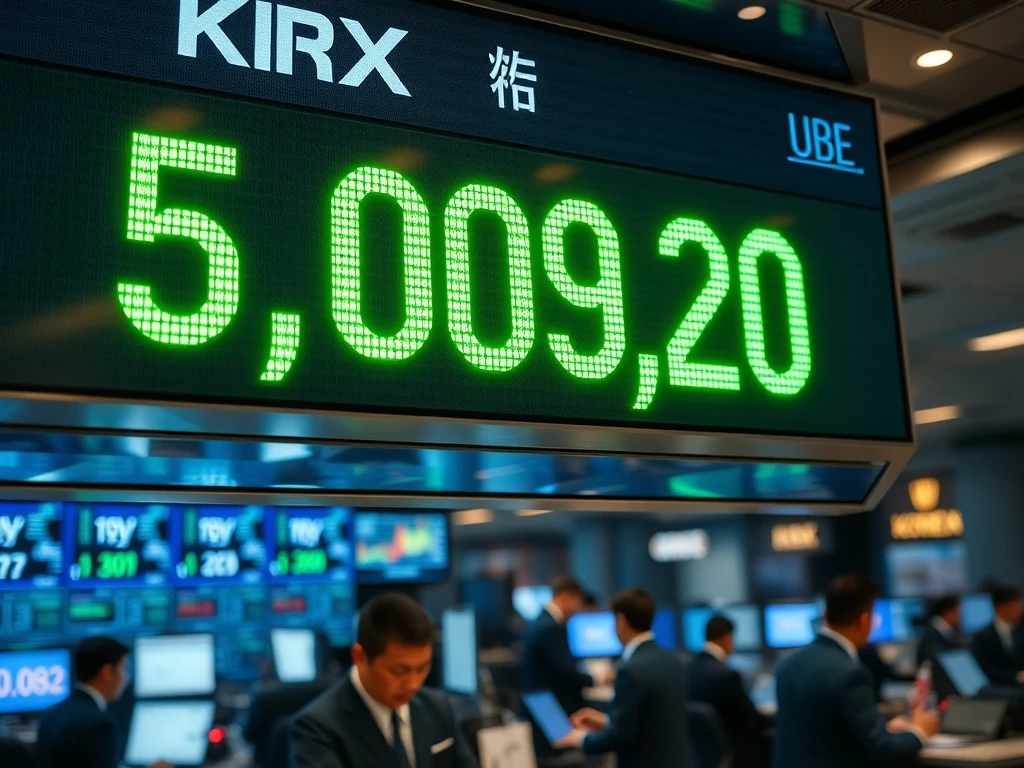
In a historic moment for Asian finance, South Korea’s benchmark KOSPI index decisively shattered the 5,000-point barrier for the first time in its history. The landmark breach occurred during early trading on Thursday, March 6, 2025, with the index surging to 5,012.20, marking a powerful 2.08% gain from the previous session. This unprecedented milestone represents more than just a number; it signifies a profound shift in investor confidence and the maturing strength of South Korea’s economic engine on the global stage.
KOSPI’s Historic 5,000 Breakthrough: Analyzing the Moment
The Korea Composite Stock Price Index, known globally as the KOSPI, finally conquered a psychological and technical resistance level that market watchers had monitored for years. Trading volume spiked significantly as the index crossed the threshold, reflecting intense institutional and retail investor interest. Market analysts immediately highlighted the breakthrough as a watershed event, comparable to the Dow Jones Industrial Average first crossing 10,000 points. The rally was broad-based, with gains seen across multiple sectors including technology, automotive, and finance. Consequently, this surge propelled the total market capitalization of companies listed on the KOSPI to a new record high. Furthermore, the achievement underscores a decade-long recovery and growth trajectory following periods of regional volatility.
The Economic Drivers Behind the Record Surge
Several key macroeconomic and corporate factors converged to fuel this historic rally. First, stronger-than-expected corporate earnings reports from major chaebols like Samsung Electronics and Hyundai Motor provided a solid foundation. Second, sustained foreign investment inflows into Korean equities have been notable, driven by attractive valuations relative to other developed markets. Third, the Bank of Korea’s recent policy stance has fostered a stable monetary environment. Additionally, robust export data, particularly in semiconductors and electric vehicles, has bolstered economic optimism. The government’s continued focus on digital innovation and green energy initiatives has also created positive sectoral momentum. Below is a brief comparison of key index milestones:
| KOSPI Milestone | Year Achieved | Notable Context |
|---|---|---|
| First Trades | 1983 | Index started at 100 points |
| Surpassed 1,000 | 1989 | During the Asian economic boom |
| Surpassed 2,000 | 2007 | Pre-global financial crisis peak |
| Surpassed 3,000 | 2018 | Driven by tech and memory chip rally |
| Surpassed 5,000 | 2025 | Broad-based economic strength and foreign investment |
Expert Analysis on Market Sustainability
Financial experts emphasize the quality of the current rally. “This isn’t speculative fever,” notes Dr. Min-ji Park, a senior economist at the Korea Development Institute. “The breakout is supported by tangible improvements in corporate governance, dividend policies, and global competitiveness in key industries.” Analysts point to several health indicators: reasonable market P/E ratios, strong balance sheets, and diversified growth. However, they also caution about potential headwinds like global interest rate shifts and geopolitical tensions. The consensus suggests a focus on long-term structural strengths rather than short-term momentum. Therefore, the market’s foundation appears more resilient than during previous peaks.
Global Context and Regional Market Impact
The KOSPI’s record performance resonates across global financial markets. It positions South Korea’s equity market firmly among the world’s top performers for the year. Neighboring markets in Asia, such as Japan’s Nikkei and Taiwan’s Taiex, often exhibit correlated movements with the KOSPI. This milestone may reinforce positive sentiment across the Asia-Pacific region. Internationally, major index providers like MSCI may see increased weighting for Korean stocks in global benchmark funds. The achievement also highlights the growing decoupling of Asian markets from traditional Western economic cycles. For global investors, the event underscores the critical importance of dedicated exposure to Korean and Asian equities in a diversified portfolio.
Conclusion
The KOSPI index’s historic breach of the 5,000-point mark is a defining moment for South Korea’s financial markets and its economy. This achievement reflects deep-seated strengths in technology, manufacturing, and corporate reform. While markets naturally fluctuate, this milestone provides a new baseline for assessing the country’s economic trajectory. The breakthrough will likely influence investment flows, corporate strategy, and economic policy in the coming years. Ultimately, the KOSPI at 5,000 symbolizes South Korea’s confident position as a leading and innovative force in the global economy.
FAQs
Q1: What does the KOSPI index measure?
The KOSPI is the benchmark stock market index of South Korea. It tracks the performance of all common stocks listed on the Korea Exchange’s main board, serving as the primary indicator of the country’s overall market health.
Q2: Why is breaking 5,000 points such a significant milestone?
The 5,000 level represented a major psychological and technical resistance point. Surpassing it signals strong investor confidence, reflects sustained economic growth, and often attracts further institutional investment into the market.
Q3: Which companies had the biggest impact on pushing the KOSPI past 5,000?
Large-cap technology and automotive giants, often referred to as chaebols, were primary drivers. This includes global leaders like Samsung Electronics, SK Hynix, Hyundai Motor, and LG Energy Solution, whose combined weight significantly influences the index.
Q4: How does this affect the average Korean investor or citizen?
A rising stock market can increase household wealth through pension funds and individual investments, potentially boosting consumer confidence and spending. It also enhances the global prestige and capital-raising ability of Korean companies, which can lead to job creation and economic growth.
Q5: What are the potential risks following such a record high?
Analysts monitor for overvaluation, external shocks from global monetary policy, currency volatility, and geopolitical issues. A healthy market advance requires continued earnings growth and economic stability to sustain new highs.