Crypto Futures Liquidations Surge: $471M Wiped Out in 24-Hour Market Turmoil
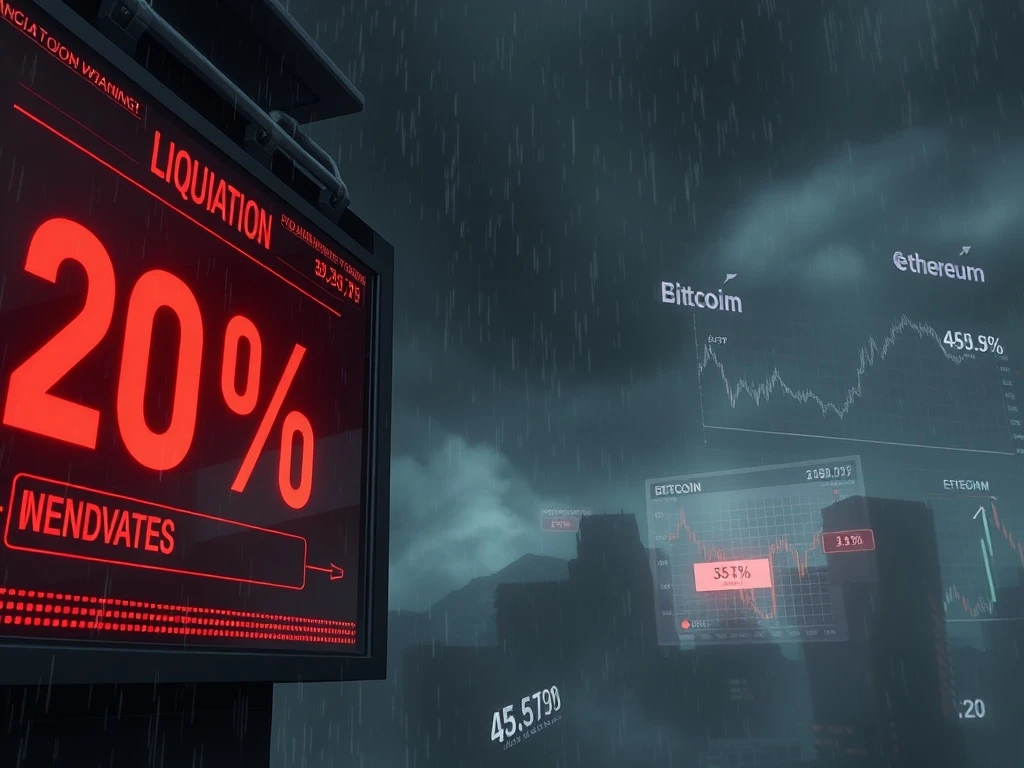
Global cryptocurrency derivatives markets experienced a severe stress test on March 21, 2025, as forced liquidations of leveraged perpetual futures contracts skyrocketed to a staggering $471 million within a single 24-hour period. This significant liquidation event, primarily driven by sharp price movements in major digital assets, highlights the inherent risks and amplified volatility within crypto’s leveraged trading ecosystem. Consequently, traders faced massive position closures, providing a stark reminder of the mechanisms that automatically unwind bets when collateral values plummet.
Crypto Futures Liquidations Reach Critical Levels
The $471 million liquidation total represents one of the most substantial single-day deleveraging events in recent months. Market data reveals a clear breakdown by asset, with Ethereum (ETH) and Bitcoin (BTC) accounting for the overwhelming majority of the value erased. Specifically, Ethereum futures saw $238 million in forced closures, while Bitcoin futures witnessed $217 million liquidated. Interestingly, the directional bias of these liquidations differed between the two market leaders. For Bitcoin, short positions—bets on price declines—comprised 55.38% of the total, indicating a squeeze on traders expecting further downside. Conversely, Ethereum’s liquidations were more balanced but slightly favored short positions at 50.28%.
Meanwhile, a notable outlier in the data was the token HYPE, which experienced $16.6 million in liquidations. Unlike the top two assets, the majority (54.33%) of HYPE’s liquidations affected long positions, suggesting a rapid price drop caught bullish traders off guard. This event underscores how liquidation cascades can affect both large-cap and smaller altcoins, often exacerbating price swings. The collective liquidation pressure likely contributed to increased market volatility, as large, forced sell and buy orders hit the order books.
Understanding Perpetual Futures and Leverage Mechanics
To comprehend the scale of this event, one must first understand the product at its center: perpetual futures contracts. Unlike traditional futures with set expiry dates, perpetual contracts allow traders to hold positions indefinitely, using a funding rate mechanism to tether the contract price to the underlying spot asset. The critical danger emerges when traders employ high leverage, sometimes exceeding 100x, to amplify their potential gains. While leverage can magnify profits, it also drastically increases risk. Exchanges require traders to maintain a minimum margin level; if the position moves against them and their collateral value falls below this threshold, the exchange automatically closes—or liquidates—the position to prevent negative balances.
Key factors that typically trigger such widespread liquidations include:
- Sudden Price Volatility: Rapid, unexpected price moves of 5-10% or more can quickly wipe out highly leveraged positions.
- Cascading Effects: Initial liquidations create large market orders, pushing prices further and triggering more liquidations in a feedback loop.
- High Aggregate Open Interest: When total leveraged money in the market is high, the potential liquidation volume during a move is correspondingly larger.
- Funding Rate Swings: Sharp moves can cause extreme funding rates, making it expensive to hold losing positions.
Historical Context and Market Impact
Liquidation events of this magnitude are not unprecedented but serve as critical stress points. For instance, the crypto market has witnessed several larger deleveraging events, such as the May 2021 crash where over $8 billion was liquidated in 24 hours or the FTX collapse fallout in November 2022. The March 2025 event, while smaller, follows a period of increased leverage buildup as prices consolidated, leaving the market vulnerable to a shakeout. The immediate impact is a rapid reduction in overall market leverage, which can sometimes create a foundation for price stabilization after the volatility subsides. However, the process is painful for affected traders, resulting in total loss of their positioned capital.
Furthermore, data from analytics platforms like Coinglass and Bybit show that liquidations often cluster around key technical price levels where large numbers of stop-loss orders and liquidation points are set. This event likely flushed out overleveraged speculators, transferring assets to more cautious hands. The high proportion of short liquidations in Bitcoin suggests a violent upward price move triggered the event, potentially a short squeeze where rising prices forced bearish traders to cover their positions at a loss.
Risk Management Lessons from a $471M Liquidation
The scale of this liquidation event offers clear, evidence-based lessons for participants in cryptocurrency derivatives markets. First, it demonstrates the non-linear risk of high leverage. A seemingly small adverse price move can result in a total loss. Second, it highlights the importance of understanding exchange-specific liquidation engines and margin requirements, which can vary. Third, traders must monitor overall market leverage and funding rates as leading indicators of potential instability. Experts from major trading firms often advise using lower leverage, diversifying across assets, and employing stop-loss orders wisely—not just as liquidation triggers but as part of a broader risk framework.
Moreover, the event has implications for market health. While liquidations cause immediate pain, they can reduce systemic leverage risk in the medium term. Regulators and institutional observers often view such events as necessary corrections that purge excessive speculation. For the broader ecosystem, it underscores the need for robust risk education and tools, such as isolated margin modes and liquidation price calculators, which many exchanges now provide. The data from this event will likely be studied by quantitative analysts to model future liquidation cascades and improve market infrastructure resilience.
Conclusion
The $471 million crypto futures liquidation event on March 21, 2025, serves as a powerful case study in market dynamics and risk. Driven by sharp price movements in Ethereum and Bitcoin, this deleveraging flush impacted thousands of traders and temporarily heightened volatility. By analyzing the breakdown—$238M for ETH, $217M for BTC, and $16.6M for HYPE—market participants can glean insights into positional biases and market structure. Ultimately, such events reinforce the critical importance of prudent leverage management and continuous market education. As the cryptocurrency derivatives market matures, understanding the mechanics and triggers of forced liquidations remains essential for navigating its high-stakes environment.
FAQs
Q1: What are forced liquidations in crypto futures trading?
Forced liquidations occur when an exchange automatically closes a trader’s leveraged position because the value of their collateral has fallen below the required maintenance margin. This mechanism prevents the trader’s account from going into negative balance.
Q2: Why did Bitcoin have more short liquidations while HYPE had more long liquidations?
The difference indicates the price direction that triggered the liquidations. A higher percentage of short liquidations for Bitcoin suggests a rapid price increase liquidated bearish bets. For HYPE, more long liquidations imply a sharp price drop liquidated bullish positions.
Q3: How can traders avoid being liquidated?
Traders can avoid liquidation by using lower leverage, maintaining ample collateral above the maintenance margin, setting prudent stop-loss orders, monitoring positions actively, and understanding the specific liquidation price calculations of their exchange.
Q4: Do large liquidation events like this affect the spot price of cryptocurrencies?
Yes, they often do. Large-scale liquidations generate substantial market sell or buy orders (depending on the position direction), which can create immediate selling or buying pressure, exacerbating spot price movements in the short term.
Q5: What is a liquidation cascade?
A liquidation cascade is a chain reaction where initial forced liquidations cause enough price movement to trigger subsequent rounds of liquidations at nearby price levels. This feedback loop can dramatically amplify volatility in a very short time frame.