Altcoin Season Index Surges 4 Points to 32, Hinting at Crucial Market Shift
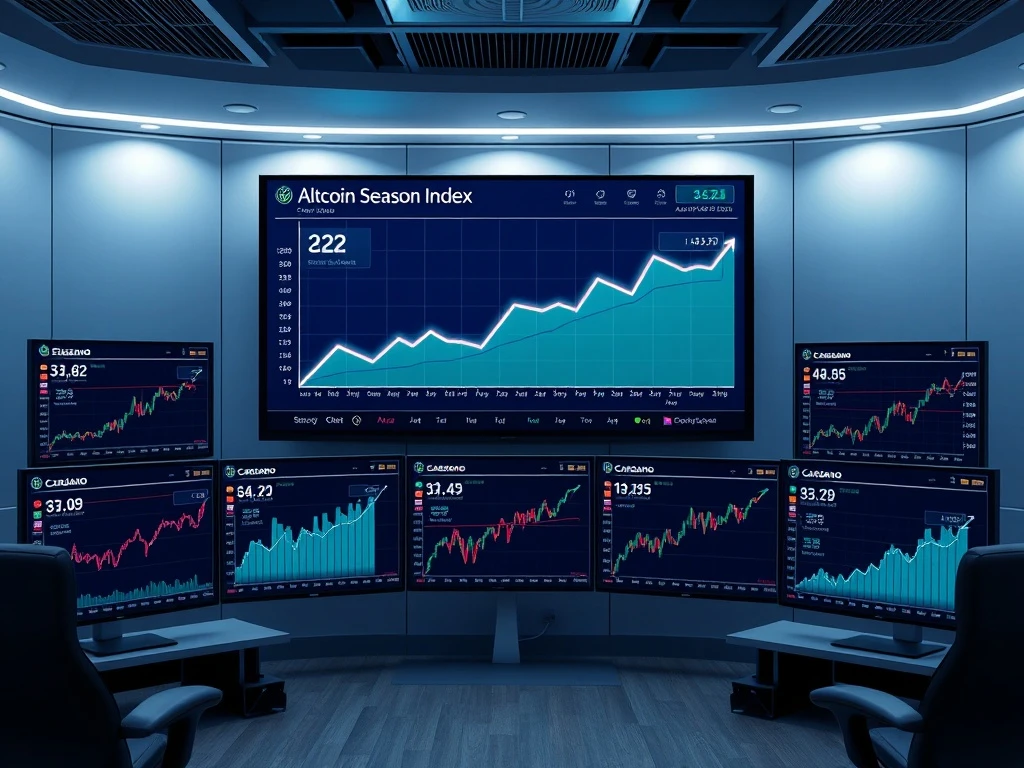
Global cryptocurrency markets are witnessing a subtle but significant signal as CoinMarketCap’s Altcoin Season Index climbs four points to a score of 32. This movement, recorded on April 10, 2025, provides a data-driven glimpse into the evolving relationship between Bitcoin and the broader altcoin market. Consequently, analysts and investors are scrutinizing this metric for clues about the next major phase in the digital asset cycle. The index serves as a critical barometer, measuring whether capital is rotating toward alternative cryptocurrencies or remaining concentrated in Bitcoin.
Understanding the Altcoin Season Index Mechanics
CoinMarketCap’s Altcoin Season Index operates on a transparent and quantitative methodology. Fundamentally, it compares the 90-day price performance of the top 100 cryptocurrencies, excluding stablecoins and wrapped assets, against Bitcoin’s performance over the same period. The platform declares an official “altcoin season” when 75% of these assets outperform Bitcoin. Therefore, the index score reflects the percentage of altcoins currently beating Bitcoin, with a score of 100 representing a full altcoin season. The recent rise from 28 to 32 indicates that four additional major altcoins have begun outperforming the pioneer cryptocurrency over the last quarter.
The Historical Context of Market Cycles
Historically, cryptocurrency markets move in distinct cycles dominated by either Bitcoin or altcoins. For instance, during Bitcoin seasons, investors typically flock to the perceived safety and liquidity of BTC, especially during periods of macroeconomic uncertainty. Conversely, altcoin seasons often emerge during bullish market phases characterized by high risk appetite and speculation on newer technologies. The current index level of 32, while below the 75 threshold, represents the highest reading in several months. This gradual ascent suggests a potential early-stage rotation, a pattern observed in previous cycle transitions.
Analyzing the Drivers Behind the Index Movement
Several concurrent factors in the broader blockchain ecosystem may be contributing to this incremental shift. Firstly, increased institutional development on smart contract platforms like Ethereum, Solana, and Avalanche is generating tangible utility. Secondly, recent protocol upgrades and successful mainnet launches are drawing developer attention and capital. Meanwhile, Bitcoin’s price has exhibited relative stability, creating a comparative window for altcoins to capture gains. Market data shows trading volume for major altcoins increasing by approximately 15% week-over-week, supporting the index’s narrative.
Key characteristics of a developing altcoin season include:
- Increased Relative Strength: Altcoin/Bitcoin trading pairs show strengthening trends.
- Rising Social Dominance: Discussions shift from Bitcoin-centric topics to specific altcoin projects.
- Volume Divergence: Altcoin trading volumes grow as a percentage of total crypto market volume.
Expert Perspectives on the Metric’s Significance
Financial analysts emphasize that the Altcoin Season Index is a lagging indicator, confirming trends already in motion. “A move from 28 to 32 is noteworthy, but it’s a signal to watch, not a trigger to act,” notes a market strategist from a major digital asset fund. “Historically, sustained moves above 50 have preceded more aggressive rotations. We monitor on-chain flows and derivatives data alongside this index for confirmation.” This cautious analysis underscores the importance of using the index as one tool within a broader analytical framework, not a standalone predictor.
Comparing Current Data to Previous Cycle Thresholds
To assess the potential of the current reading, a comparison to previous cycles is essential. During the pronounced altcoin season of early 2021, the index sustained levels above 75 for nearly five months. The climb to that peak, however, began with similar incremental gains from a low base. The table below illustrates key threshold levels and their historical market implications:
| Index Range | Market Phase Interpretation | Typical Investor Sentiment |
|---|---|---|
| 0-25 | Strong Bitcoin Dominance | Risk-Off, Cautious |
| 26-50 | Neutral to Early Rotation | Selective, Research-Driven |
| 51-74 | Developing Altcoin Strength | Increasing Risk Appetite |
| 75-100 | Confirmed Altcoin Season | High Risk-On, Speculative |
The current position in the 26-50 range suggests a neutral market with early signs of rotation. Accordingly, market participants are likely increasing their research into fundamental altcoin projects rather than making broad, speculative bets.
The Impact on Trading and Investment Strategies
A rising Altcoin Season Index directly influences portfolio management decisions. Seasoned traders often use such metrics to adjust their asset allocation between Bitcoin and altcoins. For example, a trend toward a higher index may prompt a gradual rebalancing into high-conviction altcoin positions. However, risk management remains paramount. The cryptocurrency market’s volatility means that a four-point index gain can reverse quickly based on macroeconomic news or Bitcoin price action. Therefore, diversification and position sizing are critical, even when indicators suggest a shifting trend.
Integration with Broader Market Analysis
Astute analysts never view the Altcoin Season Index in isolation. They correlate it with other vital metrics like Bitcoin dominance, total stablecoin supply on exchanges, and funding rates in perpetual swap markets. Presently, Bitcoin dominance remains elevated but has ticked down slightly, offering a congruent signal with the rising altcoin index. Simultaneously, the aggregate stablecoin reserve on exchanges provides the potential fuel for altcoin purchases if sentiment improves further. This multi-faceted analysis creates a more robust picture than any single metric can provide.
Conclusion
The Altcoin Season Index’s four-point rise to 32 marks a notable development in the ongoing assessment of cryptocurrency market structure. While the index remains far from the 75-point threshold that defines a full altcoin season, the movement indicates a measurable shift in relative performance. This data point, when combined with on-chain activity and development progress across multiple Layer 1 and Layer 2 networks, suggests a market in a state of careful evaluation. Ultimately, the Altcoin Season Index serves as a crucial quantitative gauge, helping investors navigate the complex and often sentiment-driven transitions between Bitcoin and altcoin market cycles. Monitoring its trajectory in the coming weeks will be essential for understanding the market’s next directional phase.
FAQs
Q1: What exactly does an Altcoin Season Index score of 32 mean?
A1: A score of 32 means that approximately 32% of the top 100 cryptocurrencies (excluding stablecoins) have outperformed Bitcoin in price over the past 90 days. It indicates early but not dominant strength in the altcoin market.
Q2: How is the Altcoin Season Index calculated?
A2: CoinMarketCap calculates the index by comparing the 90-day price performance of each of the top 100 cryptocurrencies against Bitcoin’s performance. The score is the percentage of those altcoins that have outperformed BTC.
Q3: Has a true altcoin season been declared?
A3: No. According to the standard definition used by the index, an altcoin season is only declared when the index reaches 75 or higher, meaning 75% of top altcoins are outperforming Bitcoin. The current score is 32.
Q4: Is a rising index always a bullish sign for altcoins?
A4: Not necessarily. A rising index shows relative strength compared to Bitcoin, but if the overall crypto market is in a downturn, both Bitcoin and altcoins could be losing value, just with altcoins losing less. Context is key.
Q5: What other metrics should I watch alongside the Altcoin Season Index?
A5: For a complete picture, monitor Bitcoin dominance, total cryptocurrency market capitalization, trading volume distribution, and on-chain metrics like exchange flows. These together provide better context than the index alone.