Bitcoin Plummets: Trump’s Aggressive Tariff Threats Trigger Widespread Risk Aversion, Analysis Shows

TOKYO, March 2025 – Bitcoin faces significant downward pressure as renewed tariff threats from former U.S. President Donald Trump trigger a sharp retreat from risk assets across global markets, according to a comprehensive analysis by XWIN Research Japan. The firm, a noted contributor to the on-chain analytics platform CryptoQuant, directly links current cryptocurrency weakness to escalating trade policy uncertainty. This development marks a critical moment for digital asset investors navigating an increasingly complex macroeconomic landscape.
Bitcoin Price Faces Direct Pressure from Tariff Policies
XWIN Research Japan’s analysis presents a clear causal relationship. The firm explains that Trump’s proposed tariff policies exert measurable downward pressure on Bitcoin’s valuation from 2025 onward. Tariffs directly impact three key economic pillars: corporate earnings, inflation rates, and monetary policy expectations. Consequently, these factors collectively weaken overall investor risk appetite. In this environment, speculative assets like Bitcoin become particularly vulnerable to corrections.
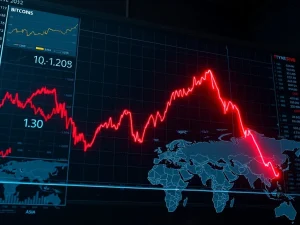
The research highlights a consistent historical pattern. Periods of Bitcoin price decline from the previous year to the present have frequently coincided with spikes in economic uncertainty. These spikes often originate from trade conflicts and tariff announcements. The analysis suggests Bitcoin now acts as a sensitive barometer for global trade tensions. Furthermore, the firm notes that economic risks now price into cryptocurrency markets with remarkable speed.
Mechanisms of Market Sentiment Shift
Uncertainty over future economic growth and interest rate trajectories causes investors to reassess portfolios. They systematically reduce short-term exposure to volatile assets during such periods. In this risk-off process, market participants often treat Bitcoin more as a liquid asset for quick risk reduction than a long-term store of value. This behavioral shift leads to temporary but pronounced sell-offs. The liquidity and 24/7 trading nature of cryptocurrency markets accelerate this reaction compared to traditional markets.
Key Transmission Channels Identified:
- Corporate Earnings Shock: Tariffs increase costs for import-dependent companies, potentially lowering equity valuations and creating a negative wealth effect that spills into crypto.
- Inflation Expectations: Higher import prices can fuel inflation, prompting fears of more aggressive central bank tightening, which historically pressures growth-sensitive assets.
- Monetary Policy Uncertainty: Central banks face a complex dilemma—fighting potential tariff-induced inflation without stifling growth—creating volatility in rate expectations.
- Global Growth Concerns: Trade wars threaten global supply chains and economic output, reducing capital available for speculative investment.
Expert Insight from Financial Historians
Financial historians note that trade policy shocks have historically precipitated capital flight from emerging and speculative markets. Dr. Eleanor Vance, an economic historian at the Global Finance Institute, contextualizes this pattern. “Throughout modern financial history, from the Smoot-Hawley Tariff Act to recent U.S.-China tensions, the initial market reaction to protectionist measures is a flight to safety. Cryptocurrencies, despite their decentralized nature, are not immune to this classic risk-off dynamic. They are traded within a global financial system that remains highly sensitive to policy rhetoric.” This perspective underscores that Bitcoin’s reaction, while modern in its asset class, follows a traditional financial playbook.
Comparative Analysis with Previous Risk-Off Events
The current scenario invites comparison with other recent risk-off episodes. The table below contrasts key market characteristics.
| Event | Primary Trigger | Bitcoin Drawdown | Recovery Time | Key Difference in 2025 |
|---|---|---|---|---|
| COVID-19 Market Crash (Mar 2020) | Global Pandemic Fear | ~50% | 2 Months | Liquidity crisis; Fed response was immediate and massive. |
| 2022 Fed Tightening Cycle | Inflation & Rate Hikes | ~65% | 16+ Months | Monetary policy was the clear, measurable driver. |
| 2025 Tariff Threats (Current) | Trade Policy Uncertainty | Ongoing | TBD | Trigger is fiscal/political, creating unpredictable policy response. |
This comparison reveals a critical distinction. The current trigger stems from fiscal and political rhetoric, not a monetary policy shift or a singular external shock. This makes the market’s path forward less predictable. The uncertainty lies not just in the economic impact, but in the final form and implementation of the policies themselves.
The Dual Nature of Bitcoin in Modern Portfolios
XWIN Research Japan’s findings underscore Bitcoin’s evolving and sometimes contradictory role. During calm, growth-oriented periods, narratives often emphasize its potential as “digital gold”—a long-term store of value uncorrelated to traditional finance. However, during acute stress events, its trading behavior often reverts to that of a high-beta, high-liquidity risk asset. This duality creates complex dynamics for portfolio managers. The analysis cautions that the current negative impact on Bitcoin’s price could persist. However, the market’s assessment remains fluid and may change based on two critical on-chain signals.
First, a structural increase in exchange inflows could indicate sustained selling pressure or preparation for further volatility. Second, a general deterioration in supply and demand conditions, visible in metrics like exchange reserves and active address growth, would confirm a broader bearish shift. Monitoring these on-chain fundamentals becomes essential for separating political noise from genuine market weakness.
Real-World Impact on Retail and Institutional Investors
The implications extend beyond charts. For retail investors, this volatility tests conviction in dollar-cost averaging strategies during geopolitical storms. For institutions, it complicates asset allocation models that may have recently begun assigning a non-correlated hedging role to Bitcoin. Pension funds and endowments, now with small crypto allocations, must weigh this volatility against their long-term mandates. Meanwhile, cryptocurrency mining operations face pressure from both falling Bitcoin prices and potential increases in energy costs, should tariffs affect hardware imports or energy markets.
Conclusion
The analysis from XWIN Research Japan provides a crucial framework for understanding current Bitcoin price action. It directly links market weakness to the risk aversion triggered by Trump’s tariff threats. The report demonstrates how trade policy uncertainty swiftly transmits to cryptocurrency valuations through established economic channels. While Bitcoin’s long-term narrative remains debated, its short-term sensitivity to macroeconomic and geopolitical shocks is now undeniable. Investors must now navigate a landscape where presidential rhetoric can be as influential as Federal Reserve announcements, highlighting the deepening integration of digital assets into the global financial system.
FAQs
Q1: How do tariffs specifically affect the price of Bitcoin?
A1: Tariffs affect Bitcoin indirectly through several channels. They threaten corporate profits and economic growth, which reduces overall investor appetite for risk. They can also increase inflation expectations, leading to fears of tighter monetary policy from central banks. As uncertainty rises, investors sell liquid assets like Bitcoin first to reduce portfolio risk.
Q2: Is Bitcoin still considered a hedge against inflation if tariffs cause inflation?
A2: The “inflation hedge” narrative for Bitcoin is challenged in this scenario. Tariff-induced inflation is often seen as negative for economic growth (stagflation risk). In such cases, traditional safe-havens like the U.S. dollar or Treasuries may initially benefit, while growth-sensitive assets, including Bitcoin, can struggle until the policy path becomes clear.
Q3: Does this analysis mean Bitcoin is just a risk asset, not digital gold?
A3: The analysis highlights Bitcoin’s current market behavior during a stress event, where it is acting as a liquid risk asset. Its long-term identity is still evolving. Historically, its correlation to risk assets like tech stocks increases during market downturns, but its behavior can diverge over different time horizons and under different types of crises.
Q4: What should cryptocurrency investors watch for next?
A4: Investors should monitor: 1) The specific details and implementation timeline of any announced tariff policies, 2) On-chain metrics like exchange inflows/outflows and whale wallet movements, 3) Broader market indicators like the U.S. Dollar Index (DXY) and bond yields, which signal risk appetite, and 4) Commentary from major central banks regarding their policy response.
Q5: Have trade wars impacted cryptocurrencies like Bitcoin in the past?
A5: Yes. Previous episodes of U.S.-China trade tensions during the late 2010s often coincided with increased volatility in Bitcoin markets. However, the cryptocurrency ecosystem was smaller and less integrated with traditional finance at that time. The 2025 context is different due to Bitcoin’s larger market capitalization, institutional participation, and its recognition as a legitimate, though volatile, financial asset.