Bitcoin ETF Inflows Defy Global Tensions, Anchoring Price Near $92K
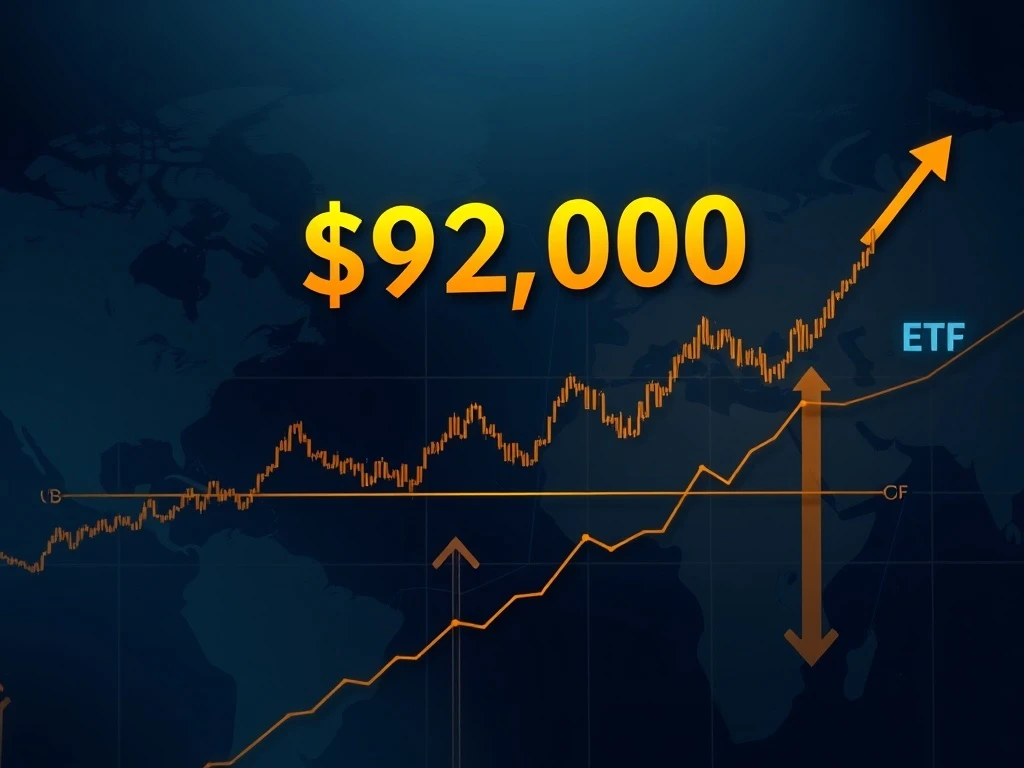
Global, January 2025 – Bitcoin demonstrates remarkable resilience, stabilizing near the $92,000 threshold despite a week marked by significant geopolitical friction and market turbulence. This stability primarily stems from substantial and consistent capital flowing into U.S. spot Bitcoin exchange-traded funds (ETFs), which is effectively counterbalancing the negative sentiment driven by escalating U.S.-Europe trade disputes. The dynamic creates a fascinating tug-of-war between institutional adoption and macro risk, offering a clear window into the cryptocurrency’s evolving market structure.
Bitcoin ETF Inflows Provide Structural Market Support
Spot Bitcoin ETFs have transitioned from a novel product to a foundational pillar of market support. Recent weekly net inflows reached their highest level in three months, providing a continuous bid for the underlying asset. This capital, largely from institutional and long-term investors, exhibits lower sensitivity to daily price volatility compared to speculative traders. Consequently, these inflows create a durable demand floor. Analysts observe that this structural shift allows Bitcoin to absorb sell-side pressure more effectively than in previous market cycles, where leverage and retail sentiment dominated price action.
The mechanism is straightforward yet powerful. When an investor buys shares of a spot Bitcoin ETF, the issuer must purchase an equivalent amount of actual Bitcoin to back the shares. This process creates direct, sustained buying pressure on the cryptocurrency. The consistency of these inflows, even during periods of broader market uncertainty, signals a deepening conviction in Bitcoin’s long-term value proposition among professional asset allocators. This trend represents a maturation of the market, moving it closer to other established asset classes where fund flows significantly influence price discovery.
On-Chain Data Reveals Underlying Strength
Beyond ETF flow data, on-chain metrics corroborate the narrative of underlying demand. Following a sharp sell-off that triggered over $865 million in leveraged position liquidations, blockchain data shows accumulation activity resumed swiftly. This rapid buyer response suggests that a significant portion of the market viewed the dip as a buying opportunity rather than a trend reversal. Furthermore, the liquidation event itself served a healthy market function by clearing excessive leverage, which reduces the risk of cascading sell-offs and creates a more stable foundation for price appreciation.
Geopolitical Tensions Inject Short-Term Volatility
While ETF inflows provide a bullish undercurrent, immediate price action remains susceptible to global macroeconomic and political developments. Two primary flashpoints are currently weighing on risk assets, including cryptocurrencies. First, renewed trade tensions between the United States and Europe have escalated, with threats of tariffs up to 25% on certain European imports. Such protectionist measures threaten global economic growth and trade flows, prompting investors to reassess risk exposure across their portfolios.
Second, diplomatic friction concerning Arctic sovereignty, specifically involving Greenland, has introduced another layer of geopolitical uncertainty. Communications between U.S. and Norwegian leadership have highlighted strategic tensions in the region. Historically, digital assets like Bitcoin have experienced correlated selling pressure during periods of strained international relations and trade uncertainty, as investors seek safer havens or reduce overall portfolio risk. The current environment tests Bitcoin’s perceived role as a potential hedge against traditional market stress.
Options Market Signals Caution
The derivatives market provides a forward-looking sentiment gauge. Data reveals a rising demand for put options, which are contracts that profit if Bitcoin’s price falls. This trend is reflected in a falling 25-delta skew metric. Essentially, more traders are paying a premium to insure their holdings against potential downside, anticipating that near-term volatility will persist. This activity does not necessarily predict a major drop but indicates that professional market participants are hedging their bets, acknowledging the elevated uncertainty from geopolitical headlines while maintaining core positions supported by the ETF inflow thesis.
The Interplay of Conflicting Market Forces
The current Bitcoin market is a textbook example of conflicting fundamental forces. On one side, powerful supportive factors are at work. These include:
- Steady Institutional Capital: ETF inflows represent a new, predictable source of demand.
- Reduced Systemic Leverage: Recent liquidations decreased market fragility.
- Long-Term Holder Conviction: On-chain data shows seasoned investors are not distributing coins.
Conversely, significant headwinds create resistance. The primary opposing forces are:
- Geopolitical Risk: Trade wars and diplomatic strains dampen risk appetite.
- Regulatory Overhang: Unresolved U.S. crypto policy creates uncertainty.
- Technical Resistance: The $92,000-$95,000 zone has historically acted as a supply area.
This balance of forces explains the current consolidation. The market is in a state of equilibrium where neither bulls nor bears have decisive control, resulting in price action that appears range-bound but is internally dynamic. The resolution will likely come from a shift in the intensity of one of these primary drivers, such as a de-escalation in trade rhetoric or a notable acceleration in ETF adoption.
Historical Context and Market Maturation
Comparing the current scenario to past market cycles highlights Bitcoin’s maturation. Previous periods of geopolitical stress, such as the U.S.-China trade war in 2019, often led to more pronounced and prolonged sell-offs in crypto markets. The presence of large, regulated ETFs appears to be altering this dynamic by introducing a class of buyers whose investment thesis is less reactive to daily news flow and more focused on multi-year adoption trends. This development suggests Bitcoin is gradually decoupling from pure risk-on/risk-off behavior and establishing a more independent price trajectory based on its unique value drivers, though the process is incomplete.
Conclusion
Bitcoin’s stability near $92,000 is a testament to the powerful countervailing forces shaping its market. Robust and consistent Bitcoin ETF inflows from institutional investors are providing unprecedented structural support, effectively anchoring the price against waves of geopolitical anxiety. While trade tensions and options market hedging signal that volatility may persist in the short term, the underlying demand narrative remains compelling. The market is currently digesting macro risks while simultaneously building a stronger foundation through regulated investment vehicles. This interplay between immediate geopolitical headwinds and long-term institutional tailwinds defines the current phase, making Bitcoin’s resilience a key indicator of its evolving role in the global financial landscape.
FAQs
Q1: How do Bitcoin ETF inflows directly support the price?
A1: When investors buy shares of a spot Bitcoin ETF, the fund issuer must purchase an equivalent amount of actual Bitcoin to custody. This creates direct, sustained buying pressure in the market, increasing demand for a finite supply of coins.
Q2: Why do geopolitical tensions like trade wars affect Bitcoin’s price?
A2: Bitcoin is still largely considered a risk asset by many institutional portfolios. During periods of geopolitical stress, investors often reduce exposure to perceived riskier assets across the board, which can lead to correlated selling pressure in crypto markets.
Q3: What does rising demand for put options indicate?
A3: Increased buying of put options shows that traders are seeking insurance against a potential price decline. It reflects a market that is cautious and expects near-term volatility, not necessarily one that is predicting a major crash.
Q4: Did the recent large liquidations help the market?
A4: Yes, in a healthy way. The $865+ million in liquidations cleared out excessive leverage from overextended traders. This reduces systemic risk and the potential for a cascading series of forced sells, creating a more stable base for price movement.
Q5: Is the current institutional demand through ETFs a permanent change?
A5: While future flows can vary, the launch of spot Bitcoin ETFs represents a permanent structural change. It has created a regulated, accessible pathway for traditional finance capital to enter the Bitcoin market, a channel that did not exist at this scale prior to 2024.