Greenland Tariff War Threatens Global Economy: Could Slash GDP Growth to Alarming 2.6%
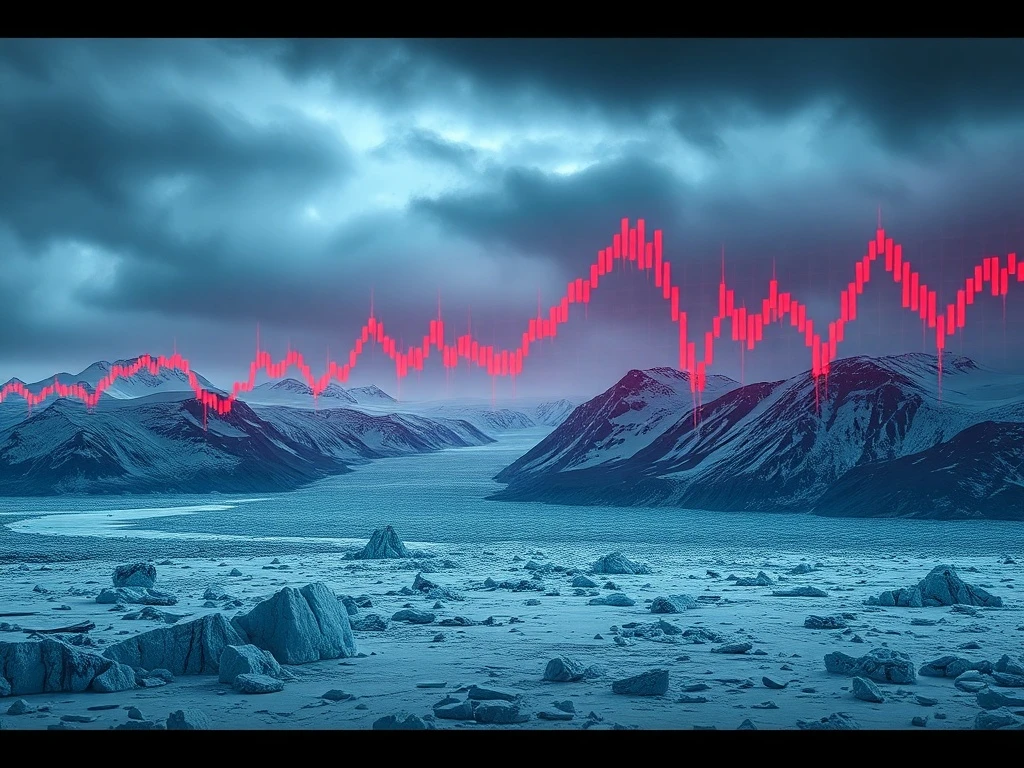
LONDON, March 2025 – A simmering geopolitical dispute over the future of Greenland has escalated into a severe economic warning, as a new analysis projects a potential tariff war could drag global GDP growth down to a concerning 2.6%. This stark forecast, detailed in a comprehensive report from the renowned research firm Oxford Economics, highlights how a U.S. push to acquire the strategic Arctic territory could trigger a damaging trade conflict with the European Union, with repercussions echoing across the world economy.
Greenland Tariff War: The Economic Mechanics of a Geopolitical Flashpoint
Oxford Economics constructed a detailed scenario to model the potential fallout. The firm’s analysis centers on a specific chain of events: the United States imposes an additional 25% tariff on imports from six key European Union nations. This aggressive move is framed as a pressure tactic within broader negotiations concerning U.S. ambitions to acquire Greenland from the Kingdom of Denmark. Consequently, the EU enacts swift and escalating retaliatory tariffs on American goods. This tit-for-tat cycle, according to the model, would not remain contained. The immense combined economic weight of the U.S. and Eurozone—representing nearly half of global GDP—ensures the shockwaves propagate through international supply chains, financial markets, and consumer confidence worldwide.
The report’s projections are precise and sobering. U.S. GDP could fall by up to 1% from current baseline forecasts. Meanwhile, the Eurozone would experience a similar magnitude of economic damage, though the negative effects would likely persist over a more extended period due to structural differences in their economies. This synchronized slowdown among the world’s largest advanced economies creates a powerful drag on global growth. Oxford Economics emphasizes that a 2.6% global growth rate would dip below the stable 2.8% to 2.9% range maintained over the past three years. More alarmingly, it would represent the lowest annual global growth figure since the depths of the 2009 financial crisis, explicitly excluding the anomalous collapse during the 2020 COVID-19 pandemic.
Historical Context and the Precarious Global Outlook
To fully grasp the significance of a 2.6% growth rate, one must examine recent economic history. The global economy has demonstrated remarkable resilience following the pandemic, navigating persistent inflation, shifting monetary policies, and regional conflicts. However, this resilience has been fragile, built on a delicate balance of trade and cooperation. The period from 2022 to 2024 saw growth stabilize in the high-2% range, a pace economists considered sustainable if unspectacular. A drop to 2.6% signifies a meaningful break from this stability, pushing growth perilously close to what many analysts define as a “global growth recession”—a period where expansion falls significantly below potential.
The potential conflict stems from Greenland’s immense strategic value. Its location offers control over emerging Arctic shipping routes and access to vast untapped resources, including rare earth minerals critical for technology and green energy. While a U.S. purchase is considered a long-shot political scenario, the mere discussion has intensified diplomatic tensions. The EU views the Arctic as a region of strategic interest and cooperation, and any unilateral move by a major power is met with deep skepticism. This report translates those geopolitical frictions into concrete economic metrics, showing how political posturing can swiftly translate into tangible financial pain for businesses and consumers far from the Arctic Circle.
Expert Analysis from Oxford Economics
The credibility of this warning hinges on its source. Oxford Economics is a leader in global forecasting and quantitative analysis, serving corporations, financial institutions, and government agencies. Their models incorporate millions of data points on trade flows, sectoral dependencies, and consumer behavior. In this analysis, they have applied their proven trade war modeling framework—previously used to assess the impacts of U.S.-China tensions—to the novel scenario of a Greenland-induced transatlantic rift. The firm’s experts note that modern global supply chains are so deeply integrated that tariffs act as a tax on efficiency, raising costs for producers and prices for consumers simultaneously in both blocs. They also highlight the risk of a “confidence shock,” where uncertainty from the dispute causes businesses to delay investments and hiring, amplifying the initial direct impact of the tariffs.
Comparative Impact: Sectors and Global Regions at Risk
Not all sectors or regions would feel the pain equally. A targeted tariff war would create distinct winners and losers, further distorting global markets.
- Manufacturing & Automotive: These highly integrated transatlantic industries would be hit hardest. Complex supply chains for automobiles, aerospace, and machinery span the U.S. and EU. Tariffs would disrupt production schedules and squeeze profit margins.
- Agriculture: Historically a flashpoint in trade disputes, farmers on both sides of the Atlantic would face immediate market loss and price volatility for commodities.
- Emerging Markets: Nations reliant on exporting raw materials or intermediate goods to either the U.S. or EU would see demand slump. Additionally, global financial tightening triggered by the uncertainty could trigger capital flight from vulnerable economies.
- Arctic & Green Technology: Ironically, the very sectors related to Greenland’s value—mining for critical minerals and developing green energy—could suffer from reduced cross-border investment and collaboration.
The following table illustrates the projected deviation from baseline GDP forecasts in the report’s core scenario:
| Region/Economy | Projected GDP Impact | Key Driver |
|---|---|---|
| United States | Down ~1.0% | Retaliatory EU tariffs, reduced export demand |
| Eurozone | Down ~1.0% (extended period) | Initial U.S. tariffs, stronger currency headwinds |
| Global GDP Growth | Falls to 2.6% | Combined demand destruction and supply chain disruption |
| Other Advanced Economies (e.g., UK, Japan) | Moderate negative spillover | Reduced trade with core blocs, financial contagion |
| Export-Dependent Emerging Markets | High vulnerability | Commodity price drops, reduced manufacturing orders |
Pathways Forward: Mitigation Versus Escalation
The Oxford Economics report serves as a preventive warning rather than a certainty. The firm outlines the severe economic costs precisely to underscore the value of diplomatic resolution. Several pathways could avert this scenario. First, multilateral dialogue through existing forums like the Arctic Council could reaffirm commitments to peaceful cooperation, sidelining discussions of territorial transactions. Second, the U.S. and EU could pursue a targeted critical minerals agreement, separately addressing resource security concerns without linking them to Greenland’s sovereignty. Finally, strengthening the global trade rulebook at the World Trade Organization would provide a more robust mechanism for resolving disputes, preventing the rapid escalation modeled in the report.
Conversely, the analysis also maps the risks of escalation. Should initial tariffs be implemented, the automated retaliation mechanisms now embedded in many trade policies could quickly lock both sides into a cycle. Political rhetoric could harden, making de-escalation more difficult. Furthermore, other global powers might exploit the transatlantic rift, leading to a broader fragmentation of the global economy into competing blocs—a outcome with even more dire long-term growth implications than a single-year drop to 2.6%.
Conclusion
The Oxford Economics analysis delivers a clear, evidence-based message: a Greenland tariff war represents a severe and plausible threat to global economic stability. By quantifying the potential damage—a drop in global GDP growth to 2.6%, marking the weakest performance since 2009 outside of the pandemic—the report translates Arctic geopolitics into universal economic terms. The core takeaway is that in an interconnected world, regional disputes over territory and resources can no longer be isolated. They carry immediate and significant costs for worldwide growth, investment, and employment. The findings underscore the paramount importance of diplomatic engagement and the preservation of open, rules-based trade channels to avoid triggering a self-inflicted economic wound that would slow growth across all continents.
FAQs
Q1: Why is Greenland at the center of a potential trade war?
Greenland’s strategic location in the Arctic and its vast resources, including rare earth minerals, make it a geostrategic prize. A U.S. interest in acquiring it, however unlikely, conflicts with EU strategic interests and Danish sovereignty, creating a flashpoint that could spill over into trade policy as a pressure tactic.
Q2: How does Oxford Economics calculate the 2.6% global GDP growth figure?
They use sophisticated economic modeling that simulates the impact of specific tariff increases on trade volumes, production costs, consumer prices, and business investment. The model then calculates how these changes in the U.S. and EU propagate through global supply chains and financial markets to affect worldwide aggregate demand.
Q3: Which six EU nations are mentioned in the tariff scenario?
While the report summary does not name them, analysts suggest they would likely be major U.S. trading partners within the EU, such as Germany, France, Italy, the Netherlands, Spain, and Ireland, given their significant export economies.
Q4: Is a global growth rate of 2.6% considered a recession?
Not technically a global recession, which typically requires a contraction. However, 2.6% would be considered a “growth recession” or a significant slowdown, falling below the economy’s potential and leading to rising unemployment and underutilized resources worldwide.
Q5: Could this tariff war actually happen?
The report analyzes a scenario, not a prediction. Its purpose is to quantify the risks of escalating rhetoric and protectionist actions. The probability depends entirely on political decisions, which is why economists publish such warnings—to inform those decisions with clear data on the potential consequences.