Altcoin Season Index Plummets to 26: A Stark Signal of Bitcoin’s Resurgent Dominance in 2025
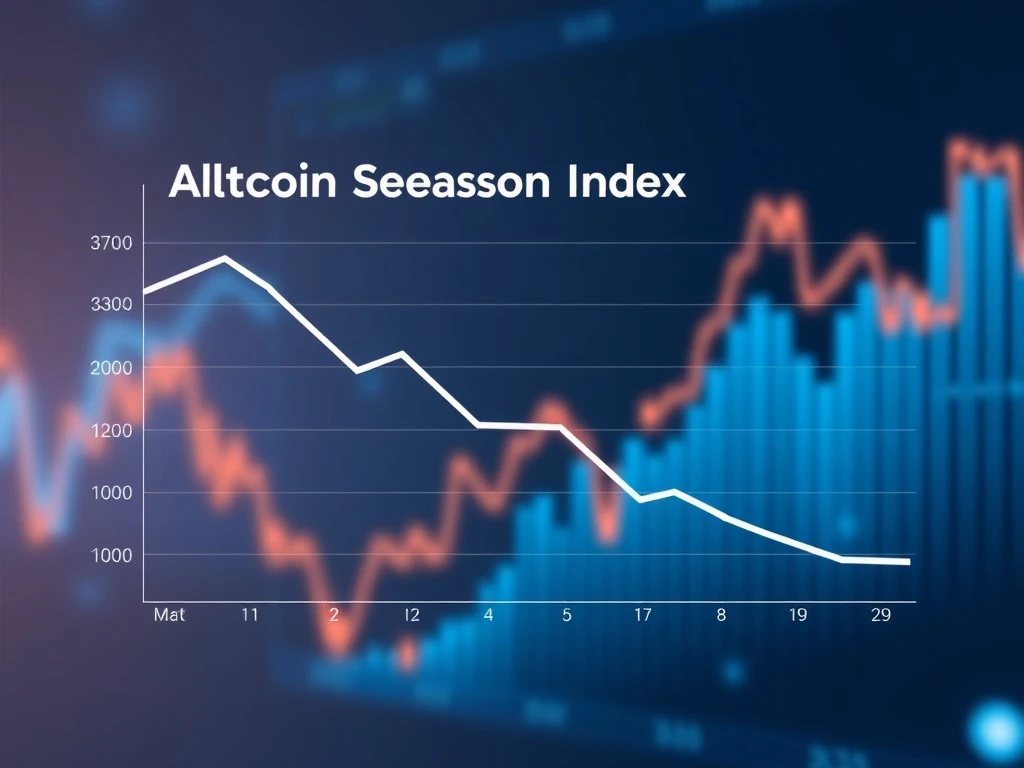
Global cryptocurrency markets witnessed a significant shift this week as CoinMarketCap’s closely watched Altcoin Season Index fell three points to a stark 26, intensifying discussions about a potential prolonged Bitcoin season. This notable decline, recorded on April 10, 2025, provides a crucial data point for investors navigating the complex dynamics of digital asset cycles. The index serves as a primary barometer for market sentiment, measuring the relative performance of major altcoins against the pioneering cryptocurrency, Bitcoin. Consequently, this drop signals a period where Bitcoin is significantly outperforming the broader altcoin market, a trend with substantial implications for portfolio strategy and market psychology.
Understanding the Altcoin Season Index and Its Critical Drop
The Altcoin Season Index operates on a transparent, quantitative methodology. Analysts at CoinMarketCap calculate it by comparing the 90-day price performance of the top 100 cryptocurrencies by market capitalization. This calculation deliberately excludes stablecoins and wrapped tokens to focus purely on speculative assets. The core question the index answers is simple: what percentage of these major altcoins have outperformed Bitcoin over the last quarter? A reading above 75 triggers an official “altcoin season” declaration, indicating widespread altcoin strength. Conversely, a reading of 26, as seen now, places the market firmly in “Bitcoin season” territory, highlighting Bitcoin’s relative strength.
This three-point drop from 29 to 26 is not an isolated data point. Instead, it represents a continuation of a trend observed throughout early 2025. Market data shows the index has struggled to climb above 35 this year, following a volatile end to 2024. Several factors contribute to this environment. Firstly, institutional investment flows, often channeled through newly approved spot Bitcoin ETFs, have disproportionately favored Bitcoin. Secondly, macroeconomic uncertainty has historically driven capital toward Bitcoin as a perceived digital gold standard, rather than riskier altcoins. Finally, the current market cycle phase often exhibits strong Bitcoin dominance before potential altcoin rotations later.
Historical Context and Market Cycle Analysis
To fully grasp the significance of a score of 26, historical comparison is essential. During the peak of the 2021 bull market, the Altcoin Season Index repeatedly surged above 75, with some periods even approaching 90. These phases were characterized by explosive growth in decentralized finance (DeFi) and non-fungible token (NFT) projects, which fueled altcoin mania. In stark contrast, the prolonged bear market of 2022 saw the index languish below 25 for months, mirroring today’s level but under vastly different sentiment conditions.
The current landscape in 2025 presents a unique hybrid scenario. Unlike the deep fear of a bear market, current conditions feature cautious optimism largely centered on Bitcoin. This creates a bifurcated market. On one hand, Bitcoin benefits from its established store-of-value narrative and regulatory clarity in major economies. On the other hand, altcoins face heightened scrutiny regarding their utility, tokenomics, and regulatory pathways. The index effectively captures this tension, quantifying the market’s preference for the benchmark asset over speculative alternatives.
Expert Insights on Index Movements and Investor Implications
Financial analysts specializing in crypto markets emphasize that the index is a lagging indicator, reflecting performance over a 90-day window. Therefore, the drop to 26 confirms a trend that has been building for weeks. “The index is a powerful confirmation tool,” notes a veteran market strategist from a major crypto analytics firm. “A reading this low tells us that capital rotation into altcoins has stalled. Investors are not just favoring Bitcoin; they are actively choosing it over other crypto assets for the time being. This often precedes a period of consolidation before the next market phase.”
For practical portfolio management, this data suggests several actionable insights. Investors might consider reviewing their asset allocation to ensure it aligns with the dominant market trend. Furthermore, a low index reading can sometimes identify potential buying opportunities in fundamentally strong altcoins that have been oversold relative to Bitcoin, a strategy known as “contrarian accumulation.” However, this approach carries higher risk and requires thorough fundamental research beyond mere price performance metrics.
The Mechanics of Market Capitalization and Performance Measurement
The index’s reliance on the top 100 coins by market capitalization ensures it reflects the movement of the majority of liquid capital in the crypto space. Market capitalization, calculated as circulating supply multiplied by current price, serves as a proxy for network size and investor commitment. The exclusion of stablecoins like USDT and USDC is critical, as their pegged value does not reflect speculative performance. Similarly, wrapped tokens (e.g., WBTC) are excluded to avoid double-counting Bitcoin’s performance.
The 90-day performance window is a deliberate design choice. It smooths out short-term volatility and noise, capturing sustained trends rather than temporary spikes. This timeframe is long enough to filter out pump-and-dump schemes yet short enough to remain relevant for quarterly investment decisions. The resulting score provides a clear, single-digit snapshot of complex market dynamics, making it an accessible tool for both novice and experienced market participants.
Conclusion
The decline of the Altcoin Season Index to 26 offers a clear, quantitative signal of the current market structure. It underscores a period of pronounced Bitcoin dominance, driven by institutional flows, macroeconomic factors, and cyclical patterns. While this metric does not predict the future, it provides essential context for the present, confirming that the market remains in a phase where the original cryptocurrency commands superior performance. For investors, this emphasizes the importance of cycle awareness and disciplined strategy, reminding us that cryptocurrency markets move in distinct phases of dominance between Bitcoin and altcoins. Monitoring this index remains a key practice for navigating these evolving trends.
FAQs
Q1: What does an Altcoin Season Index score of 26 mean?
An index score of 26 means that only a small fraction of the top altcoins have outperformed Bitcoin over the past 90 days. It strongly indicates a “Bitcoin season,” where Bitcoin is the dominant performer in the cryptocurrency market.
Q2: How is the Altcoin Season Index calculated?
CoinMarketCap calculates the index by tracking the 90-day price performance of the top 100 cryptocurrencies (excluding stablecoins and wrapped tokens). It determines the percentage of these assets that have outperformed Bitcoin, translating that percentage into a score out of 100.
Q3: What is the difference between Bitcoin season and altcoin season?
Bitcoin season refers to a market phase where Bitcoin’s price performance outpaces the majority of alternative cryptocurrencies (altcoins). Altcoin season is the opposite phase, where 75% or more of the top altcoins outperform Bitcoin over a sustained period.
Q4: Can the Altcoin Season Index predict future price movements?
The index is primarily a descriptive, lagging indicator that confirms past trends. While it can signal the prevailing market structure, it should not be used alone to predict future prices. It is most valuable when combined with other fundamental and technical analysis tools.
Q5: Why are stablecoins excluded from the Altcoin Season Index calculation?
Stablecoins are excluded because their value is pegged to a fiat currency like the US dollar. Their price is designed to be stable, so including them would not provide meaningful data on speculative performance relative to volatile assets like Bitcoin and other altcoins.