On-Chain Loans with Off-Chain Collateral: Anchorage Digital and Spark Launch Revolutionary Bridge for Institutional DeFi Access
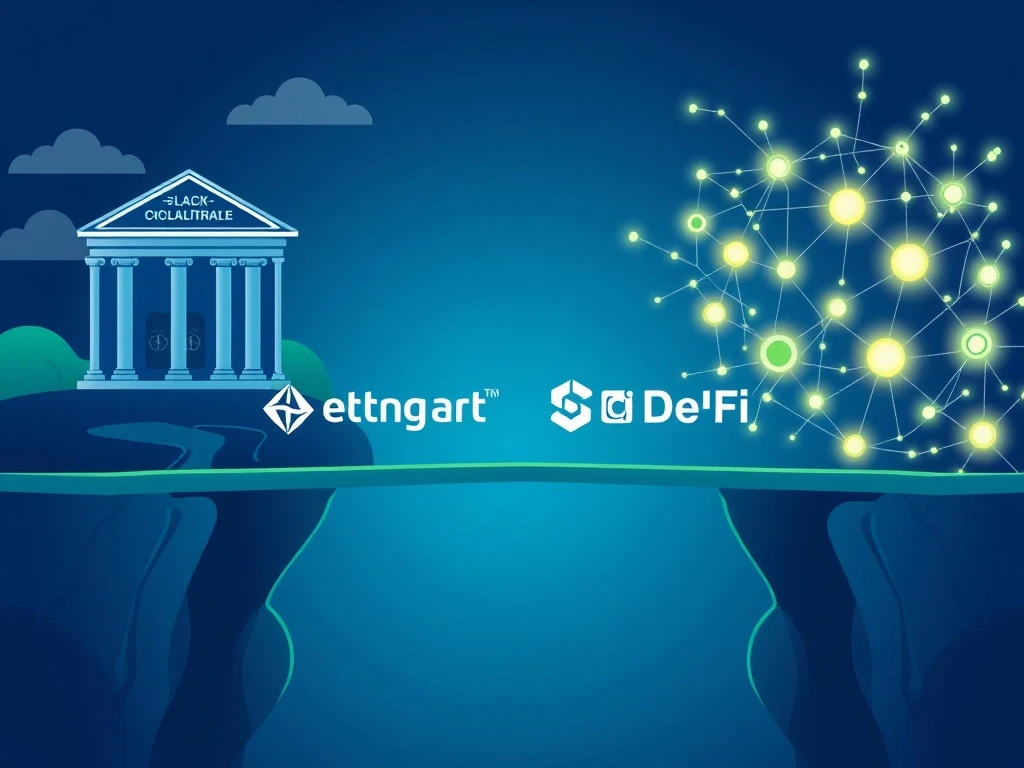
In a landmark development for institutional cryptocurrency adoption, crypto bank Anchorage Digital and decentralized finance protocol Spark have launched a pioneering lending product that fundamentally bridges two financial worlds. This innovative solution, reported by The Block, enables on-chain loans secured by off-chain collateral, directly addressing a critical barrier for major financial institutions. Consequently, this partnership signals a significant maturation phase for DeFi infrastructure, potentially unlocking billions in institutional capital. The announcement, made from San Francisco, California, on March 21, 2025, represents a strategic fusion of regulated custodial services with permissionless lending markets.
On-Chain Loans with Off-Chain Collateral: A Technical Breakdown
The core innovation lies in its hybrid architecture. Anchorage Digital, a federally chartered digital asset bank, securely holds the client’s collateral off-chain in its regulated custody. Simultaneously, Spark’s smart contracts on the Ethereum blockchain facilitate the loan origination and management. A verifiable attestation or proof of the collateral’s existence and lien is then communicated to the Spark protocol. This process allows the institutional client to borrow digital assets from Spark’s liquidity pools without physically moving their pledged assets onto a public blockchain. Therefore, the product mitigates key concerns around operational complexity, settlement risk, and regulatory uncertainty associated with direct on-chain transfers. The system leverages zero-knowledge proofs or signed attestations from the qualified custodian to provide the necessary cryptographic assurance to the lending protocol.
The Institutional Adoption Challenge
For years, a chasm has existed between traditional finance and decentralized finance. Major financial institutions possess vast pools of assets but face significant hurdles in participating in DeFi. These hurdles include:
- Operational Friction: Moving large-scale collateral on-chain involves complex wallet management, gas fees, and transaction finality risks.
- Regulatory Scrutiny: The act of transferring assets to a non-custodial, public smart contract can raise compliance and audit trail concerns.
- Counterparty Risk Perception: Institutions are accustomed to known, regulated entities rather than anonymous code-based protocols.
The Anchorage-Spark model directly confronts these challenges. It provides a familiar, regulated entry point via Anchorage while granting access to the capital efficiency and global liquidity of Spark.
Anchorage Digital and Spark: A Strategic Partnership Analysis
This collaboration is not coincidental but stems from complementary strengths. Anchorage Digital brings its foundational regulatory status as a qualified custodian, its deep relationships with hedge funds, venture capital firms, and corporate treasuries, and its institutional-grade security framework. Conversely, Spark contributes its robust, battle-tested DeFi lending infrastructure, its deep liquidity pools primarily in stablecoins like DAI, and its composability within the broader Ethereum ecosystem. Together, they create a trusted conduit. This partnership follows a growing trend of “institutional DeFi” or “DeFi 2.0” initiatives, where regulated entities build compliant gateways to decentralized protocols. Other examples include Figure Technologies’ use of Provenance blockchain and various bank-led tokenization projects. However, the direct integration of a chartered crypto bank’s custody with a leading money market protocol like Spark is particularly noteworthy for its seamlessness.
| Feature | Traditional Secured Loan | Native DeFi Loan (e.g., Aave, Compound) | Anchorage-Spark Hybrid Model |
|---|---|---|---|
| Collateral Location | Off-Chain (Bank Ledger) | On-Chain (Smart Contract) | Off-Chain (Regulated Custody) |
| Loan Issuance | Off-Chain (Bank System) | On-Chain (Smart Contract) | On-Chain (Spark Protocol) |
| Counterparty | Regulated Bank | Smart Contract / Pool | Spark Protocol (backed by custodian attestation) |
| Primary Audience | Institutions & Individuals | Crypto-Native Users & Funds | Institutional Crypto Holders |
| Key Innovation | N/A | Permissionless, Global Access | Regulatory & Operational Bridge |
Potential Market Impact and Future Implications
The immediate impact is the unlocking of dormant capital. Institutions holding large Bitcoin, Ethereum, or other digital asset positions can now leverage them for liquidity without selling, a process known as “collateralized borrowing.” This liquidity can be used for further investment, operational expenses, or treasury management. Looking forward, this model could set a new standard for institutional interaction with public blockchains. It paves the way for more complex financial products, such as cross-margin accounts that blend on- and off-chain assets, or structured products that use DeFi yields. Furthermore, it validates the role of regulated crypto-native banks as essential infrastructure, not competitors, to the DeFi ecosystem. Regulatory bodies, particularly the OCC which charters Anchorage, will likely observe this model closely as a potential template for compliant innovation.
Expert Perspectives on the Convergence
Industry analysts view this development as inevitable. “The future of finance is hybrid,” stated a report from Galaxy Digital in Q4 2024. “The greatest value will be captured at the intersection of regulated trust and decentralized efficiency.” This launch exemplifies that thesis. Diogo Mónica, co-founder and President of Anchorage Digital, has previously emphasized the need for “sovereign-grade” security and compliance to serve large institutions. Similarly, Spark’s development, stemming from the MakerDAO ecosystem, has always focused on creating the most stable and reliable decentralized money market, making it a natural fit for risk-averse institutional capital. The success of this product will be measured by its total value locked (TVL) from institutional clients over the next several quarters and whether similar partnerships emerge between other custodians and lending protocols.
Conclusion
The launch of on-chain loans with off-chain collateral by Anchorage Digital and Spark represents a pivotal moment in the evolution of decentralized finance. By building a secure, compliant bridge, this partnership directly addresses the core operational and regulatory hesitations of institutional capital. This model successfully merges the trust and familiarity of a regulated custodian with the efficiency and openness of a DeFi money market. As a result, it has the potential to dramatically accelerate the flow of institutional assets into the DeFi ecosystem, providing deeper liquidity and fostering more sophisticated financial applications on-chain. The success of this pioneering approach to on-chain loans will likely influence the trajectory of both traditional finance and decentralized finance for years to come.
FAQs
Q1: What exactly are “on-chain loans with off-chain collateral”?
A1: This is a hybrid financial product where the borrowing process occurs via a blockchain-based smart contract (on-chain), but the assets used to secure the loan are held in traditional, regulated custody (off-chain). A verifiable proof from the custodian enables the loan without physically moving the collateral.
Q2: Why would an institution use this instead of a traditional bank loan?
A2: Institutions holding cryptocurrency may seek liquidity against those assets without triggering a taxable sale. This product can offer faster settlement, global liquidity pools, and potentially competitive rates compared to niche crypto lending desks at traditional banks, all while maintaining a relationship with a regulated custodian.
Q3: What risks does this model mitigate for institutions?
A3: It primarily mitigates operational risks associated with managing private keys and executing blockchain transactions for large sums. It also reduces regulatory and audit complexity, as the collateral remains with a known, chartered entity, and provides a clearer compliance framework than interacting directly with a permissionless protocol.
Q4: Is Spark a stablecoin protocol?
A4: Spark is a decentralized lending and borrowing protocol, often described as a money market, that is part of the MakerDAO ecosystem. It is closely associated with the DAI stablecoin, as it is a primary source for borrowing DAI against various forms of collateral.
Q5: Could this model be applied to assets beyond cryptocurrency?
A5: Conceptually, yes. The model of using custodian-attested off-chain collateral (like tokenized real-world assets such as bonds, real estate, or commodities) to secure on-chain loans is a major area of exploration in finance. This partnership is a foundational step toward that broader vision of a unified financial market.