BTC Perpetual Futures Long/Short Ratio Reveals Crucial Bullish Tilt Across Major Exchanges
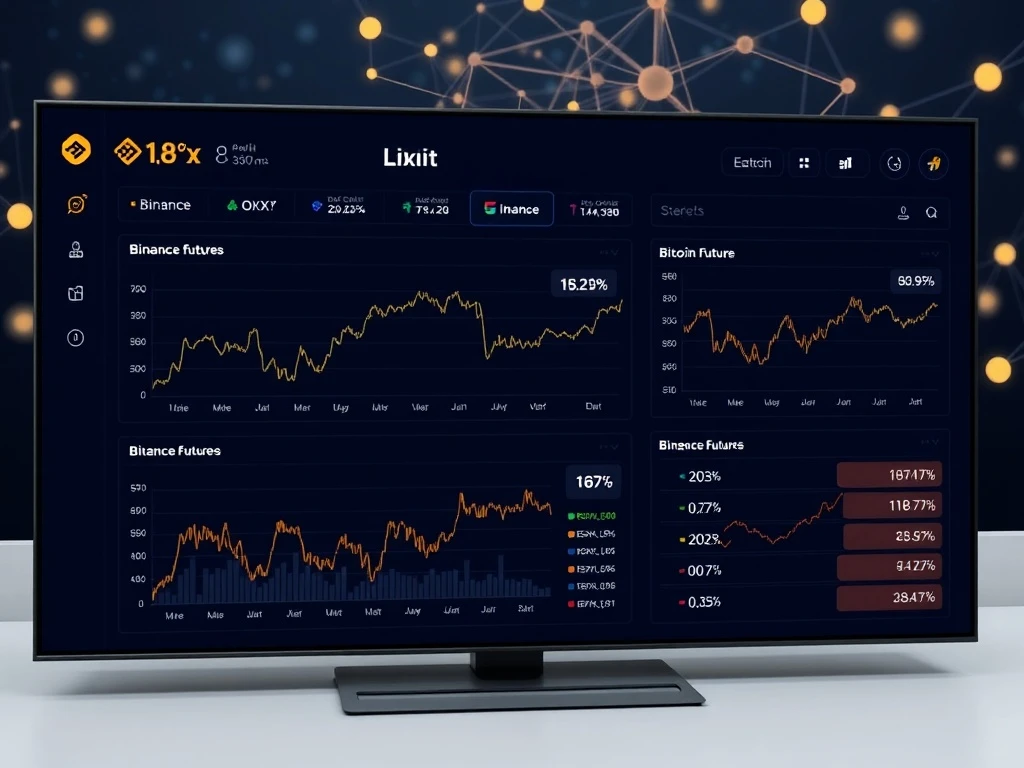
Market participants globally are scrutinizing the latest BTC perpetual futures long/short ratio data, a pivotal gauge of trader sentiment that currently shows a narrow but consistent bullish bias across the world’s largest cryptocurrency derivatives platforms. This data, captured over a critical 24-hour period, provides a transparent window into the collective positioning of sophisticated traders as Bitcoin navigates a complex macroeconomic landscape. The aggregated figures reveal a market delicately balanced yet leaning towards optimism, with significant implications for short-term price discovery and volatility.
Decoding the BTC Perpetual Futures Long/Short Ratio
The long/short ratio for BTC perpetual futures serves as a fundamental sentiment indicator within cryptocurrency markets. Essentially, this metric calculates the proportion of open positions betting on a price increase (long) versus those anticipating a decline (short). Analysts and institutional traders monitor these ratios closely because they often reflect the prevailing mood among leveraged market participants, who can amplify both gains and losses. A ratio above 50% indicates more long positions, suggesting bullish sentiment, while a figure below 50% points to a bearish majority. However, extreme readings in either direction can sometimes act as contrarian signals, warning of potential market reversals when crowd psychology becomes overly one-sided.
Perpetual futures, unlike traditional futures, lack an expiry date. This feature allows traders to hold positions indefinitely, provided they can fund the ongoing funding rate payments. Consequently, the long/short data for these instruments represents a more persistent view of market sentiment rather than a fleeting snapshot. The data from the top three exchanges by open interest—Binance, OKX, and Bybit—carries particular weight. These platforms collectively represent the lion’s share of global Bitcoin derivatives volume, making their aggregated metrics a reliable barometer for the entire sector.
Detailed Analysis of Exchange-Specific Data
A granular examination of the provided 24-hour data reveals a remarkably uniform trend. The overall market ratio stands at 50.48% long versus 49.52% short. This indicates a marginal majority of traders are positioned for upward movement. The consistency across major venues is striking and suggests a broad-based, though cautious, optimism rather than sentiment isolated to a single platform.
| Exchange | Long Ratio | Short Ratio |
|---|---|---|
| Binance | 51.61% | 48.39% |
| OKX | 51.34% | 48.66% |
| Bybit | 51.11% | 48.89% |
Binance, the world’s largest crypto exchange by volume, shows the most pronounced bullish tilt at 51.61% long. OKX follows closely at 51.34%, and Bybit registers 51.11%. The narrow range—just 0.5 percentage points separating the highest and lowest long ratios—underscores a market consensus. This alignment is significant; divergent ratios between exchanges can sometimes signal arbitrage opportunities or regional sentiment differences. The current harmony implies a globally synchronized, if measured, expectation for price stability or appreciation. Key factors traders might be considering include:
- Macroeconomic Catalysts: Shifting expectations around interest rates and inflation.
- On-Chain Metrics: Trends in Bitcoin accumulation by long-term holders.
- Regulatory Developments: Clarity or progress in major jurisdictions like the EU and U.S.
- Technical Analysis: Bitcoin’s price action around key support and resistance levels.
Contextualizing the Data Within Market Structure
To fully appreciate this long/short ratio data, one must place it within the broader context of crypto derivatives market structure. Open Interest (OI), the total number of outstanding derivative contracts, has grown exponentially alongside Bitcoin’s adoption. High OI alongside a balanced long/short ratio often indicates a healthy, liquid market with diverse opinions. Conversely, extreme long/short skews during periods of high OI can precede violent liquidations, where over-leveraged positions are forcibly closed by exchanges. The current data, showing a slight long bias without extreme readings, suggests a market that is not overly complacent or euphoric. This equilibrium can be a stabilizing factor, potentially reducing the likelihood of a sharp, liquidation-driven price cascade in the immediate term.
Historically, periods where the aggregate long/short ratio hovered near parity, as it does now, have sometimes preceded significant directional moves. The balance indicates a tense equilibrium between bulls and bears. Consequently, any new fundamental catalyst—such as a major regulatory announcement, a surprise macroeconomic data point, or a breakthrough in Bitcoin ETF flows—could tip this balance decisively. Market technicians often watch for a sustained move in the ratio above 52-53% or below 47-48% as a potential early signal of shifting momentum.
The Impact of Funding Rates and Trader Psychology
The long/short ratio does not exist in a vacuum; it directly interacts with the funding rate mechanism of perpetual futures contracts. When the majority of positions are long, the funding rate typically turns positive. This means long position holders pay a periodic fee to short holders, incentivizing some rebalancing. The current slight long bias likely corresponds with a marginally positive funding rate across these exchanges. This mechanism is a built-in stabilizer, designed to tether the perpetual contract price to the underlying spot asset. For traders, monitoring the interplay between the long/short ratio and the funding rate is essential for managing cost basis and understanding potential pressure points in the market.
From a behavioral finance perspective, a balanced ratio reflects a market in a state of uncertainty or indecision. Traders are not exhibiting the fear that drives extreme shorting, nor the greed that fuels extreme longing. This psychological middle ground is often where trends begin to form. Seasoned analysts compare this data with other sentiment indicators, such as the Crypto Fear & Greed Index or options market put/call ratios, to build a multi-faceted view of market emotion. The convergence of several neutral-to-slightly-bullish signals can provide stronger confirmation than any single metric alone.
Conclusion
The latest BTC perpetual futures long/short ratio presents a clear narrative: a slight but consistent bullish inclination permeates the world’s top derivatives exchanges. This data point, reflecting the positions of leveraged traders, indicates cautious optimism rather than rampant speculation. The uniformity across Binance, OKX, and Bybit strengthens the signal’s reliability, suggesting a globally shared, if tentative, outlook for Bitcoin. While this ratio alone is not a predictive crystal ball, it forms a crucial piece of the market structure puzzle. Traders and analysts will continue to monitor these levels for signs of strengthening conviction or a shift towards bearish dominance, as such changes often foreshadow the next significant move in Bitcoin’s volatile price journey.
FAQs
Q1: What does a BTC perpetual futures long/short ratio above 50% mean?
It indicates that more traders on that exchange hold positions betting on Bitcoin’s price increasing (long) than those betting on a decrease (short). This is generally interpreted as a bullish sentiment indicator among derivatives traders.
Q2: Why is data from Binance, OKX, and Bybit so important?
These three exchanges consistently rank highest in terms of open interest and trading volume for Bitcoin derivatives. Their aggregated data is therefore considered the most representative sample of global professional and retail trader sentiment.
Q3: Can the long/short ratio predict Bitcoin’s price?
Not directly. It is a sentiment indicator, not a price predictor. However, extreme readings (very high or very low) can sometimes signal overbought or oversold conditions that may precede a market correction or reversal.
Q4: How does the funding rate relate to the long/short ratio?
They are mechanically linked. When long positions dominate, the funding rate usually becomes positive, meaning longs pay a fee to shorts. This incentivizes some traders to open short positions or close longs, helping to balance the market.
Q5: How often does this long/short ratio data update?
The data typically updates in real-time or at very short intervals (e.g., every few minutes or hourly). The 24-hour snapshot provides a smoothed-out view that reduces noise and shows the prevailing trend over a full trading day.