BTC Perpetual Futures Show Cautious Shift as Shorts Edge Out Longs in Pivotal Market Signal
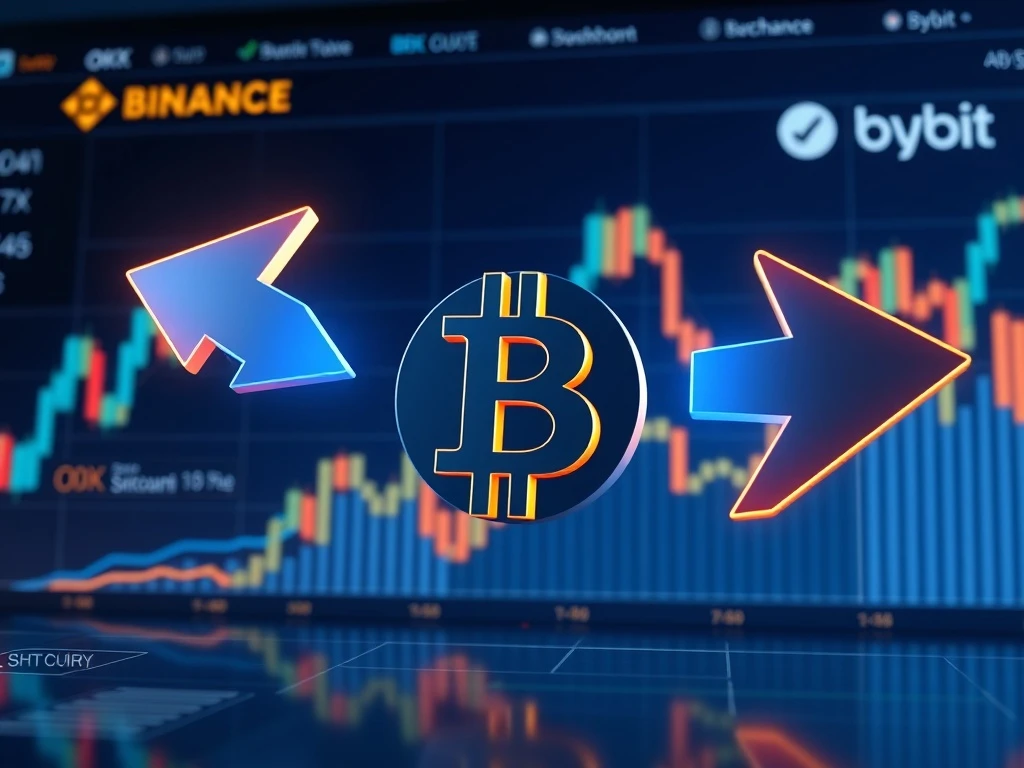
In a subtle yet significant development for cryptocurrency traders, short positions have gained a narrow majority over long positions in Bitcoin perpetual futures across the world’s largest exchanges. This shift, observed over the last 24 hours, provides a crucial snapshot of trader sentiment and potential volatility ahead. The aggregate data reveals a market finely balanced, with shorts holding a 50.37% share against 49.63% for longs. This delicate equilibrium on leading platforms like Binance, OKX, and Bybit often serves as a leading indicator for price discovery and market psychology. Consequently, market participants are now scrutinizing this data for clues about Bitcoin’s next major directional move.
Decoding the BTC Perpetual Futures Ratio Shift
The long/short ratio in perpetual futures is a fundamental metric for gauging market sentiment. Unlike traditional futures, perpetual contracts lack an expiry date, making them a preferred instrument for speculative trading and hedging. The recent data shows a collective tilt toward short positions. Specifically, Binance recorded a ratio of 49.53% long to 50.47% short. Similarly, OKX showed 49.42% long versus 50.58% short, while Bybit displayed the most pronounced skew at 49.34% long to 50.66% short. This consistent pattern across the top three exchanges by open interest suggests a broad, albeit cautious, sentiment shift rather than an isolated event on a single platform.
Market analysts often interpret a majority of short positions as an expectation of price decline. However, the margin is exceptionally slim. This scenario frequently precedes increased market volatility. When leveraged positions are nearly balanced, even minor catalysts can trigger rapid liquidations on one side, leading to sharp price swings. Historical data from previous market cycles indicates that such narrowly balanced ratios often resolve with a strong directional move. Therefore, traders monitor these levels closely for risk management.
| Exchange | Long % | Short % | Net Bias |
|---|---|---|---|
| Binance | 49.53% | 50.47% | Slightly Short |
| OKX | 49.42% | 50.58% | Slightly Short |
| Bybit | 49.34% | 50.66% | Slightly Short |
| Aggregate | 49.63% | 50.37% | Slightly Short |
The Mechanics and Impact of Perpetual Futures Trading
Perpetual futures contracts are cornerstone instruments in crypto derivatives markets. They allow traders to speculate on Bitcoin’s price direction without owning the underlying asset. A key mechanism is the funding rate, a periodic payment between long and short positions that tether the contract price to the spot price. When shorts dominate, the funding rate typically turns negative, meaning short positions pay longs. This can incentivize some traders to open long positions to collect this payment, potentially acting as a balancing force. The current slight short majority may lead to such a dynamic, influencing trading strategies in the coming hours.
Several factors can drive traders toward short positions. These include:
- Technical Resistance: Bitcoin approaching a known price ceiling on charts.
- Macro Concerns: Broader economic indicators like interest rate expectations.
- Overhead Liquidity: Large clusters of stop-loss orders above the current price that shorts aim to trigger.
- Hedging Activity: Large spot holders (“whales”) opening shorts to protect their portfolios from downside risk.
This activity highlights the sophisticated nature of modern crypto markets. The data is not inherently bearish but reflects a tactical and risk-aware positioning by a significant portion of the market.
Expert Analysis: Reading Between the Data Points
Seasoned derivatives traders emphasize that context is everything. A 50.37% short aggregate is not a overwhelmingly bearish signal. In fact, during strong bull markets, short squeezes—where rising prices force short sellers to buy back—often occur when short interest is moderately high. The current environment suggests a market in a state of indecision, waiting for a fundamental or technical catalyst. Comparing this to earlier in the year, when long ratios often exceeded 55%, the present data shows a clear cooling of outright bullish leverage. This can be a healthy development, reducing the risk of a cascading long liquidation event if prices dip modestly.
Furthermore, open interest—the total number of outstanding contracts—must be considered alongside the ratio. If open interest is rising while the ratio shifts toward shorts, it indicates new money is entering the market with a bearish bias. If open interest is flat or falling, it may simply represent longs closing their positions rather than aggressive new shorting. This nuance is critical for a complete picture. Data from analytics platforms often shows correlated movements between these metrics, providing a more robust framework for analysis.
Historical Precedents and Market Cycle Context
Examining past instances where the futures ratio hovered near parity provides valuable insight. For example, in the weeks preceding major breakout moves in 2023 and 2024, the long/short ratio frequently compressed to near-even levels. This period of consolidation and sentiment neutrality often resolved with a strong trend. The market’s memory of these events influences current behavior. Traders aware of this pattern may be positioning cautiously, contributing to the tight ratio. This creates a self-referential loop where the metric itself influences the strategies it seeks to measure.
The current global financial landscape also adds layers of context. With evolving regulatory clarity in key regions and the integration of Bitcoin into traditional finance via ETFs, the driver of futures sentiment is more complex than ever. It blends pure crypto-native technical trading with macro-economic hedging. This fusion means shifts in the BTC perpetual futures ratio may now reflect concerns about traditional market volatility or currency fluctuations, not just Bitcoin-specific news.
Conclusion
The slight edge held by short positions in Bitcoin perpetual futures marks a notable moment of market equilibrium and caution. While not a definitive predictor of a price drop, this shift away from a long-dominated landscape signals a more balanced and potentially volatile phase. Traders on major exchanges like Binance, OKX, and Bybit are displaying a tactical hesitation, likely awaiting a clearer signal for Bitcoin’s next sustained move. Monitoring the ensuing funding rates and open interest will be key to understanding whether this slight short bias develops into a stronger trend or simply sets the stage for the next counter-trend rally. In the dynamic world of crypto derivatives, such fine balances are often the calm before a significant storm.
FAQs
Q1: What does it mean when shorts outnumber longs in BTC perpetual futures?
It indicates that a slightly larger portion of the leveraged derivative market is betting on or hedging against a price decrease. However, a very narrow margin like 50.37% vs. 49.63% primarily shows market indecision and can precede heightened volatility.
Q2: How does the funding rate relate to the long/short ratio?
The funding rate is a mechanism to keep the perpetual futures price aligned with the spot price. When shorts dominate, the funding rate often turns negative, meaning shorts pay longs. This can encourage some traders to open long positions to collect these payments.
Q3: Is a majority of short positions always bearish for Bitcoin’s price?
Not necessarily. While it reflects bearish sentiment, excessively high short interest can lead to a “short squeeze.” If the price starts to rise, short sellers are forced to buy back their positions to limit losses, which can fuel a rapid upward price move.
Q4: Why focus on Binance, OKX, and Bybit for this data?
These three exchanges consistently hold the largest open interest (total value of outstanding contracts) for Bitcoin perpetual futures. Their aggregated data provides a highly reliable snapshot of the overall derivatives market sentiment.
Q5: How should a trader use this long/short ratio information?
It is best used as one of many contextual indicators, not a standalone signal. Traders combine it with price action analysis, spot market volumes, open interest trends, and broader macroeconomic news to inform their risk management and positioning decisions.