Bitcoin Price Analysis: Bulls Eye $101.5K Rally as Futures Data Reveals Critical Support Test
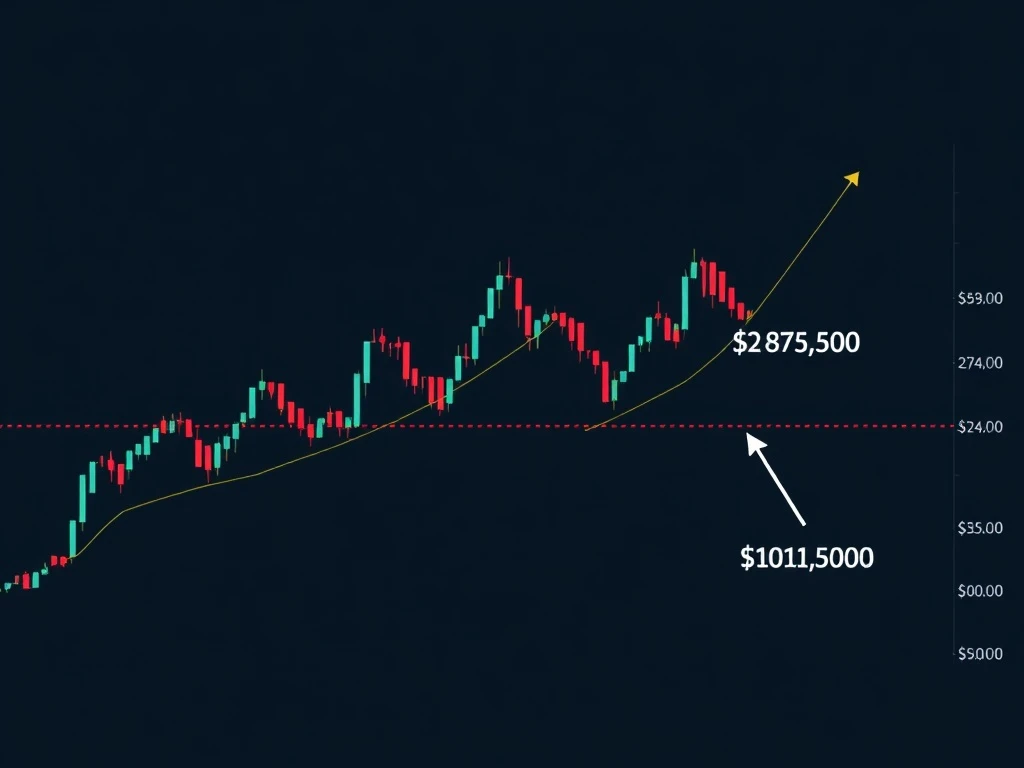
Global cryptocurrency markets entered 2026 with renewed vigor, as Bitcoin demonstrated a significant technical consolidation phase, testing a crucial underlying support level near $89,400. This pivotal movement follows a futures-led advance that propelled the premier digital asset to a weekly high of $94,800, setting the stage for a potential 13% rally targeting $101,500. Market analysts now scrutinize liquidation clusters and order book dynamics to gauge the sustainability of the bullish momentum.
Bitcoin Price Analysis and the 2026 Technical Landscape
The first week of January 2026 provided a clear illustration of improving investor sentiment across digital asset markets. Bitcoin, alongside select altcoins, rallied toward weekly range highs, supported by increasing trading volumes. A detailed examination of the daily chart reveals a pattern of tightening range consolidation, characterized by consecutive higher lows and higher highs. This constructive price action ultimately culminated in the test of the $94,800 resistance level on January 5th.
From a technical perspective, the initial 2026 rally successfully pushed Bitcoin’s price above its 20-day moving average (20-MA). Notably, this shorter-term average is currently converging with the 50-day moving average (50-MA), a classic signal often interpreted by traders as a potential precursor to a significant trend continuation or reversal. The failure to sustain momentum above $95,000 triggered a predictable profit-taking event. Consequently, many traders exited positions, anticipating a retest of the newly established support confluence around the 20-MA, precisely at the $89,400 level.
Liquidation Heatmaps and Order Book Structure
Data analytics firm Hyblock provides critical insight through its 7-day liquidation heatmap. This tool visualizes concentrations of leveraged positions vulnerable to forced closure. The current snapshot reveals two primary clusters:
- Long Liquidation Zone: A dense concentration of long positions exists between $89,000 and $87,000. A break below this support band could trigger cascading sell-offs.
- Short Liquidation Zone: A significant wall of short positions sits near the weekly range high at $95,000. A decisive break above this level would force these bearish bets to cover, fueling upward momentum.
The order book structure for the BTC/USDT pair on major exchanges like Binance further corroborates this setup. The presence of these liquidation clusters acts as a gravitational pull on price, creating clear targets for both bullish and bearish campaigns.
The Mechanics of a Futures-Led Rally
The recent price action to $94,800 was predominantly driven by activity in the perpetual futures markets, not spot trading. Perpetual futures (or “perps”) are derivative contracts without an expiry date, allowing traders to use high leverage to speculate on price direction. Data from TRDR.io highlights a compelling sequence of events on January 5th:
| Metric | Data | Impact |
|---|---|---|
| Futures Buy Volume Surge | ~$1.1 Billion | Drove rapid price ascent to $94,800 |
| Shorts Liquidated (Binance) | ~$100 Million | Added buy-side pressure via forced covering |
| Primary Driver | Perpetual Futures Traders | Highlighted the dominance of derivatives in short-term price discovery |
This event serves as a textbook example of how leveraged derivatives can amplify market moves. The surge in buy volume triggered the liquidation of over-leveraged short positions, which in turn created additional buy orders, resulting in a rapid, self-reinforcing price spike. Analysts note that the current market structure, with its defined liquidation levels, is primed for a similar event if bullish traders can muster the volume to push the price toward the $94,000 threshold once more.
Pathway to $101,500: Volume Profile and Market Gaps
The strategic opportunity for bulls lies within the volume profile of the BTC/USDT pair. The volume profile is a charting tool that displays trading activity at specific price levels over a chosen period. Analysis indicates a pronounced gap or area of low trading volume between $95,000 and approximately $101,000. In market technical analysis, such gaps often act as “air pockets” where price can move rapidly with minimal resistance due to a lack of historical buy or sell orders.
Therefore, a conclusive breakout above the $95,000 short liquidation zone could catalyze a short-covering rally. This move would likely exploit the low-density volume zone, potentially propelling Bitcoin toward the $101,500 target—a 13% gain from the breakout point. The validity of this scenario is heavily contingent on sustaining adequate trading volume to overcome initial resistance and maintain momentum through the gap.
Broader Market Context and Risk Sentiment
The bullish reset occurring at the $89,400 support level is not an isolated event. It reflects a broader shift in trader risk sentiment at the start of 2026. Several macroeconomic and on-chain factors typically contribute to such shifts, including institutional flow patterns, regulatory developments, and broader equity market correlations. While this analysis focuses on technical and derivatives-driven mechanics, these underlying fundamentals provide the bedrock for the price structures observed on the chart.
Market participants are advised to monitor the interaction between price and the converging 20-day and 50-day moving averages closely. A strong bounce from the $89,400 support, accompanied by rising volume, would validate the bullish consolidation thesis. Conversely, a breakdown and sustained trade below the long liquidation cluster ($87,000-$89,000) would invalidate the near-term rally scenario and likely lead to a deeper correction.
Conclusion
Bitcoin’s price action in early 2026 presents a clear technical narrative defined by a futures-led advance, a subsequent support test, and a defined path for a potential rally to $101,500. The convergence of the 20-day and 50-day moving averages at $89,400 establishes a critical technical support level. Simultaneously, liquidation heatmaps reveal precise levels where leveraged positions are most vulnerable. The interplay between spot market support and derivatives-driven liquidity will determine whether bulls can successfully engineer a breakout. A volume-backed move above $95,000 could trigger the necessary short covering to fuel a rapid ascent through a low-volume zone, ultimately targeting the $101,500 threshold. As always, market participants should consider the high-risk nature of leveraged futures trading and the inherent volatility of cryptocurrency markets.
FAQs
Q1: What is the key support level Bitcoin is testing?
The primary support level under examination is $89,400, which aligns with the 20-day moving average. This level is critical because a break below it could trigger liquidations of long positions clustered between $87,000 and $89,000.
Q2: How could a rally to $101,500 be triggered?
A rally to $101,500 would likely be initiated by a sustained breakout above the $95,000 resistance level. This move would liquidate over-leveraged short positions, creating a buying cascade. The price could then move rapidly through a low-volume price zone up to the $101,500 target.
Q3: What role do perpetual futures play in this market analysis?
Perpetual futures contracts, which allow high leverage, were the primary driver behind the recent price surge to $94,800. Data shows a $1.1 billion buy volume surge in futures markets triggered $100 million in short liquidations, demonstrating how derivatives can amplify short-term price movements.
Q4: What is a liquidation heatmap and why is it important?
A liquidation heatmap is a data visualization tool that shows where large concentrations of leveraged long or short positions are at risk of being automatically closed by exchanges. It is important because these clusters act as price magnets, as breaching these levels can cause rapid, volatile price movements due to forced buying or selling.
Q5: What would invalidate the bullish scenario for Bitcoin?
The bullish scenario aiming for $101,500 would be invalidated if Bitcoin’s price breaks down and sustains trading below the key support band between $87,000 and $89,000. Such a move would trigger widespread long liquidations, likely leading to a deeper and more prolonged corrective phase.